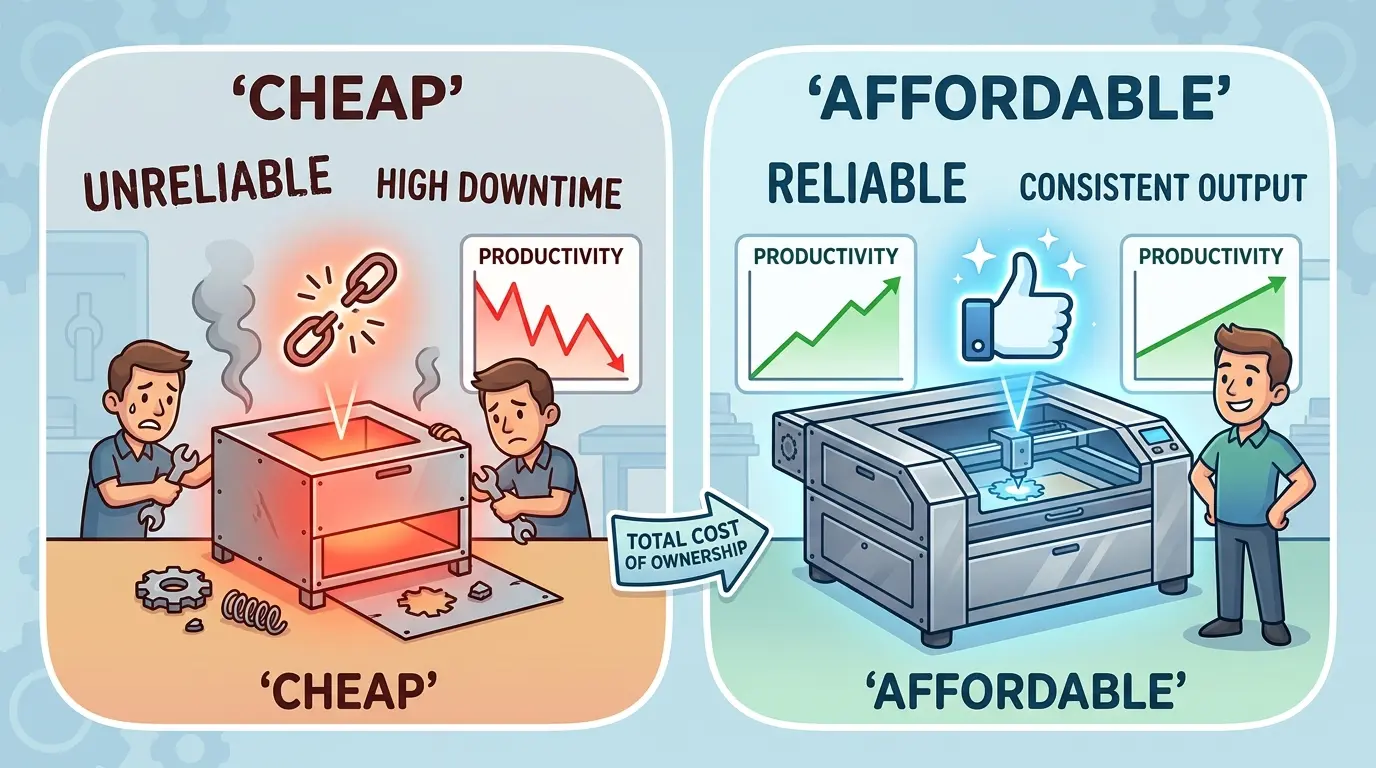
When a buyer is under budget pressure, “cheap” and “affordable” can sound like the same thing. In production, they usually are not. A cheap laser cutter is often the machine with the lowest visible purchase price. An affordable laser cutter is the one a shop can buy, install, run, and maintain without turning every order into a quality, scheduling, or maintenance problem.
For buyers comparing laser cutters and engravers for wood, acrylic, and similar non-metal materials, the real trade-off is rarely just “spend less or spend more.” It is whether the lower entry price protects the actual workflow or simply moves cost into scrap, cleanup, slow changeovers, and downtime. If the real requirement is metal processing, that should be treated as a separate equipment decision with different cost drivers rather than mixed into the same budget comparison.
Cheap and Affordable Do Not Solve the Same Problem
A cheap machine solves an accounting problem first: lower acquisition cost.
An affordable machine solves an operating problem: stay within budget while still producing acceptable parts at a predictable rate.
That distinction matters because a machine can be cheap and still become expensive once the plant absorbs:
- More Scrap
- Slower Job Changes
- More Manual Cleanup
- More Operator Supervision
- More Variation Between Runs
- Longer Downtime Waiting for Troubleshooting or Parts
In other words, “cheap” is usually a purchase label. “Affordable” is a workflow label. Affordable also does not mean over-specified. In many factories, it simply means the lowest-cost machine configuration that still protects the jobs that actually generate revenue.
Start With the Job Mix Before You Compare Price
Price only becomes meaningful when the machines being compared are intended for the same type of work. Buyers often compare a very basic laser with a more production-ready system as though both are pricing the same workload. In practice, they are usually pricing different levels of output stability.
Before deciding whether a machine is cheap or genuinely affordable, buyers should define:
- The Main Materials Running Through the Machine
- The Share of Cutting Versus Engraving Work
- The Typical Part Size and Sheet Size
- The Daily Runtime Expectation
- The Acceptable Reject Rate on Customer-Visible Parts
- The Number of Operators Who Will Use the Machine
- The Cost of Missing a Delivery Window
A workshop cutting occasional acrylic signs with loose deadlines can tolerate very different trade-offs than a plant running repeated wood panels, decorative parts, or mixed non-metal orders every day. The first shop may care most about entry cost. The second usually cares more about whether output stays stable under real production pressure.
The Trade-Offs That Usually Separate Cheap From Affordable
The most important differences are rarely hidden in marketing slogans. They usually show up in the parts of the system that influence finish quality, repeatability, and daily operating friction.
| Decision Area | A Cheap Machine Often Sacrifices | An Affordable Machine Usually Protects | Why It Matters in Production |
|---|---|---|---|
| Motion Stability and Positioning | Looser repeatability and more operator correction | More stable path control and more consistent alignment | Protects detail quality, geometry, and repeat orders |
| Cut Edge and Surface Finish | More variation, more residue, or more visible heat effects | A more controllable process window for cleaner output | Matters when parts are customer-facing |
| Extraction and Airflow Support | Higher risk of smoke buildup and extra cleanup | Better control over fumes and cut-zone contamination | Reduces cleanup time and cosmetic rejects |
| Cooling and Runtime Stability | Acceptable for lighter or irregular use | Better support for longer, repeated production runs | Helps prevent interruptions and unstable output |
| Setup and Job Recall | More manual re-setting between jobs | Faster, more repeatable job preparation | Improves changeovers in mixed production |
| Service and Spare Parts Access | Slower support response and more recovery risk | Clearer after-sales path and easier maintenance planning | Downtime becomes easier to manage |
| Safety and Work Environment | More dependence on operator discipline alone | Better support for controlled daily operation | Important when multiple people use the machine |
| Material Flexibility | Narrower practical use range | Better fit across a realistic non-metal production mix | Helps the machine stay useful as orders shift |
This does not mean every low-priced machine is automatically the wrong choice. It means the lowest number on a quote should only be trusted after the buyer checks which production risks are being accepted in exchange.
Hidden Costs Usually Decide Whether a Machine Was Actually Cheap
One reason buyers confuse cheap with affordable is that many quotes do not describe the same purchase scope. A bare machine price may look attractive simply because key cost items sit outside the quote.
Common examples include:
- Extraction or Filtration Equipment
- Cooling Equipment
- Software or Job Preparation Tools
- Installation and Commissioning
- Operator Training
- Initial Spare Parts and Maintenance Items
- Freight, Site Preparation, and Utility Requirements
When those items are excluded, the buyer is not always looking at a cheaper machine. The buyer may only be looking at a narrower quote.
That is why the better comparison method is to normalize the purchase scope first. Once buyers line up the same supporting items across each option, the difference between cheap and affordable becomes much easier to see.
Where a Cheap Laser Cutter Can Still Make Sense
A cheap machine can be a rational choice when production demands are limited and the workflow is forgiving.
That usually means conditions such as:
- Low or Intermittent Machine Utilization
- A Narrow Material Range
- Simple Part Geometry
- Non-Critical Visual Finish Standards
- One Dedicated Operator Instead of Multiple Shared Users
- Downtime That Does Not Disrupt a Larger Production Line
In those situations, the lowest purchase price may still align with the workload. If the business can tolerate slower setup, more manual intervention, and less process margin, cheap may be entirely acceptable.
The key is honesty. Cheap works best when the buyer already understands the machine’s limitations and does not expect it to perform like a higher-stability production system.
When Affordable Usually Outperforms Cheap by a Wide Margin
The meaning of affordable changes as soon as the laser becomes part of a committed production schedule.
An affordable machine usually becomes the better choice when the shop depends on:
- Daily or Multi-Shift Runtime
- Repeat Orders That Must Match Prior Output
- Customer-Visible Acrylic or Wood Finish Quality
- Mixed Job Queues With Frequent Material Changes
- More Than One Operator
- Delivery Promises That Leave Little Room for Rework
In those environments, the buyer is not simply paying for hardware. The buyer is paying to reduce instability. That often shows up as fewer rejected parts, less adjustment between jobs, more predictable throughput, and less lost time during the week.
This is where many plants misjudge the budget question. They assume the affordable choice is the one with the smallest invoice. In reality, the affordable choice is often the one with the lowest cost per good part once production starts.
Ask Whether the Machine Is Cheap to Buy or Cheap to Operate
This is the most useful test in a real factory.
If a machine saves money at purchase but creates higher operating friction every day, the machine was cheap to buy but not cheap to own. If a machine costs more upfront but keeps labor, cleanup, scrap, and downtime within control, it may be the more affordable investment even at a higher initial number.
Buyers should therefore separate two questions:
- What Is the Upfront Purchase Cost?
- What Will It Cost To Produce Acceptable Parts Reliably?
The second question is usually the one that decides whether the machine fits a real business.
Questions Buyers Should Resolve Before Approving a Budget
Before selecting the lowest offer or stretching to a higher quote, buyers should answer the following clearly:
- How Many Hours per Week Will the Machine Really Run?
- How Sensitive Are Finished Parts to Burn Marks, Residue, or Edge Variation?
- How Much Operator Setup Time Is Acceptable Between Jobs?
- What Happens to the Schedule If the Machine Is Down for a Day?
- Which Costs Sit Outside the Machine Quote?
- Will the Same Jobs Need To Be Repeated With Consistent Results?
- Is the Machine Being Bought for Today’s Workload Only or for a Likely Near-Term Expansion in Job Mix?
These questions usually reveal whether a low-priced machine is a practical fit or a false economy.
Practical Summary
Cheap and affordable are not identical buying categories. A cheap laser cutter lowers the barrier to purchase. An affordable laser cutter lowers the risk of unstable production while still respecting the budget.
If the workload is light, the material range is narrow, and the business can tolerate more manual correction, a cheap machine may be perfectly reasonable. If the laser will run regularly, produce customer-visible parts, or support repeatable non-metal production with real delivery pressure, affordable usually matters more than cheap. The stronger decision is not the one with the lowest number on the quote. It is the one that fits the actual workflow with the least avoidable friction.