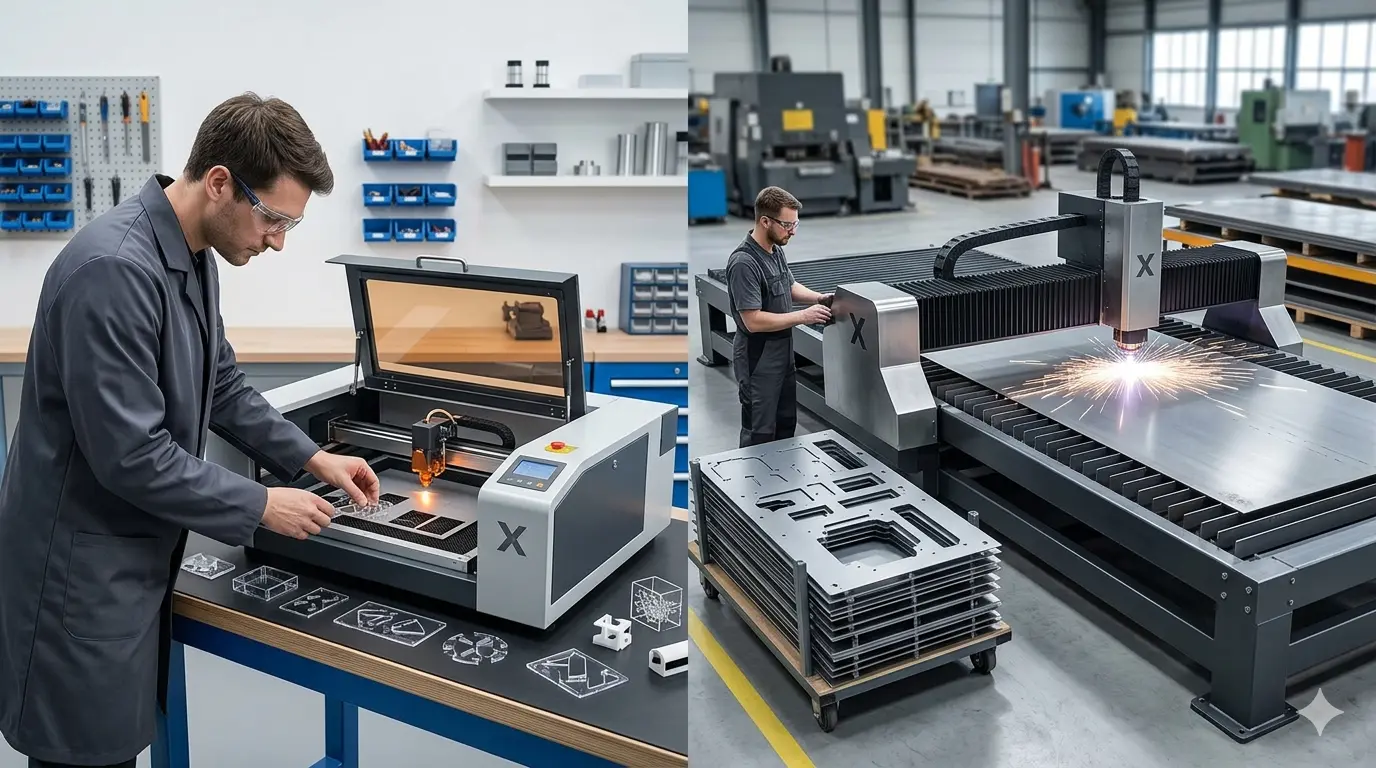
Choosing between a small laser cutter and a large-format laser cutting machine is usually not a question of buying the “bigger” or “better” system. It is a question of matching machine format to material flow, part size, nesting strategy, floor space, and the kind of orders your workshop processes every day.
For some manufacturers, a smaller machine is the more efficient choice because it keeps investment disciplined and supports fast-turn custom work. For others, a large-format platform changes the entire economics of production by reducing sheet handling, limiting repositioning, and letting more parts move through each cycle. The right answer depends on where your bottleneck really is.
The Real Difference Is Workflow, Not Just Working Area
It is easy to reduce this comparison to one point: small machines handle smaller jobs, and large-format machines handle larger sheets. That is true, but it is not the whole decision.
Machine format affects how material enters the process, how often operators need to re-stage sheets, how efficiently parts can be nested, how much manual repositioning is required, and how well the laser cell fits the rest of the production line. A machine that looks oversized on paper may be exactly right once you factor in labor, material movement, and the value of finishing full jobs in one setup.
In practical terms, the question is this: are you mainly processing compact parts and mixed custom jobs, or are you trying to move larger panels, more parts per cycle, and higher daily output through a more stable workflow?
When a Small Laser Cutter Makes More Sense
A small laser cutter is often the better fit when production is driven by flexibility rather than full-sheet throughput. That is especially true when most jobs involve small components, custom decorative work, engraving-heavy batches, samples, or short runs that change frequently.
In these conditions, a smaller machine can be easier to integrate because it typically asks less from the layout around it. Material loading is simpler, operator reach is shorter, and the machine can support frequent job changes without feeling like underused capacity.
Small-format laser systems are commonly a strong fit when:
- The majority of parts are compact and do not require large-sheet nesting.
- Orders are short-run, custom, or design-driven rather than batch-heavy.
- Engraving and cutting are mixed within the same workflow.
- Floor space is limited and the laser cell must fit into an already crowded workshop.
- Operators need a practical machine for quick setup, prototyping, or diverse daily job changes.
This kind of machine can also be a sensible step for businesses that want laser capability without restructuring the entire production area around larger-sheet handling.
Where Large-Format Laser Cutting Changes The Workflow
A large-format laser cutting machine becomes valuable when the material itself is large, when part count per cycle matters, or when repeated repositioning is already costing time and accuracy.
If a shop regularly processes full sheets of acrylic, wood-based panels, or other non-metallic substrates, a larger working envelope can reduce the need to pre-cut material before it even reaches the laser. That changes more than convenience. It can remove an upstream handling step, reduce alignment errors introduced by multiple setups, and allow more parts to be nested in one run.
That is where large-format equipment starts to produce real operational gains:
- More usable nesting area for batch jobs.
- Fewer interruptions caused by reloading or indexing material.
- Better support for oversized pieces, signage elements, display parts, and panel-based components.
- Lower dependence on manual pre-cutting before laser processing.
- More stable output when production demand grows beyond small-batch work.
Large format does not automatically mean the machine is faster for every job. If orders are small, highly varied, and constantly changing, the extra size may simply create more machine area than the business actually uses. But when the workflow is constrained by sheet size, part count, or handling effort, the difference can be substantial.
Small Laser Cutter vs Large-Format Laser Cutting Machine
| Decision Factor | Small Laser Cutter | Large-Format Laser Cutting Machine |
|---|---|---|
| Typical Workflow Fit | Short runs, custom orders, mixed engraving and cutting | Batch processing, larger sheets, higher part count per cycle |
| Material Handling | Easier for compact blanks and smaller pieces | Better for full sheets and oversized workpieces |
| Nesting Efficiency | Good for smaller layouts and lower part volume | Stronger when maximizing sheet usage across many parts |
| Operator Intervention | Often acceptable in flexible, lower-volume work | Reduced repositioning becomes more valuable in larger runs |
| Floor Space Demand | Lower | Higher |
| Production Scaling | Best when flexibility matters more than raw throughput | Better when the shop is growing into larger, more repeatable output |
| Risk If Undersized Or Oversized | Can become a bottleneck if large sheets must be split constantly | Can be underused if the workload rarely needs the larger bed |
The Hidden Cost Of Choosing Too Small
The most common mistake is assuming a smaller machine is more economical simply because the machine footprint and initial spend are lower. That view ignores the production penalties that appear when the format no longer matches the material.
If your team has to cut down full sheets before laser processing, reposition larger pieces during jobs, or break one job into multiple setups because the working area is too limited, the savings on machine size can be offset by labor, wasted material, slower throughput, and greater risk of dimensional inconsistency between sections.
This problem is especially noticeable when the order mix begins shifting from decorative one-offs toward recurring production. At that point, the issue is no longer whether the smaller machine can do the job. The issue is how efficiently it can do it without creating extra work around the machine.
The Hidden Cost Of Going Too Large
The opposite mistake also happens. Some buyers choose large-format equipment because it feels more future-proof, even though their current workflow is built around small parts, mixed materials, frequent design changes, and shorter runs.
When that happens, the machine may offer plenty of theoretical capacity without delivering practical productivity. The business ties up floor space and capital in a format that does not solve its immediate bottleneck. In real production, underused capacity is not the same thing as strategic capacity.
That is why the better question is not, “Which machine is more powerful?” It is, “Which machine format removes the most friction from our current and near-future workflow?”
Key Questions To Ask Before You Decide
Before choosing machine format, decision-makers should look at actual production patterns rather than isolated sample jobs.
Ask these questions first:
- What is the largest sheet or part size we expect to process routinely, not occasionally?
- Are we currently pre-cutting material before laser processing because the laser bed is too limited?
- Do we win more work from custom flexibility, or from batch efficiency and faster output?
- How much operator time is spent repositioning, staging, or reloading material during a typical day?
- Are we mainly cutting compact pieces, or are we nesting many parts from larger sheets?
- Will the machine support today’s order profile only, or the next stage of production growth as well?
These questions usually make the right direction clearer than a specification comparison by itself.
Where Pandaxis Fits In This Decision
For manufacturers evaluating non-metal processing workflows in wood, acrylic, and similar materials, the relevant decision is not only machine size but how the machine supports the real mix of cutting, engraving, part layout, and material movement inside the workshop.
Pandaxis offers laser cutters and engravers within that broader production context, which is why format selection should be treated as a workflow decision rather than a purely equipment-size decision. If the laser purchase is part of a broader factory planning project, the wider Pandaxis machinery lineup can also help buyers evaluate where laser processing fits alongside other production equipment.
Final Thoughts
A small laser cutter is usually the right choice when flexibility, compact part handling, and mixed short-run work define the business. A large-format laser cutting machine is usually the stronger choice when sheet size, nesting efficiency, and reduced handling are central to daily output.
Neither format is universally better. The better machine is the one that removes unnecessary steps, supports the material sizes you actually process, and keeps the laser cell aligned with the way your production floor operates.
If the goal is cleaner workflow design rather than just a larger machine bed, the format decision becomes much easier and much more profitable over time.