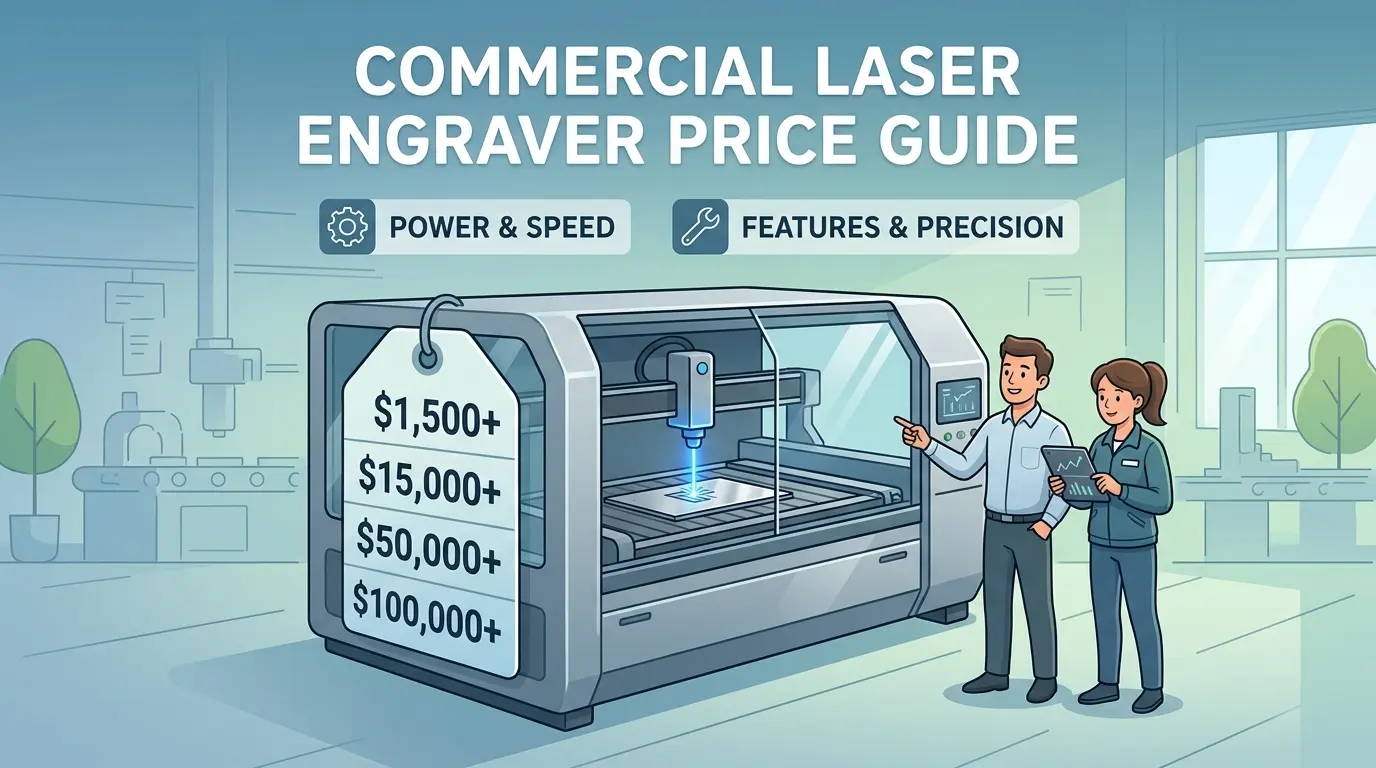
Commercial buyers looking for a laser engraving machine price guide usually run into the same problem immediately: one supplier quotes a bare machine, another includes extraction and training, and a third bundles engraving and contour cutting into the same proposal. The result is that the lowest number on paper often says very little about the real purchase decision.
For buyers comparing laser cutters and engravers for wood, acrylic, coated boards, and similar non-metallic materials, price should be evaluated as a workflow question rather than as a single catalog figure. What matters is not just what the machine costs to buy, but what it costs to install, standardize, run, and keep productive.
Why Price Is Hard To Compare At First Glance
Two machines can both be described as laser engravers and still represent very different buying situations.
One may be aimed at short-run engraving on small parts. Another may be configured for larger-format work, repeated daily production, or combined engraving-and-cutting jobs. A third may only look affordable because key items are left outside the quote.
That is why commercial buyers should normalize quotes before drawing conclusions. In practice, price comparison only becomes meaningful when you compare machines that are intended for the same job scope, quality level, and daily production rhythm.
Start With Application Scope Before You Compare Quotes
Laser engraving machine prices usually move in line with the type of work the machine is expected to carry.
Buyers should define a few operational points first:
- Whether The Main Work Is Surface Engraving Only Or Engraving Plus Contour Cutting
- Whether Jobs Are Mostly Short-Run Custom Orders Or Repeated Batch Production
- Whether Parts Are Small Labels And Signs Or Larger Decorative Panels
- Whether Finished Surfaces Are Customer-Visible At Close Range
- Whether Operators Need Fast Recipe Recall Across Several Materials
These questions matter because a machine bought for simple text and logo engraving is not necessarily priced like a machine expected to handle larger sheets, repeatable alignment, cleaner presentation standards, and more stable job changes.
If the buyer’s real need extends into metal marking, tube processing, or sheet-metal cutting, that should be treated as a separate equipment-selection decision rather than folded into one vague engraving quote comparison.
What Usually Pushes the Price Up Or Down
The biggest cost drivers are usually not marketing claims. They are the parts of the system that change workflow fit, usable output, and operational stability.
| Cost Driver | Why It Changes the Quote | When It Matters Most |
|---|---|---|
| Work Area and Table Size | Larger working zones usually change machine footprint, handling expectations, and overall system scope | Larger signs, decorative panels, or multi-part layouts |
| Engraving-Only vs Combined Engraving and Cutting | A machine expected to engrave and cut in one workflow usually needs broader process capability and tighter job control | Shops producing shaped parts, signage, or mixed decorative work |
| Motion Stability and Positioning Control | More stable motion and better repeatability help protect detail quality and reduce placement errors | Customer-visible graphics, repeated branding, and batch consistency |
| Extraction, Cooling, and Process Environment | Cleaner airflow and better thermal control help protect finish quality and long-run stability | Wood, acrylic, coated boards, and residue-sensitive production |
| Software, Job Recall, and Operator Simplicity | Better workflow control reduces setup variation and shortens repeat-job preparation | High-mix production and frequent job changes |
| Material Handling and Fixtures | Better support for part placement and repeat positioning improves usable throughput | Small-part batches, multi-piece layouts, and repeat orders |
| Service, Training, and Commissioning Scope | Installation and support packages change how quickly a machine becomes productive | First-time buyers and plants adding a new laser process |
Commercial buyers should read price through that lens. If one quote is lower because it strips out process-control items that reduce waste and rework, it may only be lower in the narrowest accounting sense.
Commercial Buying Situations Usually Follow Different Price Logic
Instead of asking for a universal market price, it is usually more useful to identify which buying situation best matches the plant.
| Buying Situation | What the Budget Usually Prioritizes | What Commonly Raises the Price | What Underbuying Often Leads To |
|---|---|---|---|
| Short-Run Engraving on Small Parts | Basic engraving capability and manageable setup | Larger work area, cleaner extraction, better software workflow | More operator dependence and slower job changes |
| Mixed Engraving and Contour Cutting | Versatility across different job types | Broader process scope, better alignment control, stronger workflow management | Jobs split across multiple steps or more manual correction |
| Repeated Daily Production | Repeatability, recipe recall, and stable output across shifts | Better consistency-focused configuration and stronger support structure | More scrap, more rechecks, and avoidable downtime |
| Finish-Sensitive Customer-Facing Work | Surface cleanliness, detail quality, and visual consistency | Better process control and stronger supporting hardware around the beam path | Rejects caused by residue, inconsistent contrast, or poor presentation |
This is where many price discussions go wrong. A buyer compares a lighter-duty quote to a production-oriented quote without recognizing that the second machine is being priced against a more demanding operational role.
Bare Machine Price and Installed Workflow Cost Are Not the Same Thing
Commercial buyers should ask every supplier to separate the quote into comparable buckets. That makes it much easier to see whether the machine price is actually lower, or whether key cost items have simply been moved off the page.
Common items that should be normalized include:
- Cooling and Extraction Equipment
- Software and Job Preparation Tools
- Material Fixtures or Positioning Aids
- Rotary or Specialty Attachments If the Product Mix Requires Them
- Installation, Commissioning, and Operator Training
- Spare Parts, Preventive Maintenance Items, and Service Coverage
- Freight, Import Terms, and Site Preparation Requirements
Without that normalization, commercial buyers are often comparing different purchase scopes rather than different machines.
A Lower Quote Can Still Produce a Higher Cost Per Good Part
Machine price is only one part of the buying decision. The more important number over time is the cost of producing acceptable parts without extra labor, repeated cleanup, or avoidable interruptions.
A cheaper machine can become more expensive when it causes:
- More Setup Drift Between Jobs
- More Surface Residue or Cleanup Time
- More Operator Intervention During Runs
- More Variation Across the Work Area
- More Rework on Customer-Visible Parts
- More Lost Time Waiting for Service or Troubleshooting
For commercial buyers, this is the real price guide question: how much does the system cost to keep producing good parts at the expected quality level?
That question is usually more useful than asking for a generic market average.
When Paying More Usually Makes Sense
Paying more is not automatically the right move. But a higher-priced quote often makes sense when the business depends on one or more of the following:
- Repeatable Output Across Several Operators Or Shifts
- Cleaner Results on Customer-Facing Products
- Faster Changeovers Across Different Materials Or Artwork Files
- More Predictable Combined Engraving-And-Cutting Workflows
- Lower Risk During Installation and Production Ramp-Up
In those cases, the extra spend is not really about prestige. It is about reducing production friction.
By contrast, if the workload is simple, low-volume, and operationally forgiving, a more basic buying position may be sensible. The key is to match budget level to workflow risk rather than assuming every buyer needs the same configuration.
Questions Commercial Buyers Should Ask Before Comparing Quotes
Before approving a shortlist, buyers should be able to answer these questions clearly:
- What Percentage of Machine Hours Will Be Engraving Only?
- How Often Will Jobs Also Require Contour Cutting?
- What Materials Will Consume Most of the Weekly Runtime?
- How Sensitive Is the Business to Residue, Contrast Variation, or Finish Defects?
- How Much Operator Setup Time Is Acceptable Per Job Change?
- Which Items Are Included in the Quote, and Which Are External Costs?
- What Support Is Available During Installation, Early Production, and Ongoing Maintenance?
These questions make quote comparison more disciplined. They also help buyers avoid approving a low initial number that creates higher downstream operating cost.
Practical Summary
Laser engraving machine pricing for commercial buyers is rarely about one number. It is about the total scope required to support the actual production job: the part size, material mix, finish standard, job-change frequency, and the level of repeatability the business expects.
The strongest price comparison starts by defining the workflow first, then normalizing the quote structure, then judging whether the machine will produce good parts with reasonable consistency and manageable operating friction. That approach gives buyers a far more useful price guide than any unsupported headline figure.