The wrong saw choice usually happens when buyers compare machine labels before they compare production reality. A small shop may assume a beam saw is the more advanced answer simply because it looks more industrial. A growing factory may stay too long with a sliding table saw because the team already knows how to work with it. In both cases, the real issue is not prestige. It is fit.
In practical terms, a sliding table saw and a beam saw solve different front-end cutting problems. One is usually stronger when the work is mixed, change-heavy, and operator-led. The other is usually stronger when the business is moving toward repeated panel sizing, cleaner batch flow, and more standardized output. The better choice depends on where the shop is now and what kind of production it is trying to become.
The Real Difference Is Production Structure
This comparison is often reduced to manual versus automated cutting, but that is too shallow to be useful. The real difference is how each machine supports the way work moves through the factory.
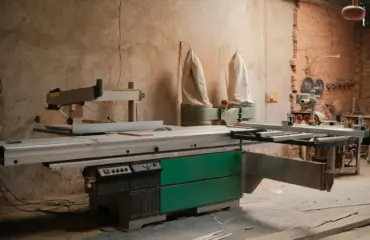
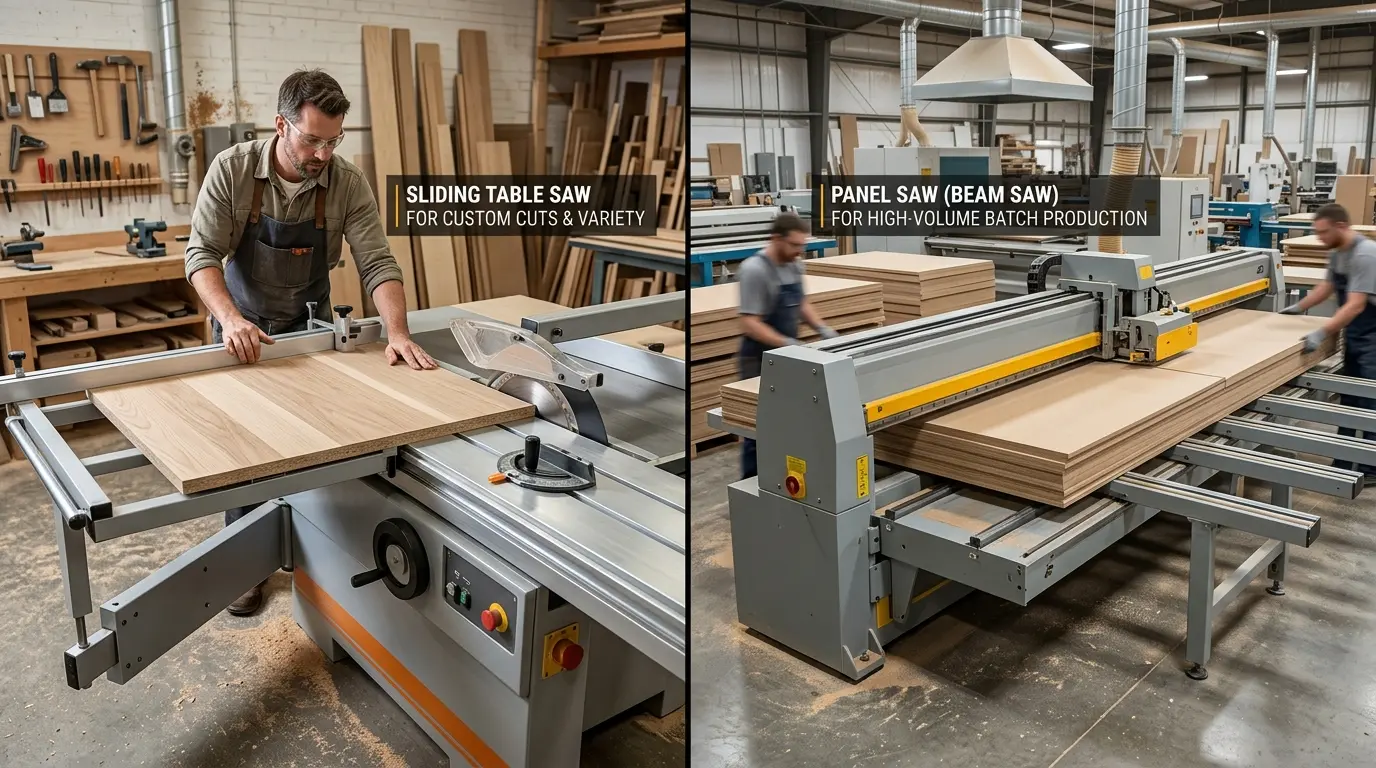
A sliding table saw is commonly chosen when cutting still depends on flexibility. Operators may need to move between sheet goods, solid wood parts, angled cuts, short runs, and job-specific adjustments without rebuilding the whole process each time.
A beam saw, in this article, refers to the production-oriented panel-sizing format used for repeated sheet processing. It is commonly evaluated when a business needs the cutting stage to behave more like a dedicated production station for rectangular parts rather than a broadly adaptable workshop tool.
That distinction matters because growth does not always mean buying the most automated machine first. It means buying the machine that removes the biggest source of daily friction.
Where A Sliding Table Saw Usually Fits Better
For many smaller operations, the biggest challenge is not lack of cutting capacity. It is the need to stay flexible while keeping quality under control. That is why many workshops exploring sliding table saws are really trying to solve a workflow problem, not just add another saw.
A sliding table saw is commonly a strong fit when the shop depends on:
- Mixed Orders With Frequent Job Changes
- Short Runs Rather Than Long Repeated Batches
- Both Sheet Processing And General Furniture Cutting
- More Direct Operator Control Over Layout And Cut Decisions
- A Single Saw Covering A Wide Range Of Daily Tasks
This usually describes custom cabinet shops, small furniture workshops, joinery businesses, and early-stage manufacturers that are still balancing repeat work with project-based production. In that environment, flexibility protects output. The saw helps the shop keep moving even when order sizes change, materials vary, or each job needs slightly different handling.
The tradeoff is that output stays more dependent on setup discipline and operator method. That is not always a problem in a small shop. In fact, it may be the right compromise if the business still wins through responsiveness rather than scale.
Where A Beam Saw Usually Fits Better
The case for a beam saw becomes stronger when the front end of production has to do more than cut accurately. It has to feed the rest of the factory in a stable, repeatable way.
Factories evaluating panel saws in beam-saw-style workflows are usually dealing with pressures such as repeated cabinet parts, growing batch sizes, more downstream dependence on part consistency, and a need to reduce variation across shifts.
A beam saw is commonly well suited to situations where the business depends on:
- Repeated Rectangular Panel Parts
- Higher Daily Volume In Cabinet Or Modular Furniture Production
- More Predictable Flow Into Edge Banding, Drilling, And Assembly
- Lower Reliance On Individual Operator Technique For Repeated Sizing
- A More Structured Front-End Process As The Factory Scales
This does not mean a beam saw is universally better. It means it becomes more logical when the factory’s main bottleneck is no longer job variation. The bottleneck becomes repeated handling, repeated measuring, inconsistent output across batches, or the inability of the cut cell to support a growing line.
In other words, beam saws usually make more sense when growth is pushing the business toward process discipline rather than workshop flexibility.
Which One Fits Different Growth Stages?
The easiest way to compare the two is to stop asking which saw is better in general and start asking which one matches the current production stage.
| Production Situation | Sliding Table Saw Fit | Beam Saw Fit | What Usually Matters Most |
|---|---|---|---|
| Small custom shop with mixed furniture and cabinet work | Strong | Limited | Flexibility, low-volume adaptability, and operator control |
| Small shop starting to repeat some panel jobs | Strong to moderate | Moderate | Whether repeat work is occasional or already shaping the weekly schedule |
| Growing cabinet shop with rising batch volume | Moderate | Strong | Front-end stability, cleaner part flow, and less operator-dependent sizing |
| Factory scaling repeated rectangular panel output | Limited to moderate | Strong | Throughput consistency, repeatability, and support for downstream processes |
| Mixed-production factory still balancing custom and repeat work | Moderate to strong | Moderate to strong | Whether flexibility or standardization removes more daily delay |
The middle row is where many buying mistakes happen. A shop may be growing, but not every growing shop is ready for a beam saw. If a large share of work is still irregular, highly customized, or dependent on manual decision-making, moving too early into a more specialized cutting format can create a mismatch.
At the same time, a shop can also wait too long. If repeated panel work now dominates the schedule, staying with a sliding table saw may preserve familiarity while limiting the business operationally.
The Best Choice Depends On What Is Slowing The Shop Down
When owners say they need a better saw, they often mean one of several different things. Those problems do not all point to the same machine.
If the shop is losing time because every job is different, the stronger answer is often a sliding table saw. If the shop is losing time because the same types of parts are being handled again and again with too much manual effort, the stronger answer is often a beam saw.
This is a more useful way to look at the decision:
| If You Are Mostly Struggling With… | The Better-Fit Direction Is Often… | Why |
|---|---|---|
| Frequent changeovers and mixed job requirements | Sliding table saw | It adapts more naturally to varied work |
| Repeated sizing of cabinet or wardrobe parts | Beam saw | It supports more stable panel flow in repeated production |
| A need for one versatile saw in a smaller footprint | Sliding table saw | It usually serves a broader daily role in smaller operations |
| Downstream departments waiting for cut parts | Beam saw | It is commonly chosen when the cut stage must feed a larger line more predictably |
| Dependence on one highly experienced operator for repeated panel work | Beam saw | It helps shift output toward a more process-driven model |
| A business still testing product mix and order pattern | Sliding table saw | It keeps the cutting process flexible while the shop model is still evolving |
This is why the smartest saw choice is often the one that fits the current bottleneck, not the one that sounds like the bigger upgrade.
Questions Small Shops And Growing Factories Should Ask Before Buying
Before choosing between a sliding table saw and a beam saw, it helps to answer a few operational questions honestly.
- Is Most Of The Weekly Work Still Mixed And Custom, Or Is It Becoming Repeated Panel Production?
- Does The Shop Need Flexibility More Than Standardized Output?
- Are Edge Banding, Drilling, Or Assembly Teams Starting To Depend On More Consistent Front-End Part Flow?
- Is Cutting Quality Still Mostly Protected By Operator Skill Rather Than Process Stability?
- Is The Business Trying To Stay Adaptable, Or Trying To Scale Repeated Production More Cleanly?
The last question is especially important. Some businesses grow by serving more custom demand. Others grow by standardizing repeated panel work. Those are different growth paths, and they do not naturally lead to the same saw choice.
When The Decision Starts To Become Obvious
For a small shop, the decision often becomes clearer when the owner realizes that flexibility is still creating more value than specialization. If the schedule changes constantly, if order sizes stay small, and if one saw must handle many different tasks, a sliding table saw is often the more grounded choice.
For a growing factory, the decision usually becomes clearer when the cost of staying flexible starts to outweigh the benefit. That often shows up as repeated part families, more pressure from downstream processes, more re-cuts from variation, or difficulty maintaining stable output as volume increases.
At that point, the question is no longer whether the sliding table saw can still do the work. It often can. The question is whether it is still the right production model for the next stage of growth.
Practical Summary
A sliding table saw is usually the stronger fit for small shops that need versatility, hands-on control, and the ability to move between mixed jobs without forcing everything into a rigid production pattern. A beam saw is usually the stronger fit for growing factories that are building around repeated rectangular panel work and need the cutting stage to support more stable, scalable production.
The better machine is not the one with the broader reputation. It is the one that matches the real operating model of the business. If the shop still depends on flexibility, a sliding table saw is often the smarter choice. If growth is pushing the factory toward repeatability, cleaner handoffs, and a more structured front end, a beam saw usually deserves more serious attention.