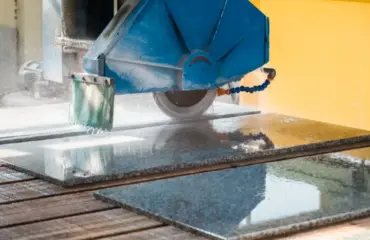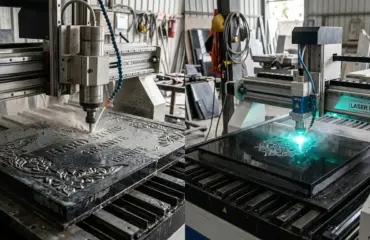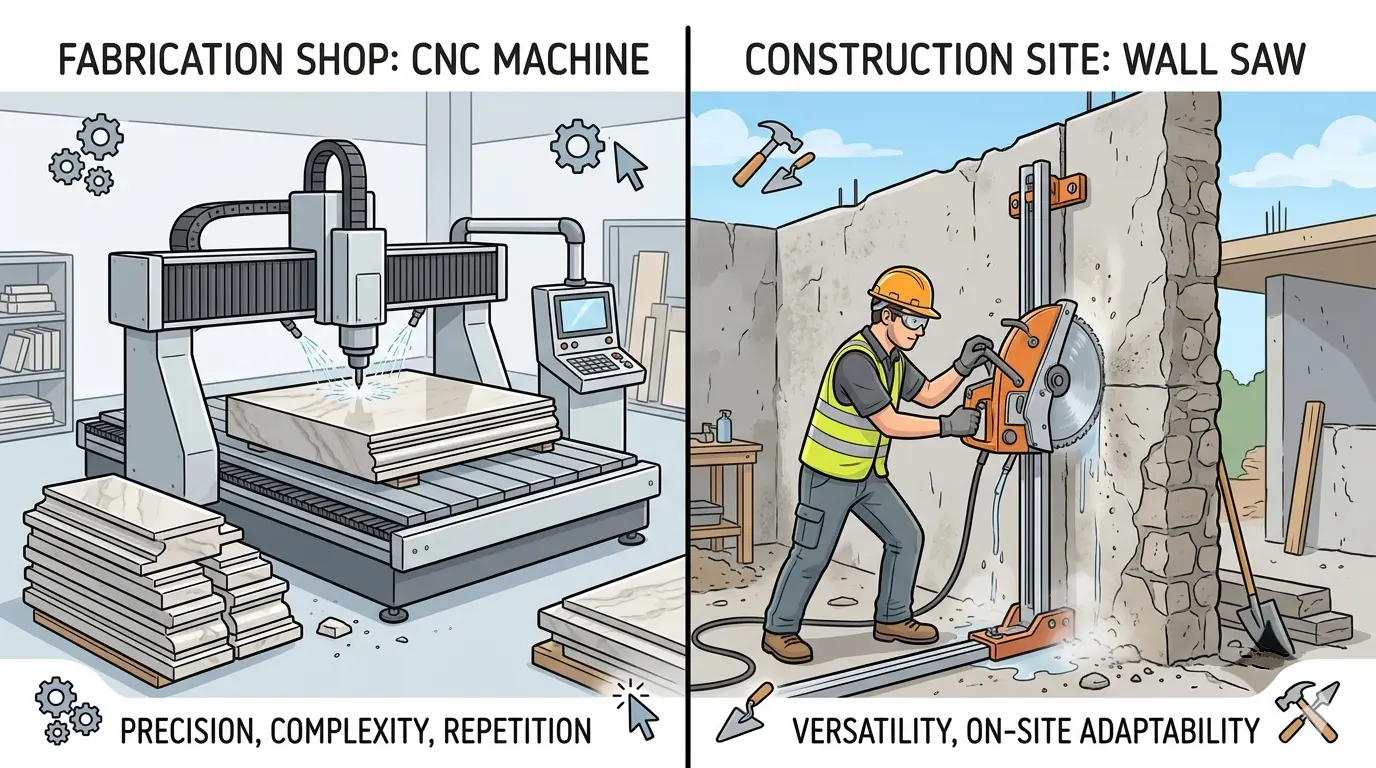
Stone shops sometimes compare a stone CNC machine with a wall saw as if they solve the same problem. In practice, they usually sit at different points in the workflow. One is primarily a fabrication tool for repeatable shop work. The other is primarily a field tool for cutting where the material or structure cannot realistically be moved back into a controlled production environment.
That distinction matters because the wrong comparison often leads to the wrong investment. If your constraint is part quality, repeatability, edge consistency, and smoother shop throughput, a stone CNC machine usually creates more value. If your constraint is access, installed material, and on-site cutting where portability matters more than programmed fabrication, a wall saw is usually the stronger fit.
Start With The Workflow, Not The Tool Name
Many equipment decisions become confusing because the comparison starts with machine labels instead of production reality. The better question is not, “Which one is better?” It is, “Where does the work actually happen, and what kind of output needs to leave that stage?”
If the job is centered on repeatable fabrication in a shop environment, the machine needs to support stable processing, cleaner handoffs, and less manual rework. If the job is centered on cutting material in place, or on dealing with pieces that are too large, too heavy, or too impractical to move, the decision shifts toward portability and site access.
In other words, this is usually a comparison between two operating environments:
- Controlled Shop Fabrication
- Access-Driven On-Site Cutting
Once that is clear, the equipment choice usually becomes much easier.
What A Stone CNC Machine Is Best At
For shops handling quartz, marble, granite, and similar materials, stone CNC machines are commonly used when the goal is to make fabrication more repeatable and less dependent on manual variation. They are generally better suited to workflows where routing, carving, edging, polishing-related processing, and consistent part geometry need to happen in a planned production sequence.
The real value is not just automation for its own sake. It is the ability to turn fabrication steps into a more controlled process. That usually helps with:
- More Repeatable Part Geometry Across Similar Jobs
- Better Consistency In Edges, Profiles, And Processed Features
- Cleaner Handoffs Into Inspection, Assembly, Or Installation Prep
- Reduced Manual Rework On High-Value Stone Parts
- Stronger Throughput In Shop-Based Fabrication Workflows
When the piece can be brought into the factory and the business depends on predictable finished-part output, a stone CNC machine usually does more than cut. It helps stabilize the entire fabrication stage.
What A Wall Saw Is Best At
A wall saw is usually the stronger fit when the work must be cut where it already is. That could mean installed material, large fixed sections, architectural elements, or situations where transporting the workpiece back to the shop would add too much time, risk, or disruption.
Its value is practical rather than production-line oriented. A wall saw is commonly chosen because it brings cutting capability to the jobsite instead of forcing the jobsite problem back into a shop workflow.
That usually makes it better suited to:
- On-Site Cutting Where Material Cannot Be Moved Easily
- Straight Or Access-Driven Cuts In Fixed Positions
- Field Adjustments That Must Be Completed During Installation
- Jobs Where Portability Matters More Than Batch Repeatability
- Situations Where Schedule Risk Comes From Site Conditions Rather Than Shop Capacity
The tradeoff is that a wall saw is usually not the better answer for repeated finished-part fabrication. It solves access and location problems very well, but it does not typically replace a dedicated shop process when the goal is consistent, repeatable fabrication output.
Side-By-Side Decision Comparison
| Decision Factor | Stone CNC Machine | Wall Saw | Stronger Fit |
|---|---|---|---|
| Primary Work Environment | Shop fabrication | Jobsite or in-place cutting | Depends On Where The Work Happens |
| Best Use Case | Repeatable fabrication, processed features, and controlled workflow | Access-driven cutting on installed or fixed material | Depends On The Constraint |
| Repeatability Across Similar Parts | Usually stronger | Usually lower for batch-style fabrication | Stone CNC Machine |
| Portability | Low, because it is part of the shop process | High relative to shop equipment, because it is meant for field use | Wall Saw |
| Geometry And Feature Processing | Better suited to programmed and repeatable fabrication tasks | Better suited to practical cutting access on site | Stone CNC Machine For Fabrication |
| Finish And Downstream Preparation | Usually stronger for controlled fabrication quality | Usually secondary to getting the on-site cut completed correctly | Stone CNC Machine |
| Ability To Solve Site Access Problems | Limited | Usually much stronger | Wall Saw |
| Throughput Value | Better when shop fabrication is the bottleneck | Better when site cutting delays are the bottleneck | Depends On The Workflow |
| Main Tradeoff | Less useful when the cut must happen in place | Less suitable as a replacement for repeatable shop fabrication | Neither Is Universally Better |
The table shows why these machines should not be treated as direct substitutes in every situation. A stone CNC machine is usually stronger when value is created in fabrication. A wall saw is usually stronger when value is created by solving cutting problems in the field.
When A Stone CNC Machine Usually Makes More Sense
A stone CNC machine is often the better choice if:
- Most Margin Is Created In Shop Fabrication Before Installation.
- The Business Handles Repeated Countertop, Vanity, Architectural, Or Similar Stone Parts.
- Edge Consistency, Processed Features, And Repeatability Matter More Than Portability.
- Manual Rework Is Slowing Down Delivery Or Hurting Finish Quality.
- Management Wants Higher Throughput From A More Controlled Fabrication Cell.
In those conditions, the machine supports far more than cutting. It helps turn fabrication into a more stable, predictable stage with fewer downstream surprises.
When A Wall Saw Usually Makes More Sense
A wall saw is often the better choice if:
- The Work Must Be Cut In Place Rather Than Returned To The Shop.
- Material Size, Weight, Or Site Conditions Make Transport Impractical.
- The Job Depends On Straight Or Access-Driven Cutting During Installation Or Field Work.
- Schedule Risk Comes More From On-Site Delays Than From Shop Fabrication Capacity.
- Portability And Site Access Matter More Than Repeatable Multi-Step Fabrication.
A wall saw usually creates the most value when the job would otherwise stall because the cut has to happen where the material already sits.
Why Many Businesses Do Not Really Choose One Or The Other
For many stone businesses, this is not a true winner-takes-all decision. The two machines often support different stages of the same commercial workflow.
A stone CNC machine helps the shop fabricate parts more consistently before delivery. A wall saw helps the team handle cuts that must happen at the installation site or in other fixed conditions. One improves fabrication control. The other protects execution when the job moves outside the factory.
That is why some buyers get better results by evaluating the broader Pandaxis product catalog as a workflow system instead of treating every machine decision as a single-tool comparison. If the business serves both shop fabrication and field installation, the right equipment plan may involve complementing one capability with the other rather than forcing one machine to cover both roles.
Questions To Ask Before You Buy
Before choosing between the two, ask a few practical questions:
- Is The Bigger Bottleneck In Fabrication Or At The Jobsite?
- Are We Trying To Improve Repeatable Finished-Part Output Or Solve In-Place Cutting Problems?
- How Often Do Jobs Require Controlled Processing Such As Edging, Carving, Or Other Fabrication Features?
- How Often Do Jobs Require Cuts On Installed, Oversized, Or Fixed Material?
- Will The Investment Primarily Improve Throughput, Finish Consistency, Or Site Execution?
These questions usually reveal the answer faster than comparing isolated features without tying them back to the actual workflow.
Practical Summary
If the decision is really about fabrication, a stone CNC machine is usually the better fit. It supports repeatability, cleaner process control, better finish consistency, and stronger shop throughput. If the decision is really about on-site cutting, a wall saw is usually the better fit. It solves access problems, reduces the need to move fixed material, and helps keep field work moving when the cut must happen in place.
The better machine is the one that removes the real constraint. For fabrication, that usually points to a stone CNC machine. For on-site cutting, that usually points to a wall saw. If your business handles both stages regularly, the smarter decision is often to treat them as complementary tools rather than competing replacements.