When a stone shop starts falling behind, the problem is often not demand by itself. It is the gap between slab cutting and finished-part machining. Straight cuts may move quickly, but sink cutouts, edge profiles, shaped pieces, and detail work can still pile up in secondary operations. That is usually when buyers start asking whether a bridge saw or a CNC stone machine is the better investment.
The short answer is this: a bridge saw is usually the stronger fit for slab breakdown and cut-to-size work, while a CNC stone machine is usually the stronger fit when the part needs several machining steps after cutting. The real difference is not simply whether one machine uses software and the other does not. Many bridge saws are also programmed. The real difference is what stage of the stone fabrication workflow each machine is built to carry.
Why The Comparison Gets Confusing
The comparison gets messy because the terms do not sit at the same level.
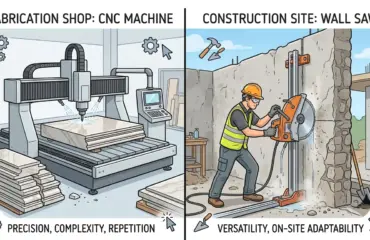
“Bridge saw” usually refers to a specific saw-based machine format used to cut stone slabs into parts. “CNC stone machine” is a broader term that usually points to a stone machining center used for operations such as routing, shaping, profiling, carving, and polishing. That overlap creates confusion because some bridge saws also include CNC control, so buyers may assume the two machines do the same job.
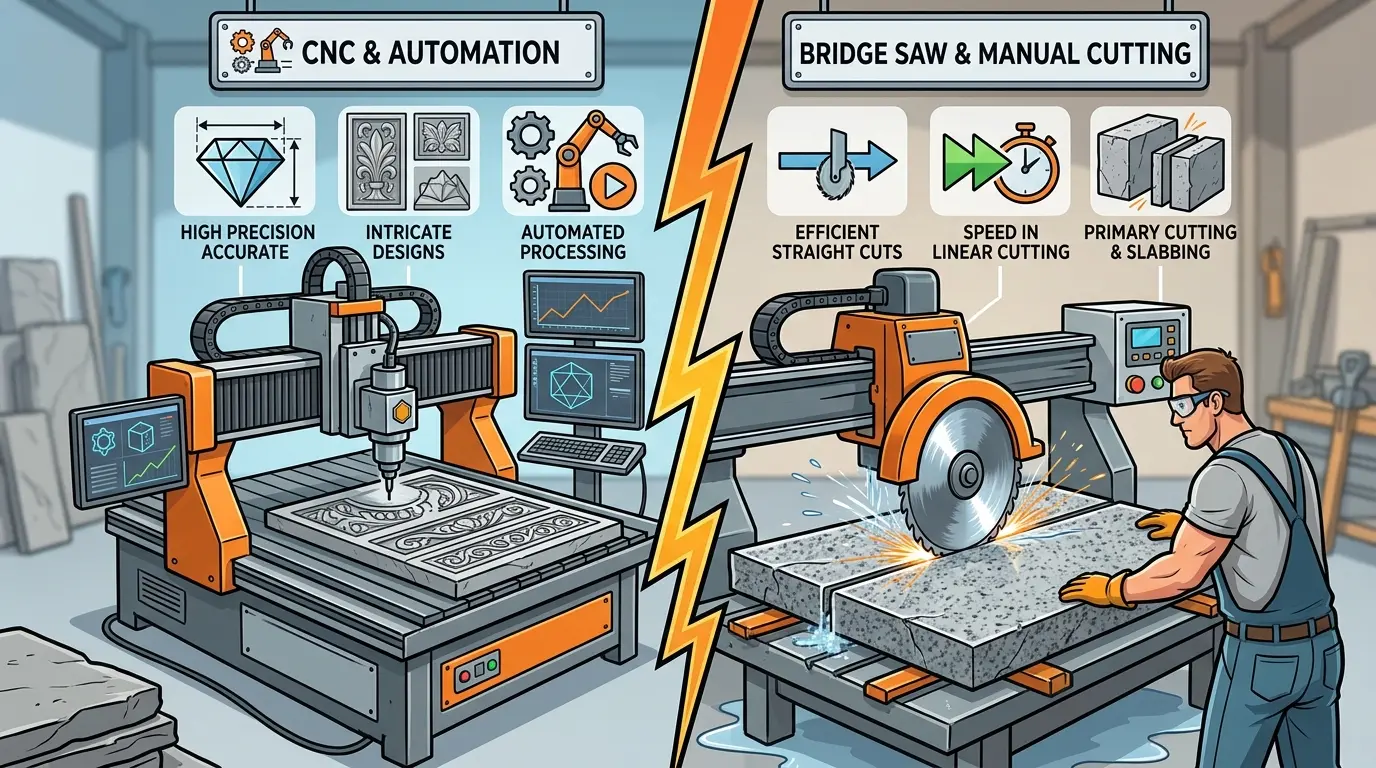
In practice, they usually do not. A bridge saw is still centered on cutting. A CNC stone machine is still centered on machining. The workflow overlap is real, but the production role is different.
The Short Answer: Cutting First vs. Multi-Step Machining
A bridge saw is commonly used when the main job is to turn full slabs into workable blanks or finished cut parts with stable dimensional control. It is usually strongest when the production cell is built around:
- Straight or predictable slab cutting
- Front-end material breakdown
- Repeated part sizing
- Faster preparation for downstream fabrication
A CNC stone machine is commonly used when the part needs more than cutting alone. It is usually stronger when the workflow depends on:
- Sink and faucet cutouts
- Edge profiling and shaping
- Routed details or decorative features
- Repeatable multi-step processing in one programmed flow
For shops evaluating stone CNC machines because shaping and finishing work are tying up skilled labor, the value usually comes from consolidating several machining steps rather than increasing cutting speed alone.
What A Bridge Saw Usually Does Best
When the bottleneck starts with full slabs, a bridge saw is often the cleaner answer. Its job is usually to break material down efficiently so the rest of the shop can work with manageable parts instead of full-size stone.
That makes bridge saws well suited to shops where the production priority is:
- Moving slabs through the front end faster
- Producing consistent straight or simple programmed cuts
- Supporting countertop, vanity, or architectural parts that begin as predictable blanks
- Keeping the cutting cell focused on sizing rather than secondary machining
The advantage is usually not complexity. It is clarity of role. If the first production problem is getting quartz, marble, or granite into cut pieces accurately and efficiently, a bridge saw often addresses that problem more directly than a broader machining center would.
What A CNC Stone Machine Usually Adds To The Workflow
If the main delay appears after the initial cut, a CNC stone machine often becomes more relevant. Its value is usually tied to process consolidation. Instead of moving a part through multiple manual or semi-manual steps, the shop can handle more of the geometry inside one programmed machining workflow.
That often matters when the production line depends on:
- Consistent sink openings and internal cutouts
- Repeatable edge profiles across similar jobs
- Routed details, carving, or contoured shapes
- Less manual repositioning between operations
- Reduced rework caused by operator-to-operator variation
In those conditions, the machine is not just replacing labor. It is helping standardize how the part is produced after the slab has already been sized.
Side-By-Side Comparison
| Production Factor | Bridge Saw | CNC Stone Machine | Stronger Fit |
|---|---|---|---|
| Primary Role | Slab Cutting And Part Sizing | Multi-Step Machining And Part Finishing Geometry | Depends On Bottleneck |
| Full-Slab Breakdown | Usually Strong | Can Be Less Direct If The Main Need Is Cutting Only | Bridge Saw |
| Straight Or Predictable Parts | Commonly Efficient | Can Handle Them, But Broader Capability May Be Underused | Bridge Saw |
| Sink Cutouts And Internal Features | Often A Secondary Workflow Question | Usually Better Suited To Repeatable Programmed Machining | CNC Stone Machine |
| Edge Profiling And Shaping | Commonly Needs Downstream Equipment Or Manual Work | Usually Better Suited | CNC Stone Machine |
| Multi-Operation Consolidation | Usually Narrower In Workflow Scope | Usually Stronger | CNC Stone Machine |
| Simple Cut-First Production Cell | Often Cleaner And Easier To Organize | May Be More Machine Than The Job Requires | Bridge Saw |
| Reducing Manual Handoffs After Cutting | Usually Less Effective | Usually Stronger | CNC Stone Machine |
The table shows why these machines should not be treated as automatic substitutes for one another. One is usually strongest at the beginning of the stone workflow. The other is usually strongest when the part needs more complex machining after the initial cut.
When A Bridge Saw Is Usually The Better Fit
A bridge saw is usually the better fit when:
- Most jobs begin with straight, angled, or otherwise predictable slab cutting.
- The main capacity problem is front-end slab breakdown rather than secondary shaping.
- Downstream edging, polishing, or finishing stations already work well enough.
- The shop needs more cutting stability before it needs more machining range.
- The goal is to improve cut-part flow without redesigning the full fabrication process.
In that situation, a bridge saw often solves the real problem more directly because the value comes from faster, more consistent preparation of blanks.
When A CNC Stone Machine Is Usually The Better Fit
A CNC stone machine is usually the better fit when:
- Sink cutouts, edge details, or shaped features are slowing production.
- The same machining patterns repeat often enough to benefit from programming.
- Manual shaping and secondary operations are creating too much variation.
- The shop handles higher-mix countertop or architectural stone work.
- Reducing repositioning, rechecking, and rework matters as much as increasing throughput.
In those conditions, the stronger benefit is usually not just automation. It is repeatable geometry across more of the finished part.
Can One Machine Replace The Other?
Not universally.
A CNC stone machine is not automatically the better answer if most of the workload is straightforward slab cutting. In the same way, a bridge saw is not automatically enough if the real delay sits in cutouts, edge shaping, decorative work, or repeated secondary machining.
In many fabrication environments, the two machine types are complementary rather than interchangeable. A bridge saw commonly prepares the material. A CNC stone machine commonly adds the routed, profiled, or finished geometry that turns the blank into a higher-value component.
That is why the smarter buying question is not which machine sounds more advanced. It is where labor time, queue time, and correction work are accumulating in the current workflow.
Practical Summary
The difference between a CNC stone machine and a bridge saw comes down to production role. A bridge saw is usually stronger for cutting full slabs into parts efficiently and consistently. A CNC stone machine is usually stronger when those parts need additional machining such as cutouts, profiling, shaping, or decorative processing.
If your bottleneck starts with slab breakdown, the bridge saw comparison usually deserves more attention. If your bottleneck starts after the cut, a CNC stone machine is usually the more relevant direction. The right choice depends less on the machine label and more on which stage of stone fabrication is limiting output, consistency, and delivery speed.