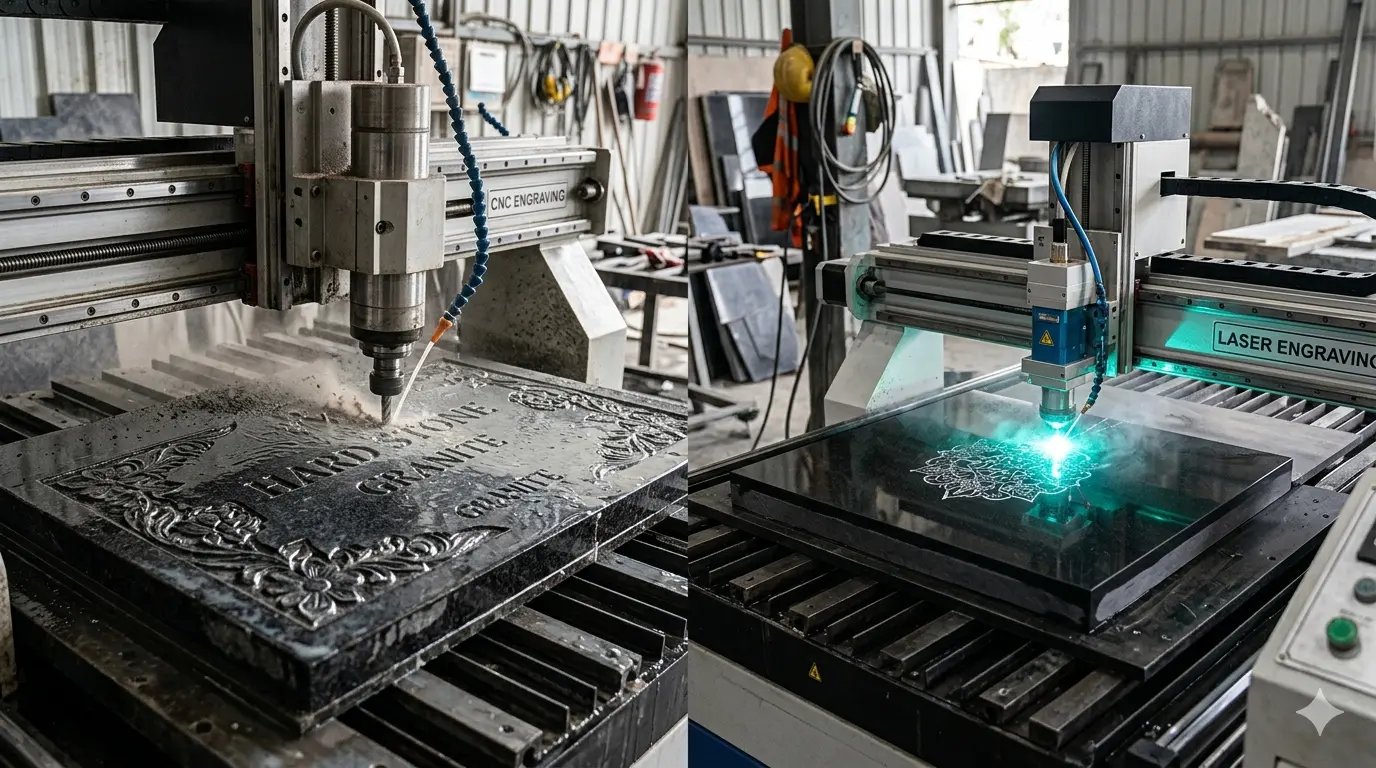
When buyers compare a stone engraving machine with a laser engraver, they are usually collapsing two very different jobs into one purchase discussion. One job is controlled material removal in stone. The other is surface marking or decorative graphics with minimal physical contact.
That distinction matters even more with hard materials than it does with wood, acrylic, or other easier-to-process substrates. Granite, quartz, marble, slate, engineered stone, and ceramic-like surfaces do not respond the same way to heat or to cutting tools, so the right machine depends first on the output you need: visible contrast, measurable depth, edge profiling, or a broader fabrication workflow.
Why The Comparison Can Be Misleading
A stone engraving machine is usually part of a cutter-based stone-processing workflow. It is selected when the shop needs grooves, relief carving, sink cutouts, recesses, lettering with depth, edge work, or repeatable shaping on hard slabs and finished parts.
A laser engraver is a non-contact digital marking system. On hard materials, it is more commonly evaluated for shallow decorative marking, logos, text, artwork, or identification marks where fast design changes matter more than material removal.
That is why the word “engraving” creates confusion. Both processes can place graphics or lettering on a part, but they create value in different ways.
- A Stone Engraving Machine Creates Value Through Depth, Geometry, And Integration With Stone-Fabrication Steps
- A Laser Engraver Creates Value Through Fast Artwork Changes, Non-Contact Processing, And Surface-Level Decoration Or Marking
If the part needs carved geometry or a machined feature, the comparison stops being close. A laser is not a practical substitute for a spindle-led stone process in that scenario.
What Changes At The Process Level
| Selection Factor | Stone Engraving Machine | Laser Engraver | Why It Matters In Production |
|---|---|---|---|
| Primary Output | Physical material removal, grooves, recesses, and carved depth | Surface contrast, light marking, and decorative graphics | Defines whether the customer is buying geometry or appearance |
| Fit For Hard Materials | Well suited to granite, quartz, marble, and broader stone-fabrication work | Usually evaluated only for selected hard-material marking applications after testing | Prevents a marking process from being treated like a machining process |
| Depth Capability | Strong fit for measurable depth and repeatable carved features | Limited fit for deeper removal and usually inefficient for that role | Keeps cycle-time expectations realistic |
| Artwork Changeover | Toolpaths, fixturing, and machining setup matter more | File-to-file changes are usually faster | Affects how well the line handles mixed or custom orders |
| Workflow Role | Can sit inside routing, carving, edging, polishing, and cutout workflows | Best suited to marking, decoration, or identification stages | Helps buyers choose the primary process, not just a sample finish |
| Daily Operating Friction | Tool wear, coolant, fixturing, and cleanup discipline | Material-response variation, thermal effects, and extraction control | Predicts where production problems are most likely to appear |
| Best-Fit Value Driver | Repeatable geometry and downstream fabrication accuracy | Flexible artwork and non-contact finishing-stage marking | Aligns the machine with the commercial value of the part |
When A Stone Engraving Machine Usually Fits Better
If production requires real material removal, a stone machine is usually the right answer. That includes jobs such as recessed drain grooves, sink areas, edge profiles, carved decorative zones, or lettering that must have visible depth instead of only surface contrast.
It also becomes the stronger fit when engraving is only one step inside a larger stone workflow. Shops making countertops, architectural stone parts, wall panels, vanity tops, or shaped stone signage often need the same platform to support routing, recessing, profiling, and finish preparation alongside decorative work. In that environment, stone CNC machines are the natural category fit because the job is really stone machining rather than surface marking.
The operating model is different as well. A cutter-based process may ask for more fixturing, tooling, coolant, and cleanup discipline, but it gives the line real geometry control. That matters when downstream fit, assembly accuracy, or finish consistency is part of what the customer is paying for.
When A Laser Engraver Usually Fits Better
A laser engraver makes more sense when the line is selling graphic detail or frequent design variation rather than carved depth. On selected hard materials, that can include logos, decorative graphics, serial information, shallow artwork, or light branding where a non-contact process helps protect finished surfaces and simplifies changeovers.
Laser is usually stronger when:
- Artwork Changes Frequently From Order To Order
- The Job Needs Visual Contrast More Than Measurable Depth
- Short Runs, Custom Designs, Or Branding Elements Are Common
- The Part Is Already Finished And The Shop Wants To Avoid Tool Contact
The main caution is material response. Hard materials do not react uniformly under laser energy. Surface contrast, edge cleanliness around the mark, and thermal stress behavior can vary by stone type, surface finish, coating, and mineral composition. Sample validation is essential before a shop treats laser as a reliable production answer.
Hard-Material Workflows And Their Better Fit
| Workflow Profile | Usually Better Fit | Why | Main Caution |
|---|---|---|---|
| Granite Or Quartz Countertops With Grooves, Recesses, Or Cutout-Adjacent Details | Stone Engraving Machine | The job requires physical removal and geometric control | A laser workflow will stay too shallow for the main task |
| Marble Or Stone Panels With Carved Decorative Patterns | Stone Engraving Machine | Visible depth and repeatable feature shape matter more than rapid artwork swapping | Tooling strategy and cycle time still need to be managed |
| Slate Plaques Or Decorative Stone Pieces With Frequently Changing Artwork | Laser Engraver | Fast digital design changes can matter more than depth | Contrast can vary sharply by surface and finish |
| Finished Stone Components Needing Identification Marks Or Light Branding | Laser Engraver | Non-contact marking can fit better late in the process | Permanence and readability should be validated on real parts |
| Shops That Fabricate Stone Parts But Occasionally Add Decorative Surface Graphics | Depends On Which Process Drives Revenue | Fabrication usually determines the primary machine, while laser may be a secondary process if marking volume justifies it | One machine should not be forced to solve two very different jobs equally well |
Questions That Usually Expose The Right Choice
Before buying, it helps to review the actual order mix rather than the most impressive sample panel.
Ask these questions:
- Is The Customer Paying For Visible Contrast Or For Measurable Carved Depth?
- Does The Job Stop At Marking, Or Does It Also Need Grooves, Cutouts, Edge Shaping, Or Relief Features?
- Which Materials Dominate The Order Book: Slate And Decorative Stone Pieces, Or Quartz And Granite Fabrication Parts?
- How Often Does The Artwork Change Across Revenue-Producing Jobs?
- Can The Line Absorb Tooling, Coolant, And Cleanup As Part Of The Real Operating Model?
- Have Representative Samples Been Run On The Actual Material Mix Instead Of A Single Best-Case Sample?
Those answers usually make the decision much clearer. The more the business behaves like stone fabrication, the more a stone engraving machine tends to be the correct primary investment. The more the work behaves like variable surface decoration or identification marking on selected hard materials, the more a laser engraver can make sense.
Practical Summary
For hard materials, stone engraving machine versus laser engraver is not a same-job comparison. A stone engraving machine is the stronger fit when the line needs genuine material removal, carved depth, or integration with a broader stone-processing workflow. A laser engraver is the stronger fit when selected hard materials only need surface graphics, identification, or shallow decorative marks and when fast digital changeovers create more value than depth.
If the part needs geometry, buy a stone machine. If it needs contrast and frequent artwork changes, laser can make sense after material testing. The wrong purchase usually happens when a shop asks a marking process to do machining work, or buys a machining platform for a workload that mostly changes artwork every day.