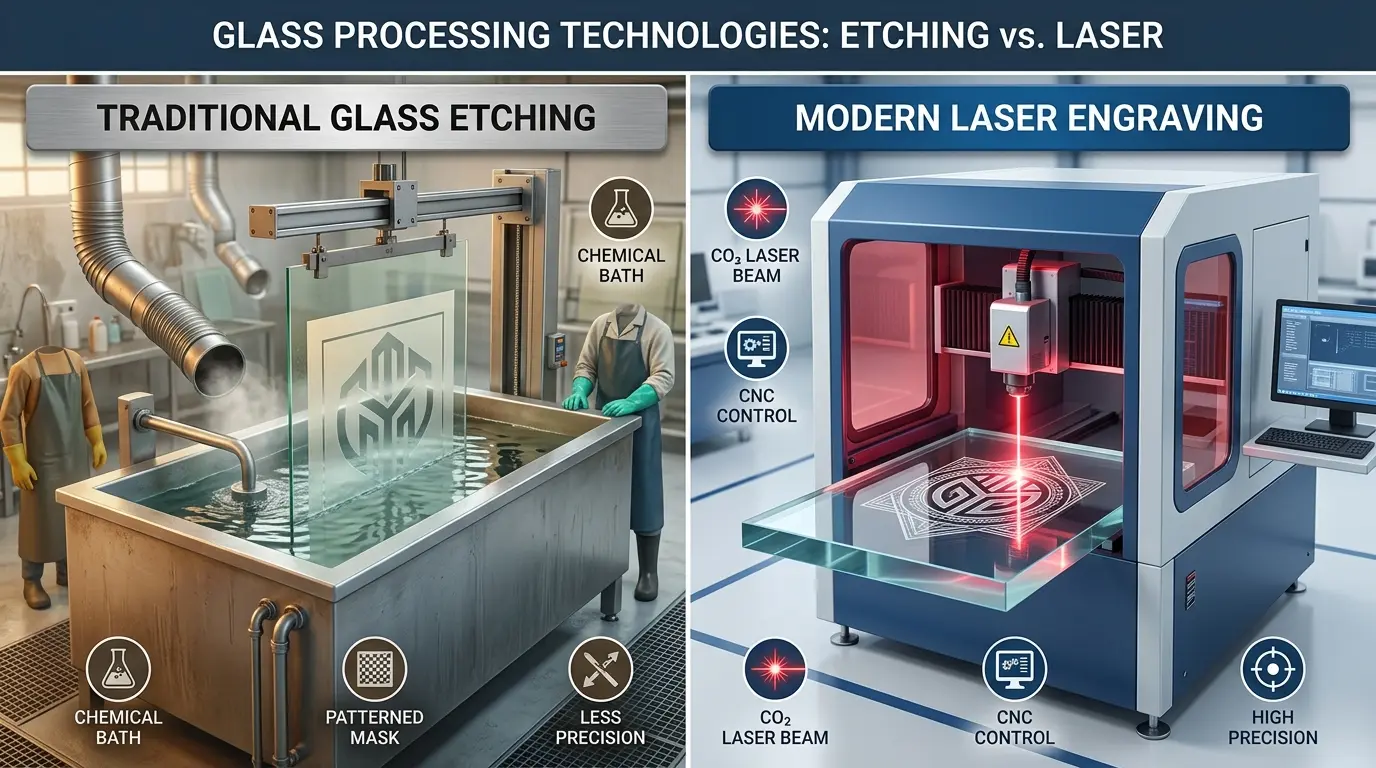
In many buying conversations, a glass etching machine and a laser engraver get treated as if they are interchangeable. They are not. One usually refers to a process built around creating an etched or frosted surface effect across glass, often through abrasive or similar surface-treatment methods. The other is a digitally controlled, non-contact system used to place graphics, text, and decorative details with far less physical setup.
If you are choosing between them, the real question is not which label sounds more advanced. The real question is which process gives you the finish quality, changeover speed, repeatability, and labor profile your workflow actually needs.
First, The Term “Glass Etching Machine” Is Broader Than It Sounds
One reason this comparison causes confusion is that “glass etching machine” is not always a single, precise equipment category. In real production discussions, it can refer to several approaches used to create a frosted, matte, or decorative etched appearance on glass.
That matters because buyers sometimes compare a finish-driven process name with a specific digital machine type.
In practical terms:
- A glass etching machine is usually associated with producing a surface-etched look across part of the glass or across the whole design area.
- A laser engraver is a specific machine type that uses a focused beam to create markings or engraved effects directly from a digital file.
So the better comparison is not just machine versus machine. It is finish style, process method, and workflow fit.
How The Two Processes Differ At The Process Level
A glass etching process is commonly chosen when the goal is a consistent etched appearance, especially across broader decorative zones. Depending on the setup, this often means preparing the artwork area, controlling where the surface is affected, and producing a more uniform frosted result.
A laser engraver works differently. It uses a digitally controlled beam to place the design directly on the workpiece without physical tool contact. That makes it easier to change artwork quickly, move from one job to the next, and handle variable designs without rebuilding masks or stencils for every run.
For buyers reviewing digitally controlled non-metallic processing options, Pandaxis laser cutters and engravers are the closest category match for engraving-led workflows.
The important distinction is this:
- Etching processes are typically chosen for the surface effect they create.
- Laser engraving is often chosen for digital flexibility, fine placement control, and faster job-to-job changes.
The Finish Is Usually The Real Decision Point
In production, the visual result usually decides the machine choice faster than the machine label does.
A glass etching process is often better suited to jobs where the etched appearance itself is the main requirement. That can include larger frosted zones, repeated decorative panels, privacy-style patterns, or jobs where the customer expects a broader matte field rather than a localized graphic.
A laser engraver is often the better fit when the value comes from detail, customization, and quick artwork changes. Logos, text, branding elements, serialized designs, and short-run decorative work tend to favor a digital process. The result is still often frosted in appearance on glass, but the workflow is different and the production logic is different.
This is why many shops discover that the real choice is not “Which machine can mark glass?” It is “Do I need broad etched coverage or digitally controlled detail?”
Comparison Table
| Decision Factor | Glass Etching Machine | Laser Engraver |
|---|---|---|
| Core Process Logic | Surface-etching workflow focused on creating an etched appearance | Digitally controlled beam-based engraving or marking |
| Typical Visual Result | More uniform frosted or matte surface effect | Localized graphics, text, linework, and digitally placed decoration |
| Best Fit For | Repeated etched designs, broader frosted areas, decorative glass workflows | Short runs, mixed batches, changing artwork, branding, and variable designs |
| Changeover Speed | Usually slower when artwork preparation or masking is involved | Usually faster because artwork changes are digital |
| Large-Area Frosting | Commonly stronger fit | Possible in some cases, but not always the most efficient choice |
| Fine Detail And Custom Text | More workflow-dependent | Commonly stronger fit |
| Variable Data | Less natural for frequent changes | Strong fit for serialized or frequently changing designs |
| Labor Profile | May involve more preparation and handling steps | Often reduces manual artwork setup between jobs |
| Workflow Advantage | Finish consistency for stable repeat jobs | Flexibility, repeatability, and faster digital switching |
When A Glass Etching Machine Usually Makes More Sense
A glass etching process is often the better choice when the finish requirement is broad, consistent, and repeated across similar parts.
That usually includes cases such as:
- Decorative or architectural glass panels with large frosted areas
- Repeat jobs where the same design stays in production for long runs
- Projects where the etched surface appearance matters more than digital changeover speed
- Workflows where broader coverage is more important than variable customization
In those situations, the process can be easier to justify because the output is stable, the artwork does not change often, and the shop is optimizing for consistent visual effect rather than flexible job switching.
When A Laser Engraver Usually Makes More Sense
A laser engraver usually becomes more attractive when the production environment changes often or when the design itself carries more value than a broad etched field.
That usually includes cases such as:
- Short-run branded glass products
- Mixed job queues with frequent artwork changes
- Text, logos, linework, and fine decorative detail
- Customization or variable design requirements
- Workflows where reducing physical setup between jobs improves throughput
This is especially important for shops that do not want every design change to create extra preparation work. In that setting, a laser system supports a cleaner digital handoff from artwork to production.
Neither Process Is Universally Better
This is where many buyers make the wrong assumption. A laser engraver is not automatically a replacement for every glass etching workflow, and a glass etching process is not automatically the better choice just because the final look is “etched.”
Each option carries tradeoffs.
An etching-focused process may deliver the appearance you want more naturally when the job is built around broad frosted coverage. But it can be less attractive when designs change often and setup labor starts slowing down the line.
A laser engraver may simplify artwork changes and improve repeatability in custom or mixed production. But if the main requirement is a large-area etched finish with a specific visual character, laser may not always be the most efficient process choice.
That is why machine selection should follow the production objective, not the buzz around one technology.
Material Validation Still Matters
Glass is not a completely uniform production material. Surface condition, coatings, product type, and finish expectations all influence results. A process that looks right on one sample may need adjustment on another.
That means sample validation is important before a purchase decision is locked in. Buyers should confirm:
- The visual finish they actually need.
- The level of detail the artwork requires.
- Whether the workload is stable and repetitive or mixed and changeable.
- How much setup labor the production team can absorb.
- Whether the glass work is a dedicated workflow or part of a broader non-metallic production mix.
That last point matters more than many buyers expect. If the same shop is also evaluating other digitally controlled equipment categories, the Pandaxis product catalog is the broadest starting point for comparing where different process families fit.
A Practical Rule For Buyers
If your main goal is a consistent etched appearance across larger decorative areas, a glass etching process is usually the more natural fit.
If your main goal is digital flexibility, faster artwork changes, finer graphic control, and easier customization, a laser engraver is usually the stronger fit.
In other words:
- Choose the etching route when finish style drives the decision.
- Choose the laser route when workflow flexibility drives the decision.
Summary
The difference between a glass etching machine and a laser engraver is not just the tool itself. It is the production logic behind the tool.
A glass etching machine is typically chosen for the etched surface effect it delivers, especially when the job calls for broader frosted coverage and repeatable decorative output. A laser engraver is typically chosen for digital control, fast design changes, and efficient handling of detailed or customized work.
Neither is universally better. The right choice depends on the finish you need, how often the artwork changes, how much setup labor you can accept, and whether your production line values broad etched coverage or fast digital flexibility.