In metal fabrication, accuracy is not just a drawing requirement. It affects whether holes line up at assembly, whether bends stay consistent, whether welded parts fit without force, and whether operators spend the shift correcting parts that should have been right the first time.
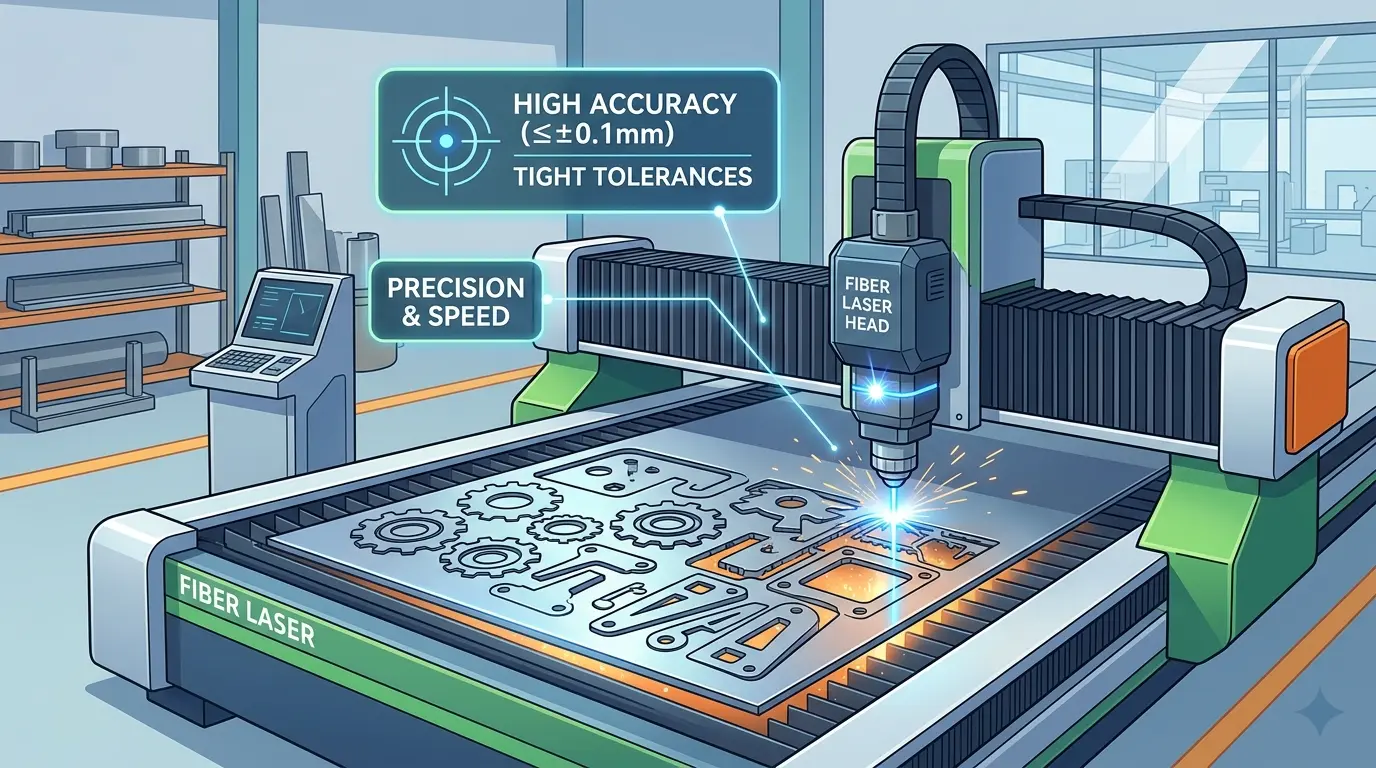
That is why fiber laser cutting matters. It improves accuracy by combining a tightly controlled beam, stable CNC motion, non-contact cutting, and repeatable digital programming. The result is not simply a cleaner cut. In many fabrication workflows, it is a more predictable part that moves downstream with less rework.
Why Accuracy Problems Show Up Later Than the Cut Table
Most fabrication shops do not first notice accuracy problems at the moment of cutting. They notice them later, when:
- Parts Need Slot Or Hole Correction Before Assembly
- Tabs And Mating Features Do Not Fit Cleanly
- Bends Become Less Predictable Because Blank Geometry Drifted
- Weld Fit-Up Takes Longer Than Planned
- Finished Parts Require More Sorting, Grinding, Or Manual Adjustment
This is why cut accuracy should be judged by downstream performance, not by how clean the cut looks in isolation. A cutting process is accurate only when it helps the next operation run with less correction.
What Fiber Laser Cutting Changes In The Process
Fiber laser cutting improves accuracy because it controls several variables at the same time.
| Accuracy Driver | How Fiber Laser Cutting Helps | Production Outcome |
|---|---|---|
| Beam Focus | A highly concentrated beam supports fine feature definition and tighter contour control | Cleaner slots, holes, corners, and edge geometry |
| Controlled Heat Input | Heat is concentrated in a smaller cutting zone than rougher thermal methods commonly create | Less distortion on many sheet-metal jobs and more stable part geometry |
| Non-Contact Cutting | The process does not rely on blade pressure or mechanical contact with the part edge | Reduced risk of tool-pressure-related deformation on detailed parts |
| CNC Path Control | Programmed motion repeats the same geometry from part to part | Better repeatability across production batches |
| Assist Gas Support | Gas flow helps stabilize the cut and manage edge condition | Less secondary cleanup when the process is tuned correctly |
These advantages are most valuable when the part has holes, internal cutouts, tabs, narrow features, or contours that would otherwise be harder to hold consistently.
Where Fiber Laser Accuracy Creates Real Shop-Floor Gains
The improvement is usually not one dramatic change. It is a series of smaller gains that compound across the workflow.
More Consistent Hole And Slot Geometry
Metal fabrication accuracy often breaks down around small features. If holes run oversized, undersized, slightly out of position, or inconsistent from sheet to sheet, assembly slows down immediately. Fiber laser cutting is commonly chosen for jobs where those details matter because it can reproduce programmed geometry more consistently than rougher cutting methods used for lower-precision work.
Better Edge Definition For Bending And Welding
Blank quality affects downstream stability. When edges are inconsistent, the next process has to compensate. More accurate cut edges help bending references stay more predictable and make welded assemblies easier to fit. That does not eliminate process variation elsewhere, but it reduces one major source of it.
Less Manual Correction Between Operations
When cut parts leave the table closer to usable condition, operators spend less time deburring aggressively, opening holes, forcing alignment, or trimming edges for fit. That improves effective throughput even if the gain does not show up in raw cut speed alone.
Stronger Repeatability On Reorders
Repeatability matters as much as first-pass quality. Shops that run recurring parts benefit from a digital cutting process that can return to the same geometry with less dependence on manual setup judgment. That stability supports more reliable scheduling and fewer surprises on repeat jobs.
Fiber Laser Versus Other Metal Cutting Methods For Accuracy
Fiber laser is not universally the right answer. Its advantage is strongest when contour quality, feature definition, and repeatable geometry matter enough to justify the process.
| Method | Accuracy Strength | Typical Tradeoff |
|---|---|---|
| Fiber Laser Cutting | Strong contour control, fine-feature capability, and repeatable edge quality for many sheet-metal jobs | Performance still depends heavily on setup, material condition, and parameter discipline |
| Plasma Cutting | Useful when productivity and cost matter more than fine-detail accuracy on certain jobs | Wider kerf and rougher edge condition can increase downstream correction |
| Turret Punching | Efficient for highly repetitive hole patterns and simple forms | Less flexible for complex contours and mixed-geometry parts |
| Waterjet Cutting | Valuable when a cold-cut process or material sensitivity drives the decision | Slower throughput and different operating economics can limit fit for some production lines |
In practice, the best choice depends on part mix, tolerance expectations, edge-quality requirements, and what happens after cutting. Fiber laser earns its place when the factory benefits from tighter geometric control, cleaner detail work, and less correction downstream.
The Process Conditions That Still Control Final Accuracy
Fiber laser cutting improves accuracy, but it does not make process discipline optional. Shops still lose precision when the surrounding conditions are unstable.
- Material Flatness And Surface Condition
Warped sheet, inconsistent coatings, or unstable incoming material can reduce cut consistency before the machine even starts.
- Nozzle, Focus, And Consumable Condition
A good machine can still produce poor results if nozzle wear, contamination, or focus drift is ignored.
- Recipe Control By Material And Thickness
Shops lose precision when they try to run one broad parameter set across too many metals, gauges, and part types.
- Motion Tuning For Real Geometry
Straight-line speed is not the same as small-feature accuracy. Corners, holes, and tight contours depend on stable motion behavior.
- Nesting And Part Support Strategy
If parts shift, heat concentrates in the wrong areas, or unloading is unstable, cut accuracy becomes harder to hold consistently.
The key point is simple: fiber laser cutting gives the process a better accuracy platform, but the platform still has to be managed correctly.
When Fiber Laser Will Not Solve The Problem By Itself
Some accuracy complaints are incorrectly blamed on the cutting method. A fiber laser will not fully solve problems caused by:
- Poor Tolerance Planning In Part Design
- Weak Brake Setup Or Inconsistent Bending Practice
- Welding Distortion Later In The Process
- Measurement Systems That Do Not Match Real Production Needs
- Maintenance Gaps In The Motion System Or Material Handling Equipment
That is why the right buying question is not, “Is fiber laser accurate?” It is, “Will fiber laser remove the accuracy losses that are currently hurting our workflow?”
If the answer is yes, the return usually appears in reduced rework, more reliable fit-up, cleaner assemblies, and better part-to-part consistency.
What Buyers Should Evaluate Before Investing
Fabricators considering fiber laser equipment should evaluate the process around the machine, not just the machine itself.
- Part Geometry Mix: Shops with many holes, slots, tabs, and contour-heavy parts usually gain more from fiber laser accuracy than shops cutting mostly simple shapes.
- Tolerance Sensitivity Downstream: If bending, welding, or assembly is highly sensitive to blank variation, cutting accuracy becomes more valuable.
- Material Range: Buyers should match the machine to the metals and thickness distribution that define everyday production, not only rare edge cases.
- Automation Needs: Loading, unloading, sorting, and parameter management affect real throughput as much as beam performance does.
- Process Discipline: The best machine will underperform if recipe control, maintenance, and operator standards are weak.
For many factories, the real decision is not just whether fiber laser can cut accurately. It is whether better cut accuracy will remove enough downstream friction to justify the investment.
Practical Summary
Fiber laser cutting improves accuracy in metal fabrication because it supports finer feature control, more repeatable geometry, cleaner edge definition, and less dependence on manual correction between operations. Those gains matter most when part quality affects bending, welding, assembly, and repeat-job consistency.
It is still not a shortcut around process control. Material condition, parameter discipline, consumable health, motion tuning, and handling strategy all determine how much of the accuracy benefit a shop actually captures.
If your team is comparing a broader equipment investment rather than a single cutting cell, the Pandaxis product catalog is a useful starting point for reviewing the machinery categories the brand currently emphasizes.