Choosing between a fiber laser marking machine and a UV laser marking machine is usually not a branding decision or a brochure comparison. It is a production-fit decision. If the wrong source is matched to the material, the result is rarely subtle: metal marks may be slower than they need to be, coated surfaces may discolor, thin plastics may show heat damage, and small codes that looked acceptable in a sample run may become a rework problem on the line.
That is why the better question is not which technology sounds more advanced. The better question is which one solves the actual marking failure mode in your workflow.
The Real Difference Is Material Response
In most factories, fiber and UV marking systems are evaluated because they behave differently at the material surface.
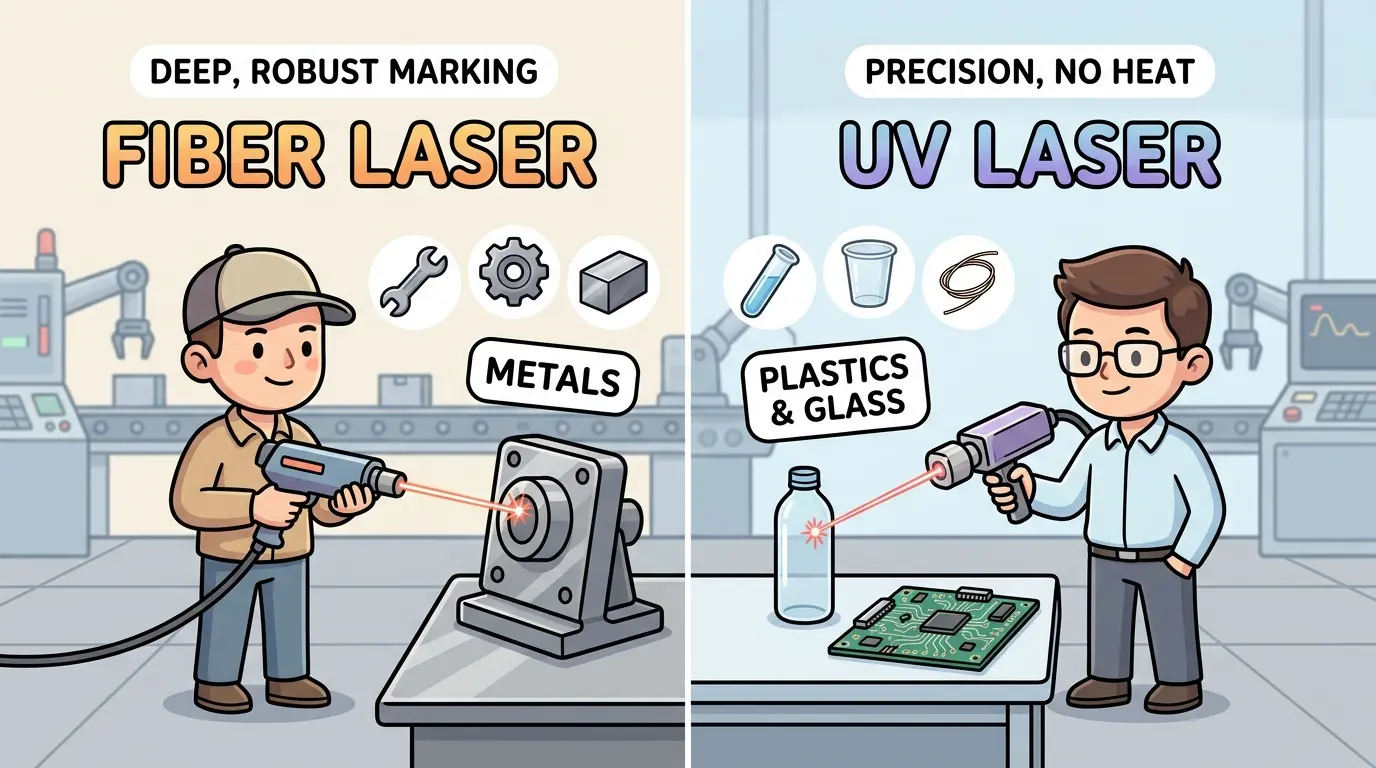
- A fiber laser marking machine is commonly selected when the production mix is heavily centered on metal parts and the goal is durable, repeatable direct part marking.
- A UV laser marking machine is commonly selected when the material is more heat-sensitive, the finish is appearance-critical, or the mark needs fine detail with tighter control over thermal side effects.
That distinction matters because the same production target cannot be assumed across both technologies. A line focused on steel tags, machined aluminum housings, and stainless components usually judges success differently from a line marking coated plastics, delicate electronic housings, or cosmetic parts.
Fiber And UV at a Glance
| Decision Factor | Fiber Laser Marking Machine | UV Laser Marking Machine | What It Usually Means in Production |
|---|---|---|---|
| Best Material Fit | Commonly chosen for metals and many industrial metal-part workflows | Commonly chosen for heat-sensitive plastics, coated surfaces, glass, and delicate substrates | Material mix usually drives the first shortlist |
| Heat Sensitivity | Less forgiving on heat-sensitive finishes or plastics | Often preferred when lower thermal impact is a priority | Cosmetic reject risk often pushes buyers toward UV |
| Typical Strength | Durable, permanent marks on metal parts with good production efficiency | Fine, controlled marking on small or sensitive surfaces | One favors robust metal marking, the other favors delicate-surface control |
| Small-Code Quality | Strong in many industrial ID applications | Often attractive for very fine, high-density marking on sensitive materials | Code size alone is not enough; material response still decides |
| Throughput Priority | Often attractive when metal-part throughput matters | Often attractive when reject reduction matters more than raw speed | Faster is not automatically better if the mark damages the part |
| Main Tradeoff | Can be the wrong fit for appearance-sensitive or heat-sensitive materials | May not be the first choice when the queue is dominated by straightforward metal marking | The stronger fit depends on the dominant production problem |
When Fiber Usually Fits Better
Fiber laser marking is often the stronger option when the line is built around metal identification and the shop needs permanent marks that can survive handling, assembly, and traceability checks.
That usually includes workflows such as:
- Serial Numbers on Machined Metal Parts
- Data Matrix Codes on Fabricated Components
- Batch And Lot Identification on Production Hardware
- Logos Or Reference Marks on Industrial Metal Surfaces
- High-Mix Part Identification Where Variable Data Changes Frequently
In these settings, fiber is commonly valued because it aligns well with direct part marking on metals and with production environments where mark permanence and station throughput both matter.
The honest tradeoff is that fiber is not automatically the better answer when the material is thin, coated, cosmetic, or easily affected by heat. A mark that is ideal on stainless steel may be a poor production result on a sensitive polymer or a finished surface.
When UV Usually Fits Better
UV marking is often the stronger option when the real problem is not whether a mark can be made, but whether it can be made cleanly enough to protect part quality.
That is commonly the case in workflows such as:
- Fine Marking on Heat-Sensitive Plastic Parts
- Identification on Coated Or Painted Components
- Small Codes on Appearance-Sensitive Consumer Or Electronic Housings
- Surface Marking on Glass, Ceramics, Or Other Brittle Materials
- Branding Or Traceability Marks Where Edge Definition Matters More Than Heavy Material Interaction
In these cases, UV is often evaluated because a lower-heat process window can reduce whitening, distortion, haze, or other cosmetic side effects that create reject risk.
The tradeoff is that UV should not be treated as the universal premium answer for every job. If most machine hours will be spent on straightforward metal identification, a UV-first decision may add complexity without improving the real production bottleneck.
The Wrong Comparison Metric Leads to the Wrong Purchase
Many buyers compare fiber and UV systems as if they are only separated by marking speed or by the appearance of a demo sample. In practice, the stronger comparison usually comes from looking at the cost of failure on the shop floor.
The metrics that usually matter most are:
- Scrap Or Cosmetic Reject Rate
- Scanner Reliability on Real Production Codes
- Setup Stability Across Different Materials
- Fixturing Consistency for Small Marking Areas
- Rework Time Caused by Poor Contrast Or Surface Damage
- How Well the Mark Survives Downstream Cleaning, Assembly, Or Handling
If the current problem is slow or inconsistent metal traceability, fiber often makes more sense. If the current problem is damaged surfaces, unstable contrast on delicate materials, or appearance-related rejects, UV often deserves the closer look.
A Practical Selection Framework
| If Your Main Constraint Is… | Usually Start by Evaluating… | Why |
|---|---|---|
| Permanent Marking on Metal Parts | Fiber Laser Marking Machine | Metal-heavy workflows often benefit from fiber’s fit for direct part identification |
| Heat Damage on Sensitive Plastics Or Coatings | UV Laser Marking Machine | The lower-heat marking behavior is often the main value driver |
| High Throughput on Similar Metal Components | Fiber Laser Marking Machine | The line usually rewards speed and permanence more than delicate-surface control |
| Fine Marks on Cosmetic Or Small Electronic Parts | UV Laser Marking Machine | Surface quality and edge definition often matter more than raw station speed |
| Mixed Production with Very Different Materials | Material-by-Material Validation Before Committing | The right source depends on which materials consume most machine hours and create most rejects |
| Codes That Look Fine but Fail in Scanning | Process Validation, Not Source Labels Alone | Code readability depends on setup, surface condition, and verification discipline as much as laser category |
This framework helps keep the decision grounded. Fiber is not simply better than UV, and UV is not simply more precise than fiber. Each technology solves a different cluster of workflow problems.
Validate the Dominant Material, Not the Best Sample
One of the most expensive buying mistakes is to choose a marking source based on a polished demo sample that does not reflect the real production queue.
Before making a final decision, buyers usually need to verify:
- Which Material Family Will Actually Use Most of the Machine Time
- Whether the Mark Is Functional, Cosmetic, Or Both
- How Small the Required Text Or Code Really Is
- Whether the Surface Is Raw, Coated, Painted, Textured, Or Curved
- Whether the Marking Step Comes Before Or After Finishing Operations
- What the Acceptable Reject Rate Really Looks Like in Daily Production
That validation step matters because many laser purchases fail for operational reasons, not because the technology itself is weak. A good sample on the wrong material priority can still lead to the wrong investment.
Practical Summary
Fiber laser marking machines are commonly the better fit when metal-part identification, permanence, and production efficiency drive the project. UV laser marking machines are commonly the better fit when the line is more sensitive to heat, cosmetic damage, or very fine marking on delicate surfaces.
The practical decision is therefore less about which laser category sounds stronger and more about which one removes the real source of scrap, rework, or traceability friction in your process. If this marking choice is part of a wider equipment-planning review rather than a standalone laser purchase, the Pandaxis product catalog can also help map adjacent production equipment around the marking step.