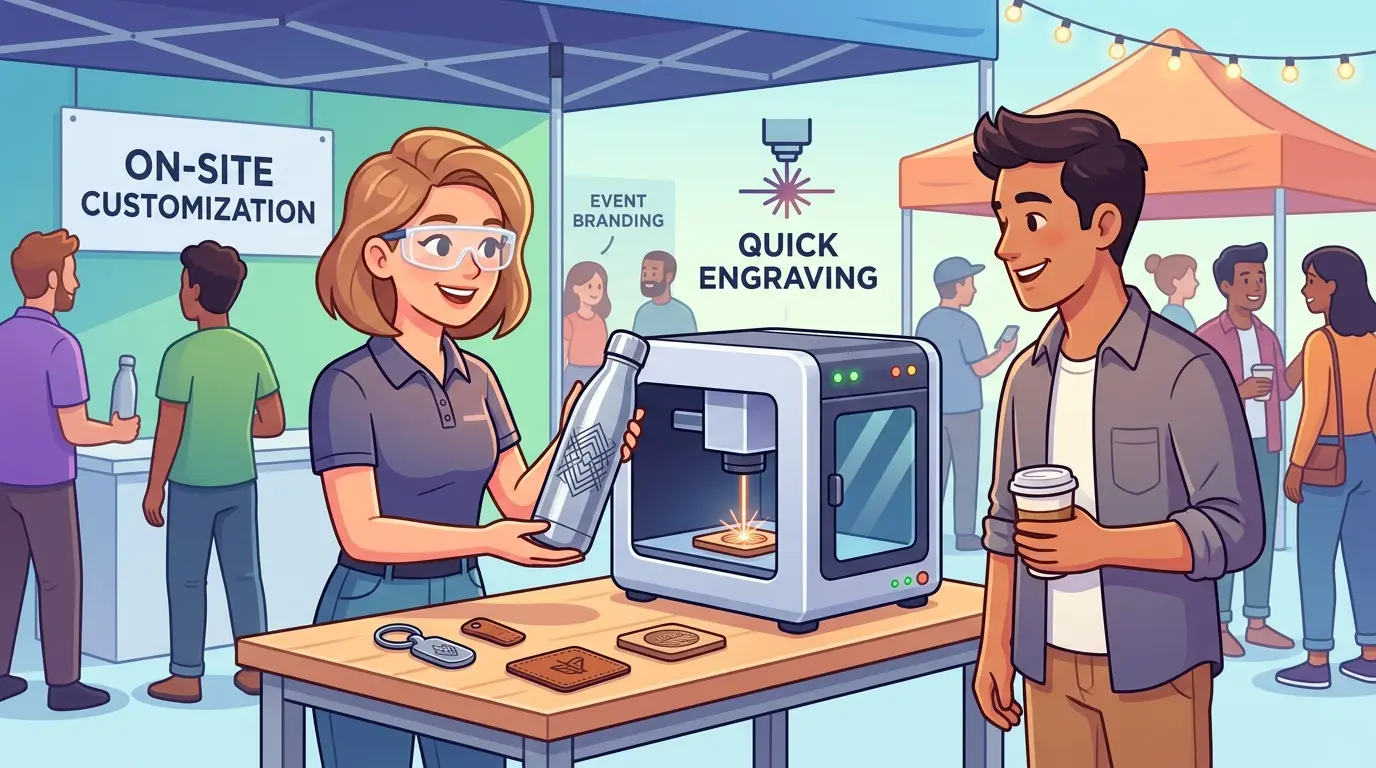
At trade shows, retail pop-ups, hotel activations, and branded gifting events, the bottleneck is rarely engraving capability alone. The real constraint is whether the setup can travel cleanly, operate safely in a public-facing environment, and finish each item fast enough to keep the line moving.
That is why a portable laser engraver should be evaluated as a workflow tool, not just a compact machine. For some businesses, it is a practical way to bring personalization closer to the customer. For others, it becomes a slow, difficult-to-control setup that looks good in a demo but struggles under real event pressure.
Why Event Portability Is Different From Factory Portability
In a factory, portability usually matters because the part is awkward to move. At an event, portability matters because the business has to move the machine, the accessories, the blanks, the power setup, the operator station, and the finishing workflow into a temporary space.
That changes the buying logic.
For event use, the better question is not “Can this machine engrave on-site?” It is “Can this setup be transported, installed, operated, and reset without breaking the customer flow?”
In practice, event-ready portability depends on several factors working together:
- Fast Transport And Setup
- Stable Product Positioning
- Predictable Cycle Time
- Safe Operation Around Staff And Visitors
- Controlled Smoke, Odor, And Debris
- Easy Template Switching For Names, Logos, Or Short Custom Messages
If one of those breaks down, the machine may still engrave well, but the live-customization workflow becomes difficult to sustain.
Which Event Jobs Usually Fit Portable Laser Engraving Best
Portable engraving makes the most sense when the item is small enough to handle quickly, the design can be repeated from saved templates, and the value of live personalization is high enough to justify on-site operation.
| Event Product Type | Why It Fits Portable Engraving | Main Watchpoint |
|---|---|---|
| Wood Tags, Ornaments, And Gift Pieces | Flat handling and simple placement support fast personalization | Surface variation can affect visual consistency |
| Acrylic Nameplates, Keychains, And Display Pieces | Strong visual impact and easy short-run customization | Edge appearance and debris control still matter in front of customers |
| Leather Patches, Tags, And Accessories | Personalization adds value without large part handling | Material variation can change engraving appearance |
| Wood Or Coated Gift Packaging | Names, dates, and logos can be added close to the point of sale | Positioning must stay consistent across repeated blanks |
| Small Promotional Items With Simple Artwork | Fast turnaround can improve booth engagement | Very small parts can slow the operator if fixtures are weak |
| Cylindrical Gift Items With Rotary Setup | Premium live customization can justify higher selling price | Setup time and alignment can reduce real throughput |
The common pattern is clear: the best event jobs are not always the most technically impressive ones. They are the ones that can be loaded, engraved, checked, and handed over with minimal interruption.
What Buyers Usually Underestimate at Live Events
Many buyers focus on engraving quality first. That is understandable, but event success is often decided by queue management rather than sample appearance.
Four problems show up repeatedly in live-customization workflows.
First, setup time is often longer than expected. A unit that is easy to move is not automatically easy to install. Tables, power access, ventilation routing, product trays, packaging, and customer-facing layout all affect whether the station is actually ready to work.
Second, product positioning becomes a major variable. In workshop production, operators can spend more time adjusting jigs or rechecking alignment. At an event, every extra adjustment is visible to the customer and slows the line.
Third, smoke and odor control matter more in temporary venues than many buyers expect. Even when the engraving result is acceptable, poor extraction can create an unpleasant customer experience or conflict with venue rules.
Fourth, event throughput is usually lower than machine-only cycle time suggests. The real cycle includes product loading, artwork confirmation, engraving, unloading, visual check, packaging, and customer handoff. If the machine runs quickly but the overall station does not, the setup still underperforms.
What Separates an Event-Ready Portable Unit From a Demo-Friendly One
For on-site customization, portability should be judged at the system level rather than the machine level.
| Evaluation Factor | Why It Matters On-Site | What to Verify |
|---|---|---|
| Transport Format | Frequent loading, unloading, and short venue windows demand practical mobility | Whether the unit, accessories, and support tools move as one workable kit |
| Enclosure And Operator Control | Public-facing use needs more controlled operation than open workshop use | Whether the setup keeps the process stable and visually manageable around customers |
| Fixture Repeatability | Live personalization slows down quickly when product alignment depends on guesswork | Whether blanks can be loaded consistently with minimal repositioning |
| File And Template Management | Event work often repeats the same layout with different names or short text changes | Whether operators can switch jobs quickly without rebuilding artwork |
| Power And Extraction Planning | Temporary venues rarely behave like permanent production spaces | Whether the setup can run cleanly under site-specific utility limits |
| Real Throughput Per Hour | Machine speed alone does not reflect customer-facing output | Whether the station can complete finished sellable pieces at the required pace |
| Product Range Discipline | Too many item types often create slow changeovers and more operator error | Whether the offering has been narrowed to a realistic live-customization menu |
A portable laser engraver usually performs better at events when the business limits the number of product formats, simplifies the artwork choices, and standardizes fixturing before the event begins.
When Portable Engraving Works Well and When It Does Not
Not every customization business should engrave live.
| Decision Factor | Portable Event Engraving | Fixed Workshop Engraving |
|---|---|---|
| Customer Experience Value | Strong when buyers want to watch the item being personalized | Lower if the order is collected later or shipped |
| Temporary Venue Flexibility | Strong if the setup is compact and repeatable | Usually weaker outside a permanent workspace |
| Throughput Stability | Can be limited by setup, queue management, and operator pace | Usually better for repeated batch work |
| Product Variety | Better with a narrow, controlled product menu | Better when many product types must be processed daily |
| Fixturing Precision | Often adequate for simple personalization | Usually stronger for tighter alignment control |
| Smoke And Environmental Control | More difficult in public or temporary spaces | Easier to manage in a dedicated production area |
| Labor Efficiency Over Longer Runs | Can drop if every job needs manual attention | Usually better once fixtures and workflows are established |
This tradeoff matters because event buyers sometimes ask one portable unit to do two separate jobs: create a strong live experience and also behave like a high-output production machine. Those are not always the same requirement.
If the business depends on long runs, frequent artwork changes, or tighter positioning standards, a fixed workshop machine often deserves the heavier workload. The portable setup then becomes a selective front-end tool for high-visibility personalization rather than the entire production system.
Why Many Successful Setups Use a Hybrid Workflow
The most reliable event operations often separate preparation from personalization.
Instead of producing every part from raw material on-site, they pre-produce blanks, fixtures, packaging, and common graphics in advance. The live station then handles only the final customized step, such as a name, short phrase, date, or event-specific mark.
That hybrid model improves several things at once:
- Faster Customer Turnaround
- Less Setup Complexity At The Venue
- More Predictable Product Quality
- Lower Risk Of Public-Facing Delays
- Easier Staff Training For Temporary Operators
For businesses that also run workshop-based wood or acrylic production, a broader look at laser cutters and engravers can help separate what should be prepared in advance from what is realistic to personalize live.
Practical Buying Questions Before You Commit
Before choosing a portable engraver for event work, buyers should answer a few operational questions honestly.
- What Exact Products Will Be Personalized Live?
Flat tags, acrylic blanks, leather patches, and cylindrical gifts do not place the same demands on the station.
- How Many Finished Pieces Per Hour Are Actually Required?
The answer should include customer interaction and packaging time, not just machine cycle time.
- Will The Event Workflow Use One Standard Fixture Or Several?
If each product needs a different loading method, real throughput usually drops fast.
- How Will Smoke, Odor, And Cleaning Be Managed In The Venue?
This affects both compliance and customer comfort.
- How Quickly Can The Operator Switch Between Repeat Templates?
Live customization becomes inefficient when every new name or layout behaves like a fresh setup.
- What Portion Of The Job Should Be Completed Before Arrival?
The more preparation completed off-site, the more stable the live station usually becomes.
- Is The Goal Brand Theater, High Volume, Or Both?
If the live engraving experience is the selling point, the workflow can tolerate more theater and less output. If the event depends on fast order turnover, the setup has to be much more disciplined.
Practical Summary
Portable laser engravers can be a strong fit for events and on-site customization when the workflow is built around a controlled product range, repeatable fixtures, clean setup, and realistic turnaround expectations. Their value comes from bringing personalization closer to the customer, not from replacing every workshop process.
They are usually most effective when the live station handles the final customized step and the more time-sensitive preparation work is completed in advance. They are less effective when buyers expect one portable setup to deliver open-ended product variety, tight production-level repeatability, and workshop-style throughput in a temporary venue.
The practical decision is straightforward: match mobility to the real event workflow. If the station can travel cleanly, run safely, and keep the queue moving, a portable engraver can create both commercial value and customer engagement. If not, the better answer is often a hybrid model that keeps complex production in the workshop and reserves on-site engraving for the part the customer actually needs to see.