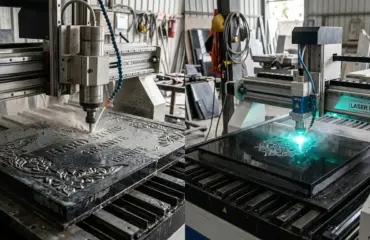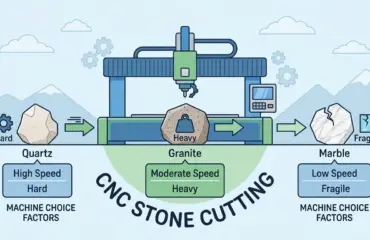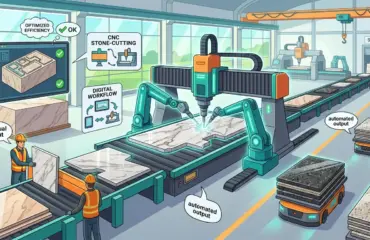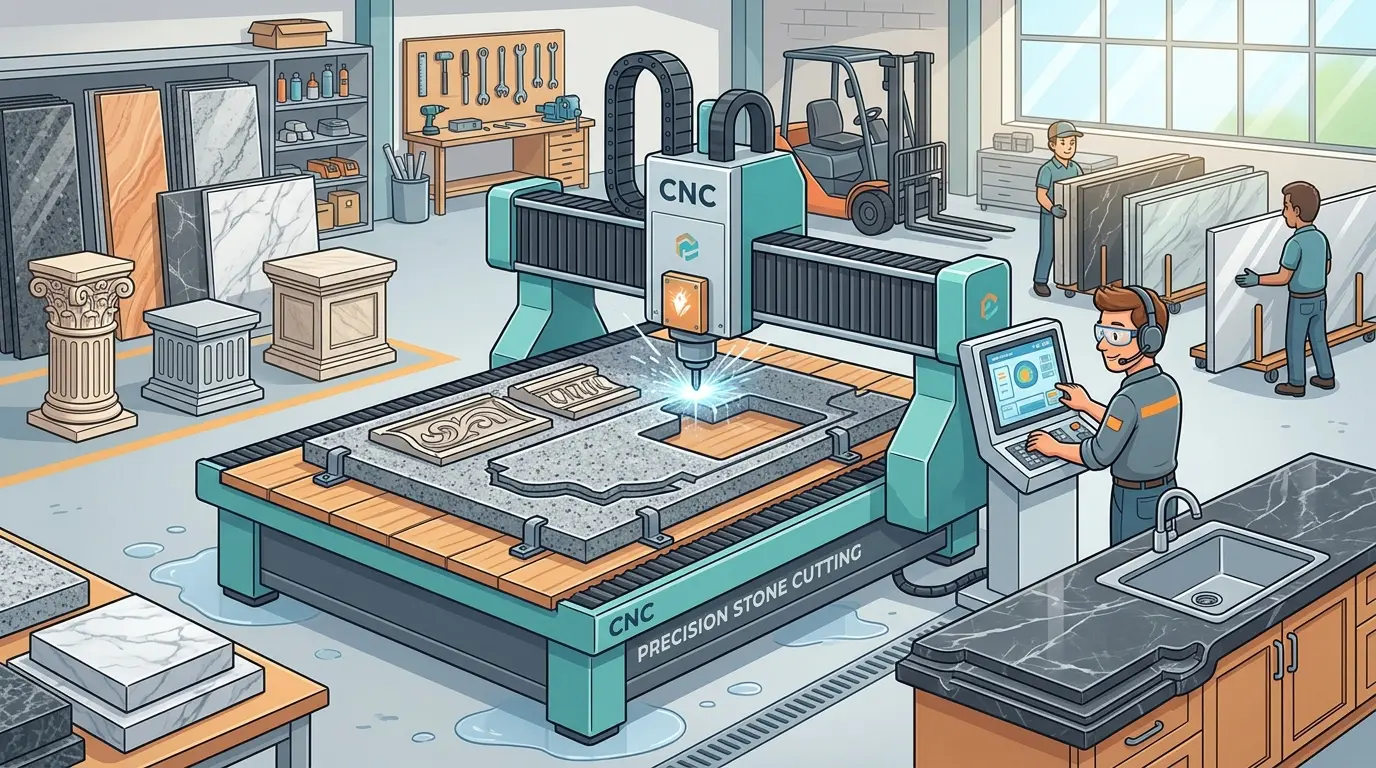
In stone fabrication, the biggest costs usually do not come from one dramatic machine failure. They come from smaller problems that keep repeating: sink cutouts that need extra cleanup, edge details that vary from piece to piece, seams that take too long to tune during installation, and architectural parts that stop matching once production moves from the drawing to the slab. Stone CNC machines improve countertop and architectural fabrication because they make routing, edge profiling, cutout work, carving, and other programmed stone-processing steps more repeatable across quartz, marble, and granite workflows.
That matters in two places at once. In countertop production, better repeatability protects fit, finish, and installation speed. In architectural fabrication, it helps shops hold tighter visual consistency across panels, surrounds, stair components, and other stone parts that must look intentional when repeated across a project.
Why Variation Becomes Expensive In Stone Work
Stone fabrication is rarely a one-step process. A part may move through cutting, routing, edging, polishing, checking, and installation preparation before it is considered finished. If one operation introduces variation, the cost usually appears later in labor, rework, or slower site fitting.
Common production problems include:
- Sink And Faucet Openings That Need Additional Hand Correction
- Edge Profiles That Drift Slightly Across Repeated Pieces
- Backsplash, Vanity, Or Island Components That Need More On-Site Adjustment Than Expected
- Architectural Stone Parts That Match The Drawing But Not Each Other Closely Enough
- Too Much Skilled Labor Being Used For Repeated Correction Instead Of Value-Adding Finishing
This is why stone shops often evaluate CNC not only as a machining upgrade, but as a workflow-control decision. If the same profile inconsistency, cutout cleanup, or alignment problem keeps returning, the value of a programmed process becomes much easier to justify.
What Stone CNC Changes In The Workflow
For shops evaluating stone CNC machines, the main benefit is not simply automatic movement. The bigger advantage is that repeated stone-processing tasks can be driven by a stable machining path instead of repeated manual interpretation.
That usually changes the workflow in several practical ways:
- Repeated Parts Can Be Machined With More Consistent Referencing
- Edge Profiles Can Be Held More Uniformly Across The Batch
- Cutouts And Recesses Can Be Produced With Less Operator-to-Operator Variation
- Downstream Polishing And Installation Teams Spend Less Time Correcting Preventable Inconsistencies
- Complex Shapes Or Decorative Details Become Easier To Repeat Reliably
In practice, CNC helps shops move from “this piece looks close enough” to “this batch follows the same logic.” That difference is especially important in stone because fit quality and visual alignment are both highly visible at the finished-project stage.
Where The Gains Show Up In Countertop And Architectural Work
| Fabrication Task | What CNC Helps Stabilize | Why It Matters In Production |
|---|---|---|
| Sink And Cooktop Cutouts | Shape Accuracy And Edge Consistency | Less Hand Correction Before Finishing And Installation |
| Faucet Holes And Access Openings | Position Repeatability | Better Fixture Fit And Fewer Last-Minute Layout Fixes |
| Straight And Shaped Edge Profiles | Profile Uniformity Across Repeated Pieces | Cleaner Visual Finish And Less Rework At Final Inspection |
| Vanity Tops, Islands, And Repeated Counter Runs | Part-To-Part Consistency | Easier Matching Across Jobs With Multiple Similar Components |
| Stair Treads, Sills, And Architectural Trims | Dimensional Repeatability | Better Fit During Assembly And Installation |
| Decorative Stone Details | Controlled Routing Or Carving Paths | More Reliable Repetition Of Design Intent |
The important point is that CNC value compounds. A shop may first justify the machine because cutouts or edge work are slowing output, but the wider return often appears in inspection, polishing, staging, packing, and installation readiness.
How Countertop Fabrication Improves
Countertop production often involves a mix of repeated logic and visible finishing standards. Even when every kitchen or vanity project is slightly different, many of the workflow demands stay the same: accurate openings, clean edge geometry, dependable part matching, and predictable prep for installation.
Stone CNC machines improve countertop fabrication when they help shops control tasks such as:
- Sink, Faucet, And Accessory Cutout Machining
- Repeated Edge Profiling Across Similar Jobs
- Island And Waterfall Components That Must Align Visually
- Consistent Preparation For Polishing And Final Finishing
- Better Part Repeatability For Faster Installation Coordination
The result is not only a cleaner machined part. It is a more stable downstream process. Installers and finishing teams can work faster when the shop sends out parts that already match the intended geometry more closely. That reduces the amount of value being lost in manual adjustment at the end of the job.
How Architectural Stone Fabrication Improves
Architectural fabrication places a different type of pressure on the process. A countertop may be judged as a single installed assembly, but architectural stone is often judged as a repeated system. Panels, trims, surrounds, stair elements, wall features, and similar components need to look consistent not just individually, but across the entire project.
That is where CNC can be especially useful. It helps support:
- Repeated Dimensional Logic Across Matching Stone Components
- Better Consistency In Decorative Or Routed Features
- More Predictable Production Of Parts That Need To Align In Sequence
- Cleaner Coordination Between Machining, Finishing, And Installation Teams
- Lower Risk Of Mixed-Batch Visual Variation On Large Architectural Jobs
Architectural work also tends to expose inconsistency more clearly because neighboring parts are often compared side by side. If edge geometry, routed details, or openings vary too much, the problem is visible immediately. CNC does not eliminate every finishing or installation challenge, but it can reduce avoidable variation before the parts ever leave the shop.
When Stone CNC Brings The Strongest Return
Not every fabrication shop needs the same level of CNC capability. The return is usually strongest when a business is already dealing with repeated machining logic, visible finish standards, or labor-heavy correction work.
| Production Condition | Why CNC Often Pays Back Faster |
|---|---|
| Repeated Countertop Configurations | Common Cutouts And Edge Details Become Easier To Reproduce Consistently |
| High Finish Expectations | Better machining repeatability reduces downstream correction pressure |
| Architectural Projects With Matching Parts | Uniformity Matters Across The Batch, Not Just On One Piece |
| Labor Bottlenecks In Edge Or Cutout Preparation | Programmed machining helps reduce repeated manual correction |
| Shops Scaling Output Across More Jobs Or More Shifts | A stable process is easier to standardize than a skill-dependent one |
| Projects With Tight Installation Tolerance | Better upstream consistency helps reduce site adjustment |
The weakest return usually appears when a shop mainly handles simple, low-volume work where most jobs can be completed efficiently with simpler cutting and finishing methods. CNC is strongest when it removes a repeated production cost, not when it is purchased only because it sounds more advanced.
What Buyers Should Evaluate Before Investing
Stone fabricators usually make better CNC decisions when they evaluate the full workflow rather than only the machine itself.
Key questions include:
- Is The Real Bottleneck In Machining, Or In Material Handling, Polishing, Or Installation Preparation?
- Are Repeated Edge Details, Openings, Or Decorative Features Creating Hidden Rework?
- Does The Product Mix Include Enough Repetition To Benefit From Programmed Consistency?
- Are Architectural Jobs Demanding Better Batch-to-Batch Uniformity Than Manual Methods Can Hold Reliably?
- Will Better Machining Consistency Reduce Labor In Finishing, Checking, Or On-Site Fitting?
- Is The Shop Prepared To Support CNC With Good Tooling Discipline, Maintenance, And Job Preparation?
These questions matter because a stone CNC machine should improve the behavior of the whole process. If the real issue sits elsewhere, even a capable machine may not solve the problem buyers expect it to solve.
Practical Summary
Stone CNC machines improve countertop and architectural fabrication by making repeated machining tasks more controllable, more consistent, and easier to scale. In countertop work, that often shows up as cleaner cutouts, more uniform edge details, and smoother installation preparation. In architectural fabrication, it often shows up as better batch consistency, more reliable decorative machining, and fewer visual mismatches across repeated parts.
That does not mean every stone shop needs the same setup. Simpler workflows may still be handled well with less complex equipment. But when repeated geometry, visible finish quality, and downstream correction costs are becoming part of the daily workload, a stone CNC machine can move the shop from manual compensation toward a more repeatable fabrication process.