In stone fabrication, growth rarely stalls because demand disappears. It usually stalls because shaping, profiling, opening preparation, and repeat machining still depend too heavily on manual interpretation. Once the shop moves from a limited number of custom jobs to a steady flow of countertops, vanity tops, stair parts, wall panels, or architectural stone components, inconsistency at the machining stage becomes a bigger problem than machine cost.
That is why fabricators evaluating stone CNC machines should look beyond the idea of automation as a general upgrade. The real question is whether CNC automation can make routing, edging, carving, and polishing preparation more repeatable while keeping the rest of the workflow stable enough to absorb higher output.
Why Growth Exposes Manual Bottlenecks So Quickly
Manual stone work can produce excellent results, especially in shops with experienced operators and a strong quality culture. The problem is that manual-heavy processes usually become harder to manage as order volume increases.
The first pressure points often show up in areas such as:
- Repeated Sink, Faucet, And Appliance Openings
- Edge Profiling That Must Match Across Multiple Parts
- Job-To-Job Variation Between Operators Or Shifts
- Extra Hand-Finishing Caused By Inconsistent Machining
- Longer Lead Times When Complex Parts Queue Behind Simpler Work
At low volume, a skilled team can often absorb those issues. At higher volume, they start to slow quoting, scheduling, machining, finishing, and installation coordination. The result is not only slower production. It is less predictable production.
Where Stone CNC Automation Changes The Workflow
Stone CNC automation matters because it shifts critical machining steps from operator memory and manual repetition into a more controlled digital process. That does not eliminate craftsmanship, but it does reduce how much throughput depends on repeating the same manual decisions all day.
| Scaling Constraint | What CNC Automation Helps Standardize | Workflow Outcome |
|---|---|---|
| Repeated Cutouts And Internal Openings | Programmed routing paths for consistent geometry | Less layout variation and fewer fit-related remakes |
| Edge Profiling Across Similar Jobs | Repeatable profile passes and machining sequences | More uniform edge preparation before final finishing |
| Complex Shapes And Decorative Features | Stored job data for shapes that must be reproduced accurately | Easier repetition of profitable custom work |
| Operator Variation Between Shifts | Process logic moves into the program instead of staying only in individual technique | More stable output as production hours expand |
| Rework From Machining Inconsistency | More predictable part dimensions and feature placement | Cleaner downstream finishing, assembly, and installation prep |
The practical benefit is not automation for its own sake. It is a machining stage that behaves more like a repeatable production system and less like a bottleneck that must be solved part by part.
Which Operations Usually Deliver The First Scaling Gains
Not every stone operation benefits from automation at the same rate. In most shops, the biggest early gains come from the tasks that combine repetition, precision, and labor intensity.
- Repeated Openings And Internal Features
Sink openings, faucet holes, appliance cutouts, and similar features often consume more time than expected when they are laid out and machined manually. CNC automation helps reduce variation in location, shape, and repeatability across similar jobs.
- Edge Profiling And Shape Repetition
When the same profile must appear across multiple parts, automation helps stabilize geometry before final polishing or inspection. This is often where shops start seeing lower rework and better visual consistency.
- Complex Or High-Value Part Geometry
Curves, decorative shapes, and repeat custom elements are difficult to scale through manual machining alone. CNC automation makes those jobs easier to reproduce without treating every part as a one-off setup.
- Standard Job Libraries
Once common part types are programmed and organized well, the shop can reuse proven machining logic instead of rebuilding the process from scratch on every repeat order.
Scale In Stages Instead Of Trying To Automate Everything At Once
One of the most common mistakes in stone fabrication is treating CNC automation as a complete transformation that should solve every production issue immediately. In practice, scaling usually works better when automation is introduced around the parts of the workflow where repeatability already matters most.
| Production Situation | First Automation Priority | Why It Usually Pays Back Faster |
|---|---|---|
| Small Shop Facing More Repeat Countertop Work | Standardize cutouts and recurring profiles | Removes a large share of repetitive manual variation quickly |
| Mid-Sized Shop Adding More Crews Or Longer Hours | Build reusable programs and setup discipline | Helps production scale beyond one operator’s habits |
| Mixed Custom And Repeat Production | Separate high-repeat parts from exception work | Keeps CNC time focused where consistency matters most |
| Shop Chasing Shorter Lead Times | Improve job prep, staging, and tooling around the CNC cell | Machine output only scales when supporting flow is ready |
This staged approach is important because a faster machining center does not automatically create a faster factory. If programming, slab staging, finishing, or inspection remain unstable, the CNC cell can simply expose those weaknesses sooner.
What Needs To Be Standardized Around The Machine
Stone CNC automation produces better scaling results when the surrounding workflow is disciplined enough to support the machine. The strongest gains usually depend on a combination of machine capability and process control.
Key support areas usually include:
- Digital Job Preparation That Reduces Last-Minute Geometry Changes
- Clear Part Identification So Similar Jobs Do Not Get Mixed Up
- Reliable Tooling And Maintenance Routines That Protect Machining Consistency
- Inspection Standards That Catch Problems Before Parts Move Too Far Downstream
- Operator Handoffs That Make Shift Changes And Crew Growth Easier To Manage
Without those disciplines, a shop may still automate machining, but it may not truly scale production. It may only move the pressure from manual shaping to programming delays, tool issues, or downstream finishing congestion.
Avoid Replacing One Bottleneck With Another
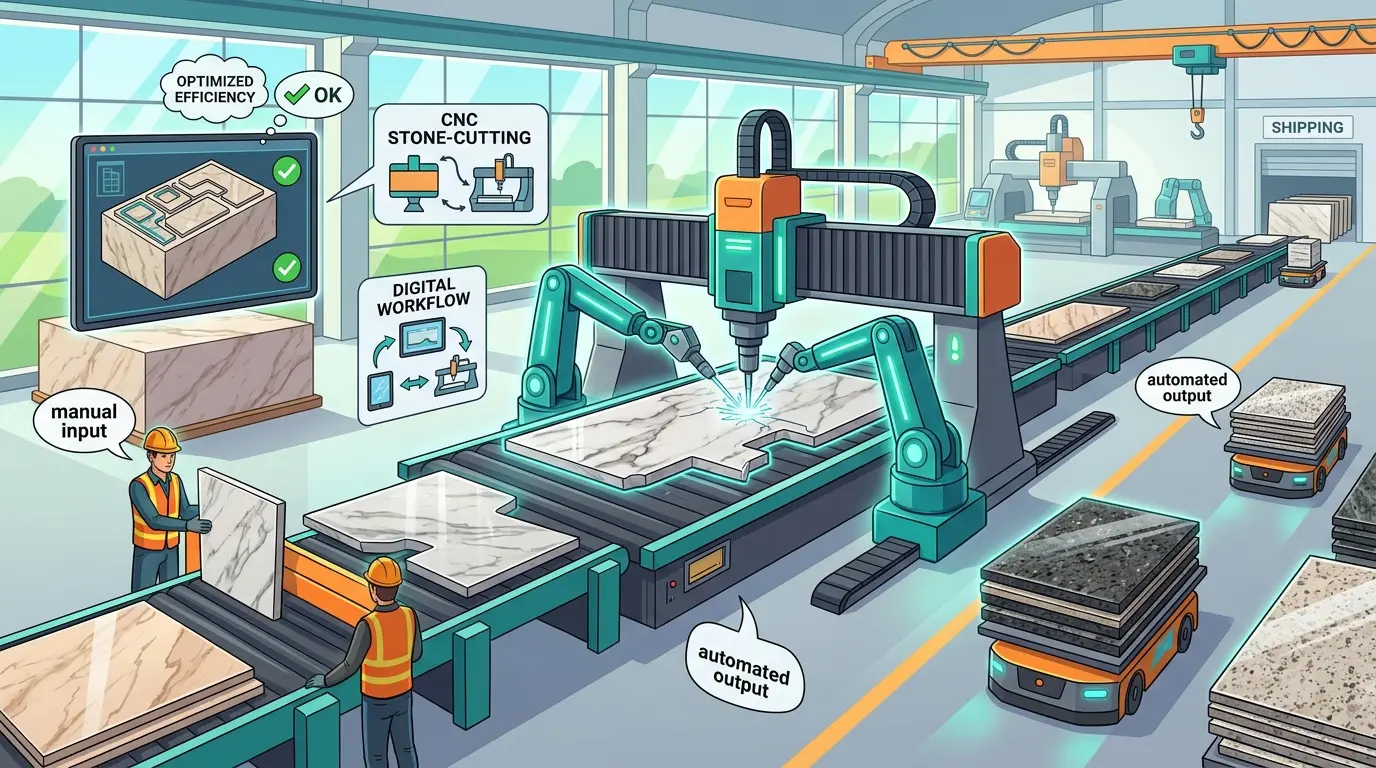
Automation in stone fabrication should be judged by total workflow impact, not only by what happens at the spindle. If machined parts leave the CNC area faster but then wait for polishing, inspection, packaging, or installation prep, the business has not solved the throughput problem. It has only moved it.
That is why scaling decisions should look at the full sequence:
- How Quickly Jobs Are Prepared Before Machining
- How Material Is Staged And Presented To The Cell
- How Finished Parts Move To Edge Finishing, Polishing, Or Quality Control
- How Exceptions, Remakes, And Urgent Jobs Interrupt Scheduled Flow
- How Well The Shop Balances Complex Work Against Repetitive Work
The more consistent the machining output becomes, the more visible the next bottleneck will be. That is a good sign if the shop is ready for it. It is a problem if the CNC cell is expected to compensate for weak production planning.
When Stone CNC Automation Makes The Most Sense
Stone CNC automation is commonly a strong fit when the shop is no longer limited by stone demand, but by how consistently it can machine similar features, profiles, and part geometries across growing job volume.
It is often well suited to fabricators dealing with some combination of the following:
- More Repeat Work In Quartz, Marble, Or Granite Fabrication
- Pressure To Shorten Lead Times Without Expanding Rework At The Same Rate
- Frequent Edge Or Opening Variability That Slows Finishing And Installation
- Higher Value Jobs That Require Better Repeatability On Complex Shapes
- A Need To Scale Beyond Individual Operator Technique
It is less transformative when production is highly irregular, digital job preparation is weak, or the shop has not yet identified which operations are truly limiting output. In those cases, the better move may be to tighten process discipline first so automation is applied where it can compound.
Practical Summary
Stone CNC automation helps scale production when it turns repeated machining work into a more controlled, reusable, and repeatable process. The most valuable gains usually show up in more consistent openings, cleaner profile repetition, lower rework, and a machining stage that is easier to manage as crews, shifts, and order volume increase.
The important tradeoff is that automation does not scale production by itself. It scales best when job preparation, tooling discipline, part flow, and downstream finishing are strong enough to keep pace. In that environment, CNC automation becomes more than a machine upgrade. It becomes a practical way to grow stone fabrication capacity without letting variation grow with it.