In panel processing, a surprising amount of edge quality is decided before anyone touches feed settings or cutting optimization. Shops often blame the saw when they see chipping, fuzzy edges, breakout, or short blade life, but the first question should usually be simpler: is the blade matched to the board you are actually cutting?
That matters because MDF, particle board, and plywood do not behave the same way under a panel saw. They differ in density, internal structure, surface layers, resin content, and how visibly they show edge damage. Good blade selection helps produce cleaner cuts, reduces rework, and creates a more stable front end for downstream processes such as edge finishing and assembly.
Why Blade Selection Matters In Panel Processing
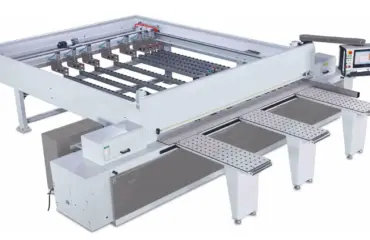
A panel saw is designed to deliver repeatable sizing in furniture and cabinet production, but repeatability alone does not guarantee a cut edge that fits the rest of the workflow. The blade has to suit both the substrate and the finish expectation.
In practical terms, the wrong blade choice can lead to problems such as:
- Chipped decorative faces
- Fuzzy or swollen-looking MDF edges
- Crumbling particle board corners
- Tear-out on plywood veneers
- Excessive heat buildup and shorter tool life
- More touch-up before edgebanders or manual finishing
The right blade does not solve every cutting problem on its own, but it gives the machine a much better chance of producing stable, usable parts at production speed.
Start With The Real Decision, Not The Blade Label
Many shops start blade selection by asking which blade is best for “wood panels.” That is too broad to be useful. A better starting point is to define four things clearly:
- The Core Material: MDF, particle board, or plywood.
- The Surface Condition: Raw board, melamine-faced board, veneer-faced board, or laminated panel.
- The Priority: Long tool life, cleaner finish, faster throughput, or fewer defects on visible faces.
- The Downstream Requirement: Whether the edge will be concealed, edge banded, painted, machined again, or left visible.
Once those are clear, blade selection becomes much more practical.
What MDF Usually Demands From A Blade
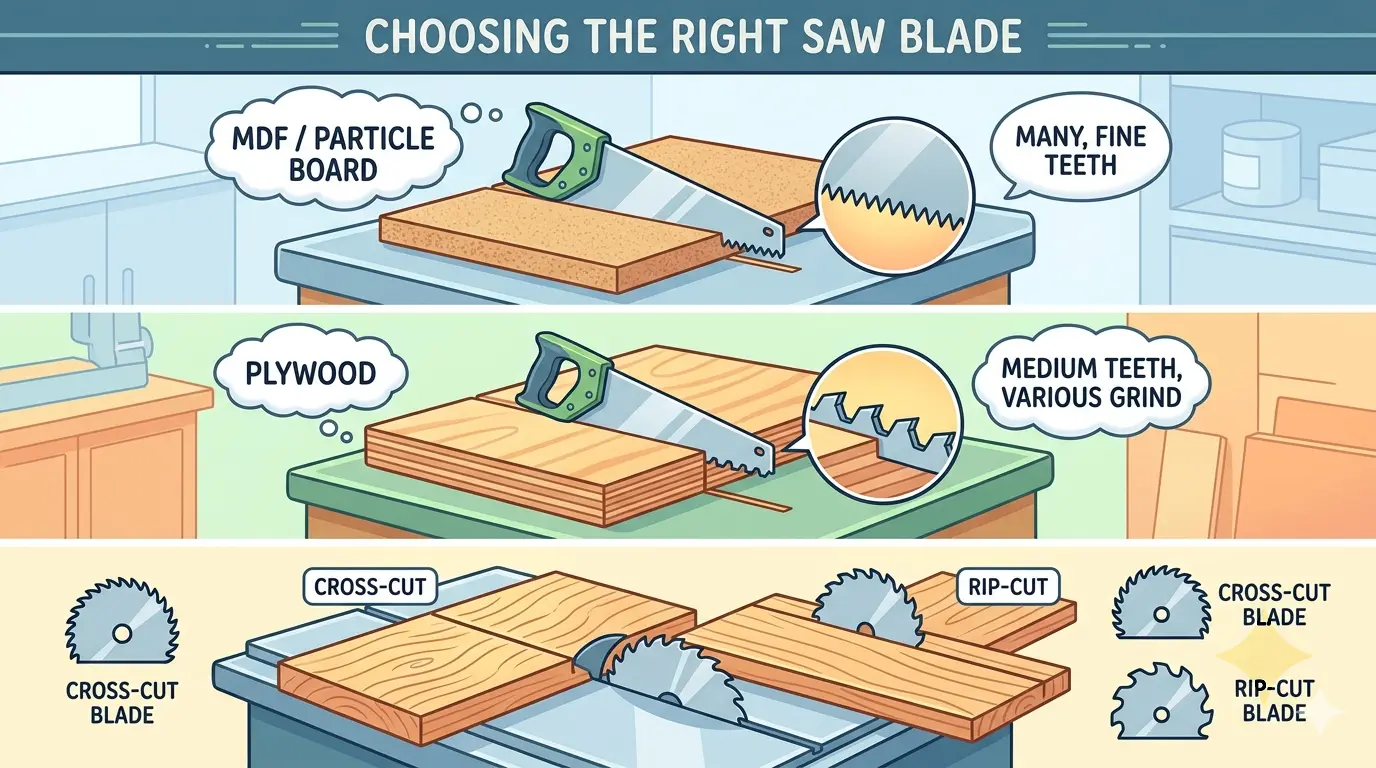
MDF cuts consistently in one sense because it has no grain direction, but it is still demanding. Its fine fiber structure and resin content can be abrasive, and the edge quality is very visible when the blade is not sharp or the tooth geometry is poorly matched.
For MDF, shops usually want a blade that supports:
- Smooth, compact edges rather than torn fibers
- Stable cutting without excess heat
- Good surface quality when parts will be painted or edge finished
- Reasonable wear resistance in higher-volume cutting
In workflow terms, MDF often rewards a cleaner-cutting blade strategy over a purely aggressive one. If the blade leaves a rough edge, the problem does not stay at the saw. It tends to show up later as extra sanding, poorer paint preparation, or slower finishing.
This is especially important in production lines built around panel saws, where the point of the machine is not only to size parts quickly, but to deliver consistent parts into the next operation.
What Particle Board Usually Demands From A Blade
Particle board is less uniform than MDF at the cut edge. The core can be more fragile, corners are easier to damage, and laminated faces can chip if the blade is not suited to the finish requirement.
Blade selection for particle board is usually less about brute cutting power and more about controlling edge breakdown. Shops commonly need:
- Better support for brittle surface layers
- Cleaner top and bottom faces on laminated boards
- Reduced corner breakout during part handling
- A cutting edge that stays sharp enough to avoid crumbling the core
When the board is melamine-faced or otherwise laminated, the finish requirement becomes stricter. A blade that is acceptable on raw particle board may still produce unacceptable face damage on decorative material. In those cases, the saw setup, scoring arrangement, and blade condition matter just as much as the base blade category.
What Plywood Usually Demands From A Blade
Plywood creates a different challenge because the blade is cutting across alternating veneer layers rather than a uniform engineered core. Even when sizing accuracy is good, the visible problem is often veneer tear-out, especially on entry or exit faces.
For plywood, blade selection usually needs to support:
- Cleaner cutting across veneer layers
- Better control of splintering on visible faces
- Stable edge quality on thinner outer plies
- Acceptable finish quality without slowing production excessively
Plywood also forces a more honest tradeoff discussion. A blade chosen for the cleanest possible veneer finish may not deliver the same productivity or life as a blade chosen for more general panel work. If the shop cuts both furniture-grade plywood and everyday board materials on the same saw, a single compromise blade may be workable, but it is rarely optimal for every job.
One Blade Strategy Rarely Fits All Three Materials
This is where many shops lose efficiency. They try to standardize around one blade setup for convenience, then spend time correcting defects that differ by board type.
The practical problem is that each material tends to reward a different balance of finish quality, edge support, aggressiveness, and wear resistance.
| Material | Main Cutting Risk | What The Blade Needs To Prioritize | Common Workflow Goal |
|---|---|---|---|
| MDF | Fuzzy edges, heat buildup, accelerated wear | Clean edge formation and stable cutting over time | Better paint prep, cleaner edge finishing, less rework |
| Particle Board | Edge crumble, chipped decorative faces, weak corners | Controlled cutting and better support for brittle surfaces | Fewer rejects before edge banding and assembly |
| Plywood | Veneer tear-out and splintering | Cleaner cross-layer cutting and visible-face protection | Better part appearance and less manual touch-up |
That does not always mean a shop needs three completely separate blade programs. It does mean the decision should be deliberate. If one blade is expected to cover all materials, management should be clear about which compromise it is accepting.
Blade Features That Matter More Than Marketing Terms
Different suppliers describe blades in different ways, but in production terms, several factors usually matter more than broad promotional language:
- Tooth Geometry: This affects how aggressively the blade enters the panel and how cleanly it leaves the cut.
- Tooth Count Balance: More teeth can help improve finish quality, while fewer teeth may favor faster stock removal and different cutting behavior.
- Carbide Quality And Edge Retention: Abrasive boards can punish weak cutting edges quickly.
- Plate Stability: A stable blade body helps support repeatable, cleaner cutting in production.
- Surface Finish Requirement: Decorative-faced boards often need a different cutting strategy than raw cores.
- Compatibility With Scoring Setup: In laminated panels, the scoring arrangement is often part of the edge-quality solution, not an optional detail.
The important point is that blade selection should be based on the cut result the line needs, not only on what sounds durable or versatile in a catalog description.
When The Problem Is Not Only The Blade
Blade selection is critical, but it should not be treated as a standalone fix for every cut-quality issue. If a shop is seeing poor results across multiple materials, the root cause may include:
- A dull blade being pushed too long for cost reasons
- Inconsistent scoring setup on laminated panels
- Poor material support or handling during cutting
- Feed conditions that do not match the blade and board combination
- Misalignment that shows up as chipping, rubbing, or unstable edge quality
This matters because the same symptom can come from different causes. For example, a chipped plywood face may point to blade mismatch, but it may also indicate that the setup is no longer holding the cut as cleanly as it should.
How To Build A More Practical Blade Program
For most cabinet and furniture factories, the best approach is not to ask for the “best” blade in isolation. It is to build a blade strategy around the boards that actually dominate production.
A practical selection process usually looks like this:
- Separate Raw And Decorative-Faced Materials: Surface-finish expectations change the blade requirement immediately.
- Identify The Highest-Volume Board Type: Standardize first around what the saw cuts most often.
- Flag The Most Defect-Sensitive Jobs: Veneered plywood and laminated particle board often deserve more attention than concealed internal parts.
- Compare Rework Cost Against Blade Cost: A cheaper blade is not cheaper if it creates visible rejects or slows finishing.
- Review Blade Life By Material Family: MDF wear patterns are not the same as plywood finish issues.
- Decide Where Compromise Is Acceptable: Convenience may justify one general-purpose setup, but only if the finish outcome remains commercially acceptable.
This kind of blade program helps the cutting department support the full production line rather than operating as a separate island.
A Simple Material-Based Decision Table
| If Your Priority Is… | MDF | Particle Board | Plywood |
|---|---|---|---|
| Cleaner Visible Edge Quality | Favor a cleaner-cutting setup with strong edge retention | Focus on face protection and reduced core breakdown | Prioritize veneer protection and splinter control |
| Longer Blade Life In Repeated Cutting | Favor wear resistance without letting the edge quality drift too far | Watch for dullness before corners begin to crumble | Balance tool life against the finish requirement of visible veneers |
| One Blade For Mixed Daily Production | Accept that MDF finish and plywood appearance may both involve compromise | Check decorative faces carefully before standardizing | Use only if visible veneer quality remains acceptable |
| Better Downstream Flow | Reduce fuzzy edges before painting or finishing | Reduce defects before edge banding and assembly | Reduce manual touch-up on exposed parts |
Practical Summary
Panel saw blade selection for MDF, particle board, and plywood is really a cut-quality and workflow decision. MDF usually pushes the shop toward clean edge formation and wear control. Particle board puts more pressure on face protection and edge integrity, especially on laminated panels. Plywood demands closer attention to veneer tear-out and visible-finish quality.
The most efficient factories usually do not treat these materials as interchangeable just because they are all sheet goods. They match the blade strategy to the board structure, the surface requirement, and the downstream process. That approach helps the saw produce cleaner parts, lowers rework, and keeps the rest of the production line moving more predictably.