Panel processing often determines whether a furniture or cabinet factory runs in a controlled rhythm or spends the day correcting avoidable variation. If raw sheets are cut slowly, arrive downstream out of square, or require repeated manual checking, the cost does not stop at the saw. It carries into edge quality, drilling accuracy, sorting, and final assembly.
That is why a panel saw should be evaluated as part of a production workflow, not as a standalone cutting machine. Different panel saw types suit different operating models, from space-conscious workshops to high-throughput batch lines. The right choice depends on part geometry, production volume, floor layout, labor model, and how the saw supports the rest of the process.
What a Panel Saw Is Really Meant to Do
A panel saw is primarily used to size sheet material into accurate, repeatable parts. In woodworking and panel furniture production, that usually means materials such as MDF, particleboard, melamine-faced board, plywood, and similar panel stock.
The practical value is not just that the machine can cut panels. It is that it can help standardize the front end of production. That matters most when cut parts need to move cleanly into edgebanders and other downstream operations without dimension-related delays, re-cuts, or avoidable handling confusion.
For many buyers, the better question is not “Can this machine cut sheet goods?” It is “What kind of panel-cutting workflow are we trying to build?”
Main Types of Panel Saws
In industrial discussions, the term panel saw can cover more than one machine layout or automation level. The main categories below are the most useful starting point when comparing production fit.
| Type | Common Production Fit | Main Strength | Main Tradeoff |
|---|---|---|---|
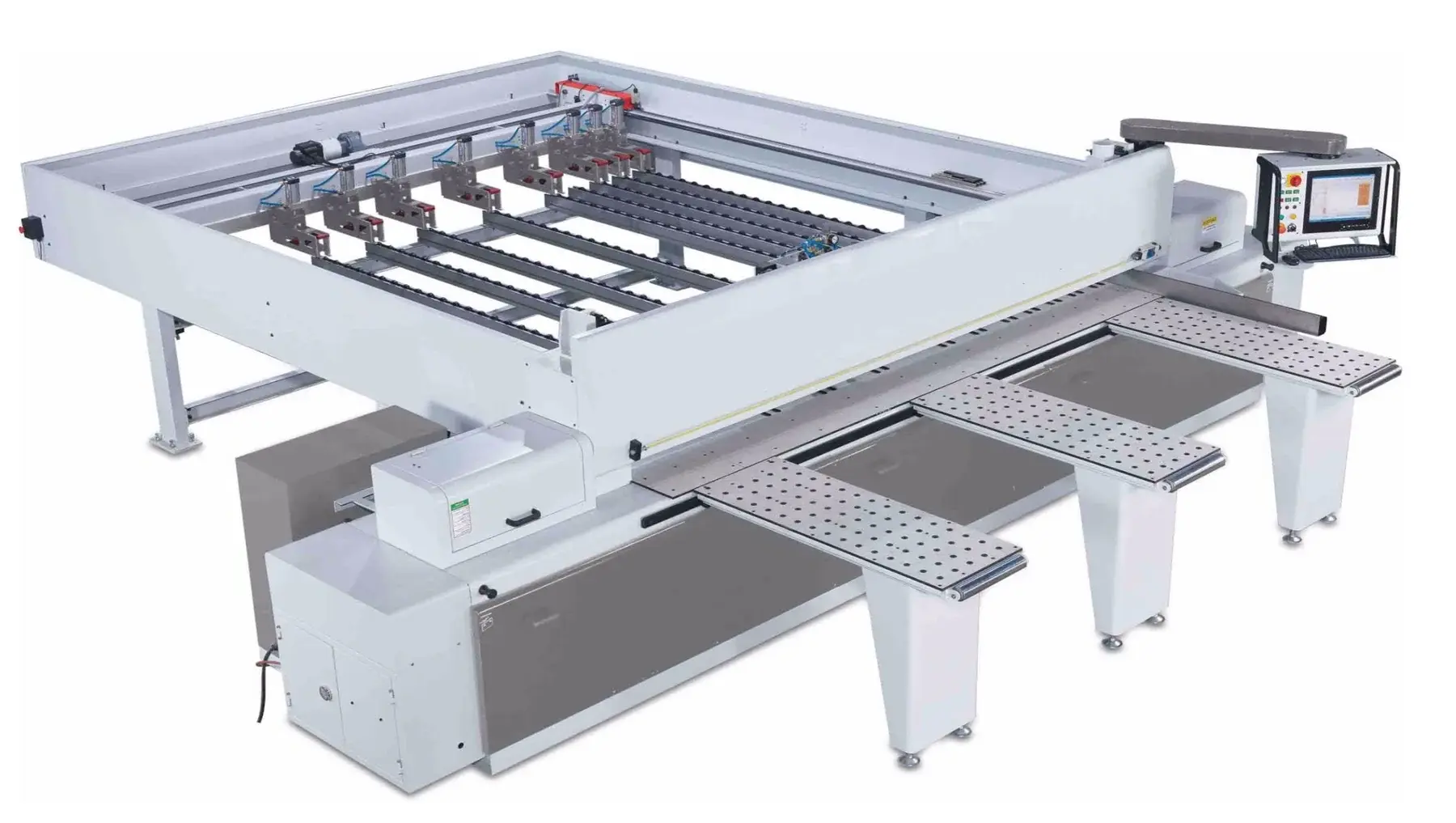
| Horizontal Beam Saw | High-volume rectangular panel sizing in furniture and cabinet production | Strong throughput and repeatability for batch work | Less flexible for irregular shapes or frequent one-off cutting |
| Vertical Panel Saw | Space-constrained workshops and lighter-duty sheet breakdown | Compact footprint and practical sheet handling in some layouts | Usually not the first choice for high-output factory panel lines |
| Operator-Guided Panel Saw Setup | Smaller shops or mixed work where manual control still matters | Flexible operation and lower process complexity | More dependent on operator technique and generally slower on repeated jobs |
| CNC-Controlled Panel Saw System | Structured production with repeated cut programs and organized material flow | Better consistency, repeatability, and process control | Delivers the most value only when the workflow is repetitive enough to justify it |
In many furniture factories, the most common buying decision centers on the horizontal beam saw side of the category. That is where dedicated panel saws are commonly used to support repeatable batch cutting and more stable front-end throughput.
Where Different Panel Saw Types Fit Best
Not every shop needs the same panel saw configuration. Application fit usually comes down to what kind of parts are being produced, how repeatable the work is, and how much throughput pressure exists at the cutting stage.
| Application | Best-Fit Panel Saw Type | Why It Fits |
|---|---|---|
| Batch Cabinet Carcass Production | Horizontal Beam Saw | Repeated rectangular parts benefit from stable sizing and faster panel breakdown |
| Wardrobe and Modular Furniture Work | Horizontal CNC Panel Saw | Standardized part families reward repeatability and organized batch flow |
| Small Workshop With Limited Floor Space | Vertical Panel Saw | A more compact format can make sense when layout is the main constraint |
| Mixed Low-Volume Sheet Cutting | Operator-Guided Panel Saw Setup | Flexibility can matter more than pure front-end throughput |
| Centralized Cut-to-Size Department | CNC-Controlled Beam Saw | Structured job processing supports cleaner handoff into downstream departments |
The important point is that one type is not universally better than another. The right machine is the one that solves the specific production problem in front of the shop.
Panel Saws vs. Sliding Table Saws vs. CNC Nesting
Buyers often evaluate panel saws alongside other cutting solutions. That comparison matters because the wrong machine is often purchased when a shop confuses throughput needs with flexibility needs.
| Machine Type | Best Fit | Main Advantage | Main Limitation |
|---|---|---|---|
| Panel Saw | Repeated rectangular parts in organized batch production | High repeatability and stronger output for sheet breakdown | Less suitable for irregular part geometry or highly varied one-off work |
| Sliding Table Saws | Custom shops, mixed material work, and flexible low-volume cutting | Greater operator control and practical flexibility | More operator-dependent and slower for repeated batch sizing |
| CNC Nesting Machines | Customized furniture, nested parts, and workflows combining cutting with routing or drilling | Integrates multiple processes in one cell | May be more machine than necessary when the core need is only fast rectangular panel sizing |
This comparison is where many buying decisions become clearer. If the production bottleneck is repeated sheet breakdown, a panel saw often becomes the stronger choice. If the business depends on mixed jobs, shaped parts, or integrated routing and drilling, another machine type may align better with the real workflow.
Buying Factors That Matter More Than Headline Claims
The strongest panel saw purchase decisions usually come from workflow analysis, not from the longest feature list. Before buying, evaluate the factors below against the way the factory actually works.
| Buying Factor | What to Evaluate | Why It Matters |
|---|---|---|
| Product Mix | Whether most parts are rectangular and repeated or highly variable | Determines whether a dedicated panel saw will actually be used to its strengths |
| Sheet-Goods Volume | How central panel processing is to daily output | Helps show whether cutting speed and repeatability are major business drivers |
| Throughput Requirement | Whether cutting is slowing the rest of the line | Prevents underbuying when front-end flow is the real constraint |
| Repeatability Expectation | How costly size variation is in downstream operations | Directly affects rework, sorting, drilling alignment, and assembly fit |
| Floor Layout and Material Handling | How sheets enter the cell and how cut parts leave it | Good machines still perform badly in weak layouts |
| Labor Model | How much the process depends on individual operator skill | Helps determine the value of greater automation and program-based consistency |
| Changeover Pattern | Whether jobs repeat predictably or change constantly | Clarifies whether a highly structured cutting cell will help or frustrate production |
| Future Production Direction | Whether the business is moving toward batch standardization or deeper customization | Prevents buying only for current jobs instead of the next stage of growth |
| Digital Job Control | How cut lists, labels, and production instructions are managed | Matters when production control is as important as cutting itself |
| Service and Stability Expectations | What level of uptime discipline the factory needs | A production machine has value only when it remains dependable in routine use |
These factors usually reveal more than isolated claims about speed or automation. A saw that looks impressive on paper can still be the wrong fit if it does not match material flow, job structure, or downstream process needs.
Signs a Panel Saw Is the Right Investment
The case for a panel saw becomes stronger when several of the conditions below are already true:
- Most daily output comes from sheet-based rectangular parts.
- Cutting variation is creating avoidable rework downstream.
- The shop wants more stable front-end throughput, not just more cutting capacity.
- Operators spend too much time repeating the same panel-sizing work.
- Production is moving toward modular, batch, or standardized furniture output.
- Management wants a cleaner cutting cell that supports planning and part flow more reliably.
When those signs are present, the machine is solving a workflow problem rather than simply adding another asset to the floor.
When Another Solution May Be Better
A panel saw is not automatically the best answer in every wood-processing environment.
Another option may be more suitable when:
- The shop mostly produces one-off custom work.
- Irregular or nested parts make up a large share of output.
- Solid-wood processing matters more than panel breakdown.
- Floor space strongly favors a smaller or different cutting format.
- The real bottleneck sits in edge finishing, drilling, or assembly rather than at the saw.
In those cases, a sliding table saw, a nesting workflow, or a different production upgrade may create better overall results. The key is to identify the real source of lost time and inconsistency before committing to any machine category.
Practical Summary
Panel saws make the most sense when a factory needs repeated, accurate sheet breakdown that supports cleaner downstream flow. Their real value is not only faster cutting, but more predictable cutting. That predictability helps stabilize batch production, reduce operator-dependent variation, and make later processes easier to manage.
The right type depends on the production environment. Horizontal beam saws usually fit higher-output rectangular part processing. Vertical formats can make sense where space is tighter. More manual or operator-guided approaches still have value where flexibility matters more than throughput. The better buying decision comes from matching the saw to the workflow, not from assuming every panel saw solves the same problem.