Textile and soft-material manufacturers rarely struggle because no process can cut the shape at all. The real bottleneck is usually elsewhere: frequent pattern changes, frayed edges, inconsistent low-ply accuracy, slow setup between jobs, or too much manual correction after cutting.
That is why a fabric laser cutting machine should be evaluated as a workflow tool, not just as a cutting technology. In the right environment, laser can improve digital repeatability, simplify short-run changeovers, and help control edge behavior on suitable materials. In the wrong environment, it can introduce heat-related defects, limit stack efficiency, and shift the problem downstream into sewing, bonding, or final finishing.
Why Soft Material Workflows Need A Different Selection Lens
Soft materials behave differently from rigid sheet goods. They can stretch, shift, compress, fray, curl, or react visibly to heat. A process that looks clean during a machine demo may still create trouble later if the cut edge hardens, discolors, or becomes harder to sew, laminate, fold, or assemble.
For most buyers, the real decision comes down to which production pressure matters most:
- Frequent Design Changes Across Many SKUs
- Consistent Geometry On Low-Ply Or Single-Ply Parts
- Less Fraying On Suitable Synthetic Materials
- Better Handling Of Small Internal Features And Tight Curves
- Lower Unit Cost On Long, Stable Production Runs
- Cleaner Results On Heat-Sensitive Or Appearance-Critical Fabrics
Laser usually becomes easier to justify when digital flexibility and contour precision matter more than high-ply throughput. If the workflow depends on tall stacks and long, repetitive runs, another process may fit better even if laser performs well on a sample part.
Where Fabric Laser Cutting Usually Creates The Most Value
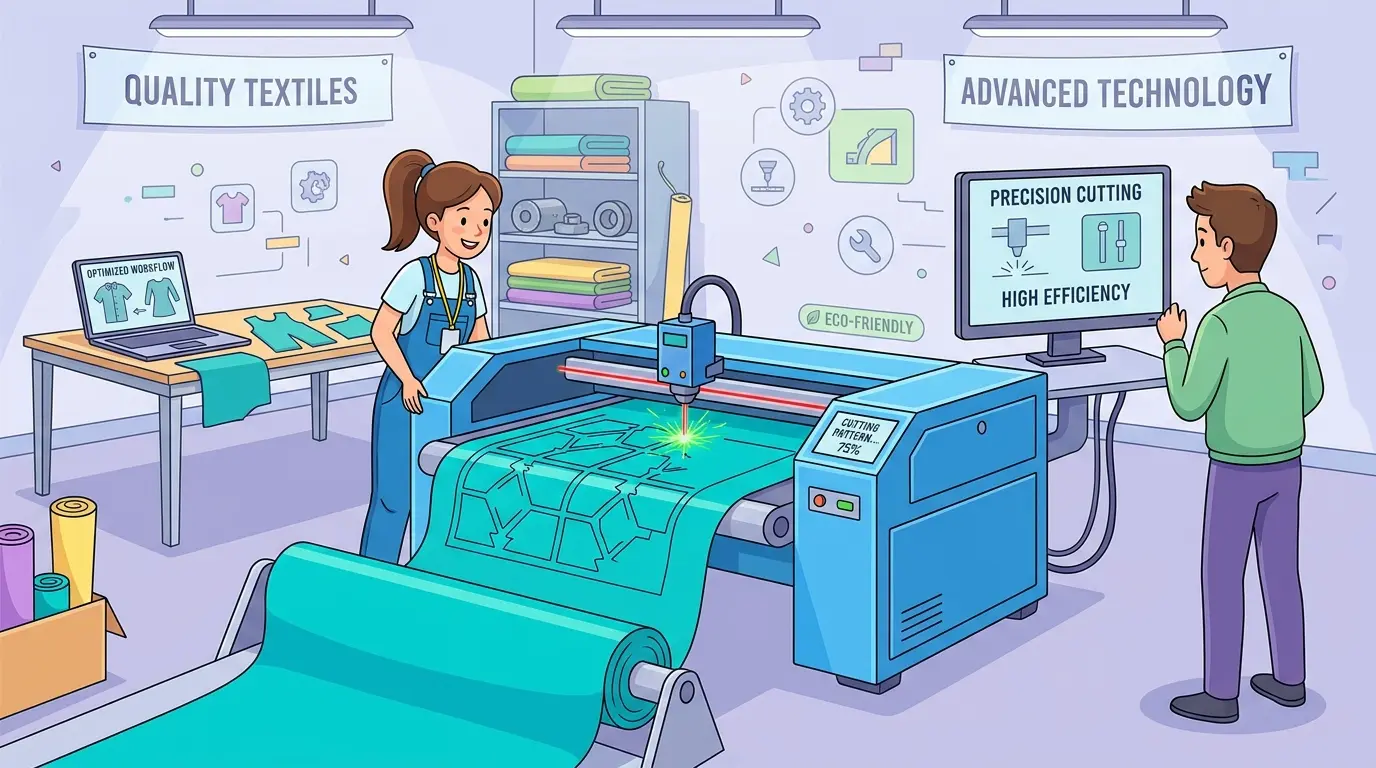
Laser cutting is commonly strongest in high-mix, lower-stack workflows where the geometry changes often and setup speed matters almost as much as cut quality.
That typically includes short-run production, custom shapes, detailed contours, and operations that want to move directly from a digital file to the cut path without dedicated tooling. In those situations, laser can reduce the friction between design revision and output. That is valuable when product variants change frequently or when the cutting department supports multiple downstream teams.
Soft-material workflows that often benefit from laser evaluation include synthetic textiles, felt-based parts, leather substitutes, thin foams, labels, decorative inserts, technical textile components, and laminated soft goods where edge control and repeatability matter. The benefit is not that laser is universally better. The benefit is that it can improve a few specific workflow outcomes:
- Faster Changeovers Between Different Part Files
- Cleaner Repetition Of Small Curves, Slots, And Internal Features
- Reduced Tooling Dependence For Short Or Variable Runs
- More Predictable Part Geometry Across Repeated Orders
- Reduced Fraying On Materials That Respond Well To Thermal Cutting
Factories already comparing broader laser cutters and engravers for non-metallic processing should still treat textile and soft-material validation as a separate step, because soft substrates do not respond as uniformly as acrylic, wood, or other more dimensionally stable materials.
Where Knife Or Die Cutting Still Wins
Laser is not the default answer for every soft-material operation. In many factories, knife cutting or die cutting remains the more practical first choice.
If the production model depends on thick lays, stacked plies, or long repetitive runs of the same shape, laser may not deliver the strongest economics. The problem is not that laser cannot cut the part. The problem is that workflow cost may still favor another method once throughput, stacking, and operator time are considered.
Heat sensitivity is the other major limit. Some natural fibers, delicate woven materials, and appearance-critical fabrics may darken, stiffen, shrink back, or develop an edge feel that is unacceptable in the finished product. The same caution applies to certain coated, adhesive-backed, or laminated materials where each layer responds differently.
Laser is also weaker when the workflow requires a very soft untreated edge, minimal thermal influence, or reliable cutting of thicker compressible stacks. In those cases, an oscillating knife system or a dedicated die process may produce better downstream behavior even if the laser edge initially looks precise.
Laser Vs Knife Vs Die Cutting At A Glance
| Process | Best Workflow Fit | Main Workflow Benefit | Main Tradeoff |
|---|---|---|---|
| Laser Cutting | High-mix, low-ply textile and soft-material work with frequent design changes | Fast digital changeovers, detailed contours, and potential edge stabilization on suitable synthetics | Heat effect, extraction demands, and weaker fit for tall stacks |
| Oscillating Knife Cutting | Heat-sensitive fabrics, thicker soft materials, and applications that need a softer cut edge | No thermal zone and broader tolerance across delicate materials | More fraying on some textiles and less advantage for very fine internal details |
| Die Cutting | Long runs of stable part geometry | Low unit cost at volume and fast repetitive output once tooling is set | Tooling lead time, reduced flexibility, and higher friction when designs change often |
This comparison matters because the real choice is usually between workflow models, not just machine types. A buyer who only compares cut-edge appearance can miss the bigger production question.
Material Validation Matters More Than General Machine Claims
Textiles and soft materials should never be treated as one broad category. Material response often determines the process decision more than the machine concept itself.
Synthetic fabrics and blends are commonly evaluated for laser because controlled heat can sometimes help reduce fraying and stabilize the cut edge. That can improve handling in downstream sewing or assembly, but only if the resulting edge appearance and feel still match the product standard.
Natural-fiber materials usually need more caution. Cotton-rich fabrics, wool, linen, and other heat-sensitive constructions may show discoloration, edge brittleness, or surface change that makes laser less attractive.
Coated and laminated soft materials need the most disciplined testing. A top layer may cut cleanly while an adhesive layer, foam backing, coating, or reinforcement layer reacts poorly. In those cases, one clean sample is not enough. Buyers need to test the full construction under realistic production conditions.
During sample validation, buyers should check:
- Edge Appearance After Cutting
- Edge Feel During Handling
- Dimensional Repeatability After Cooling And Sorting
- Fray Behavior After Downstream Processing
- Odor, Residue, And Extraction Cleanliness
- Performance During Sewing, Bonding, Lamination, Or Assembly
If the material passes those checks, laser becomes much easier to defend. If it fails even one of them in a critical application, the apparent cutting advantage can disappear quickly.
Workflow Questions Buyers Should Answer Before Comparing Suppliers
Before evaluating machine options, a factory should define the real production problem it wants to solve.
Ask:
- How Often Do Part Files Or Patterns Change?
- Are Most Jobs Single-Ply, Low-Ply, Or High-Stack?
- Is The Cut Edge Visible In The Final Product?
- Are The Main Materials Synthetic, Natural, Coated, Laminated, Or Mixed?
- Does The Next Process Involve Sewing, Bonding, Lamination, Folding, Or Manual Assembly?
- Is The Business Case Driven By Flexibility, Edge Quality, Labor Reduction, Or Unit Cost?
- Will Extraction, Material Trials, And Process Validation Be Managed As Part Of The Investment Rather Than As An Afterthought?
These questions usually clarify whether the buyer needs more digital flexibility, a gentler cutting process, or a higher-volume dedicated method. They also prevent the common mistake of buying around a technology trend instead of around the actual order mix.
What A Good Buying Trial Looks Like
A strong evaluation process should use the factory’s real material mix and real part files, not only generic demonstration samples.
That means testing common orders, not just the easiest substrate. It means checking what happens after the cut, not only at the cut line itself. It also means measuring total workflow impact: file setup time, nesting efficiency, sorting effort, part consistency, edge quality, downstream handling, and how much operator intervention remains.
For soft-material buyers, a good trial usually includes several part geometries rather than one. Simple outlines, small-radius details, internal cutouts, and parts with narrow bridges often reveal differences faster than basic rectangular samples. If multiple materials are part of the same business, each one should be treated as its own validation case.
The best buying process also compares laser against the real alternative, not an imaginary one. If the current workflow relies on knife cutting or die cutting, the comparison should look at total throughput, rework, edge behavior, setup burden, and flexibility across the actual production mix.
Practical Summary
A fabric laser cutting machine is usually the right fit when textile and soft-material workflows depend on digital flexibility, contour precision, and consistent low-ply output more than on maximum stack height or the lowest possible cost on long repetitive runs.
It is often strongest in synthetic or mixed soft-material applications where frequent pattern changes, fine detail, and edge stability matter. It is often weaker where heat sensitivity, thick lays, or soft untreated edges are the priority.
For most buyers, the right question is not whether laser can cut the material. It is whether laser improves the full production path, from file revision to downstream handling, without creating new problems in edge quality, material response, or shop-floor efficiency.