Buyers usually arrive at this comparison when they want a premium textured finish without locking the line into the wrong process. The problem is that the phrase “laser embossing machine” can blur two very different outcomes. Traditional embossing physically raises or depresses the substrate with tooling. Laser processing usually creates an embossed look through surface removal, texture, contrast, or shallow relief rather than true formed height.
For factories evaluating laser cutters and engravers for wood, acrylic, and similar non-metallic materials, that distinction matters more than the label. The real buying decision is whether the product needs true tactile embossing, or whether an emboss-like visual effect is enough to meet the finish standard without adding unnecessary tooling cost, lead time, or changeover friction.
Start With the Finished Part, Not the Process Name
This comparison becomes much clearer when buyers start with the customer requirement instead of the machine category. If the part must feel physically raised, hold a clean pressed contour, or repeat the same tactile form at high volume, traditional embossing has an inherent structural advantage. If the part mainly needs visual depth, decorative texture, branded graphics, or frequent artwork changes, a laser-based workflow may be commercially more attractive.
That is why the phrase “laser embossing” should be handled carefully. In many shops, it is market shorthand for engraving, texturing, or relief-style surface processing, not proof that the machine is performing the same physical operation as a die-based embossing line.
What Traditional Embossing Actually Delivers
Traditional embossing changes the substrate by pressure. A matched die or formed tooling set compresses and reshapes the material to create raised or recessed geometry. That makes it well suited to applications where the tactile profile itself is part of the product value, such as premium packaging, covers, labels, leather goods, decorative inserts, and other repeat formats where the same pattern runs for long periods.
From a workflow standpoint, traditional embossing is usually strongest when the design is stable, the run length is meaningful, and the operation can justify tooling preparation up front. Once the tooling is dialed in, the process can deliver consistent physical form with less dependence on repeated material removal.
What Buyers Usually Mean by Laser Embossing
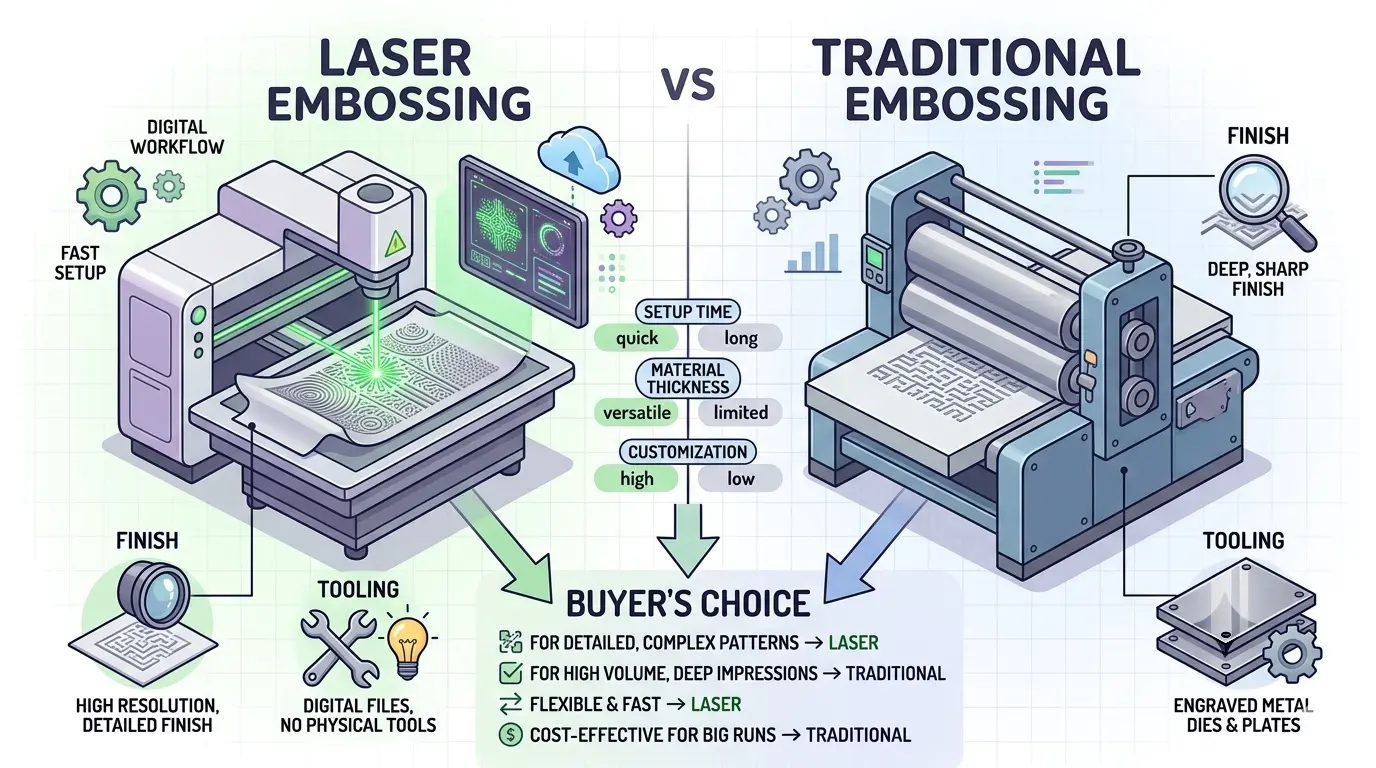
In most industrial discussions, laser embossing means creating an embossed appearance rather than a true mechanically formed emboss. The laser may remove material in controlled passes, create visible depth, change the surface texture, or build contrast that makes the part look more dimensional.
That can be useful in mixed-order production because the workflow is file-driven. There is no embossing die to remake every time artwork changes. The tradeoff is that when buyers ask for larger filled areas, deeper relief, or a stronger tactile effect, the job often becomes slower and more sensitive to residue, heat marking, and secondary cleanup.
Side-by-Side Comparison for Industrial Buyers
| Decision Factor | Laser Embossing Workflow | Traditional Embossing Workflow | What Buyers Should Watch |
|---|---|---|---|
| Surface Result | Usually textured, engraved, or relief-like surface detail | True raised or recessed physical form | If tactile height is mandatory, traditional embossing has the clearer fit |
| Tooling Requirement | File-driven with no embossing die | Requires prepared tooling or dies | Frequent design changes usually favor laser |
| Changeover Speed | Faster artwork changes and easier short-run switching | Slower when new tooling must be introduced | Mixed-SKU production changes the economics quickly |
| Best Production Pattern | Short runs, prototypes, custom orders, variable designs | Stable long runs with repeated graphics or patterns | Run structure matters as much as machine cost |
| Broad-Area Relief Work | Can become time-heavy because material is removed in passes | Often more efficient once the tooling is ready | Large decorative coverage can hurt laser throughput |
| Material Response | Commonly discussed for wood, acrylic, and similar non-metallic surfaces | Common across paper, paperboard, leather, and formed decorative work | The material should be tested under real production conditions |
| Downstream Labor | May require brushing, cleaning, or finish correction | May require setup precision, but less heat-related cleanup | Hidden labor can change the ROI picture |
| Scalability | Strong for flexible production with frequent revisions | Strong for repeated, standardized output at volume | Buyers should compare workflow stability, not only sample quality |
Where Laser Workflows Usually Make More Sense
Laser-based embossed-effect processing is often the better commercial choice when the factory is trying to reduce tooling friction rather than maximize formed relief. That is commonly true in workflows such as:
- Short-Run Decorative Panels Or Branded Surface Parts
- Custom Orders With Frequent Artwork Changes
- Prototype Development Before Committing To Tooling
- Mixed-SKU Programs Where Separate Dies Would Multiply Complexity
- Production Queues Where Fast File Changes Matter More Than True Raised Geometry
In these cases, the workflow benefit is not just “no tooling.” It is easier order variation, faster approvals, less die inventory, and less delay when the design changes between jobs. For buyers working on decorative wood, acrylic, or similar non-metallic parts, that flexibility can outweigh the fact that the result is usually not a true embossed form.
Where Traditional Embossing Still Has the Stronger Case
Traditional embossing usually keeps the advantage when the raised or recessed structure is the point of the product rather than just the appearance. Buyers should stay cautious about replacing it with a laser workflow when the job depends on:
- A Clear Physical Raised Feel
- Stable Long-Run Output With Repeated Artwork
- Consistent Tactile Premium Packaging Effects
- Broad Coverage Areas Where Repeated Laser Passes Would Slow Production
- Production Economics That Improve Once Tooling Cost Is Amortized
This is the point where many comparisons go wrong. The laser option may look more flexible in a sample conversation, but if the customer is paying for formed tactile relief at scale, traditional embossing is still doing something materially different.
Cost, Changeovers, and Production Planning
The cost discussion should not stop at equipment price or tooling price. Laser workflows often reduce launch friction because they remove die preparation from the first order. That makes them attractive for lower-volume, higher-variation work. But if the required effect depends on deeper removal or large filled patterns, machine time can rise quickly, and secondary finishing labor can eat into the apparent savings.
Traditional embossing shifts more cost to the front of the job through tooling, setup, and preparation. In return, it can become more efficient when the artwork stays fixed and the volume is high enough to spread that initial setup across many parts. For buyers, the practical question is not which process is cheaper in theory. It is which process fits the real order mix, finish standard, and scheduling pressure of the plant.
Questions Buyers Should Ask Before They Commit
Before selecting either process, buyers should pressure-test the workflow with a few direct questions:
- Does The Customer Need True Raised Geometry Or Only An Emboss-Like Visual Effect?
- How Often Will The Artwork Change Across Orders?
- Are The Typical Runs Short And Varied, Or Long And Stable?
- How Sensitive Is The Material To Heat Marks, Compression, Or Surface Distortion?
- Will The Process Add Secondary Cleaning, Brushing, Sanding, Or Finish Correction?
- Is The Factory Trying To Reduce Tooling Delay, Or Maximize Repeat Output At Scale?
Those answers usually reveal the better process faster than the machine label does.
Practical Summary
Laser embossing and traditional embossing should not be treated as direct substitutes by default. Traditional embossing creates true physical form through pressure and remains strong where tactile raised or recessed geometry is central to the product. Laser-based embossed effects are usually better understood as a flexible, file-driven surface-detail workflow that can create dimensional appearance without embossing dies, especially on wood, acrylic, and similar non-metallic materials.
For buyers, the safest selection logic is simple. If the job depends on frequent design changes, shorter runs, and decorative depth without tooling delay, a laser workflow can be a practical fit. If the job depends on repeatable tactile relief, stable artwork, and long-run efficiency, traditional embossing still has the stronger case. The right answer comes from the production requirement, not from whichever process name sounds more advanced.