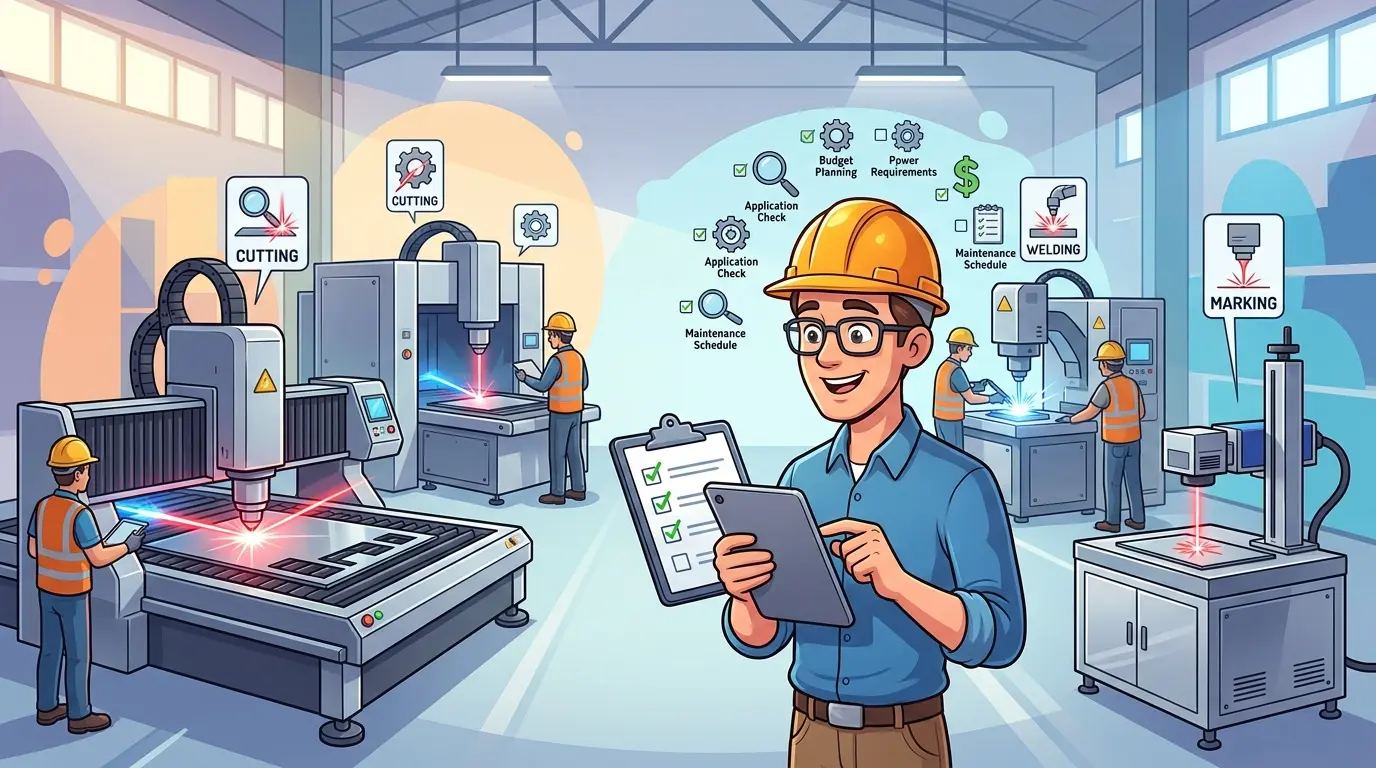
Most first-time laser purchases go wrong before the machine ever ships. The common failure is not choosing the “wrong brand” in the abstract. It is buying a system without clearly defining the material mix, the real daily workload, the acceptable finish standard, and the installed scope needed to make the machine productive.
For first-time buyers, the right laser system is the one that matches the actual job, fits the site, and reaches stable output without constant operator improvisation. That is why an industrial laser checklist should be built around workflow fit, not just wattage, table size, or headline price.
Start With The Job, Not The Machine Label
Before comparing quotations, define what the machine will do in normal production rather than what it might do in rare peak scenarios.
| Checklist Item | Why It Matters | What First-Time Buyers Should Clarify |
|---|---|---|
| Main Materials | The laser source and machine layout must match the real substrate family | Whether the work is mostly metal, mostly non-metal, or a split workflow |
| Primary Process | Cutting, engraving, and marking do not stress the system in the same way | Whether output value comes from cutting speed, engraving detail, marking permanence, or a mix |
| Largest Routine Part Size | Table size and handling method depend on the parts run every week, not once a year | Whether the largest part is a daily requirement or an occasional exception |
| Daily Runtime and Batch Pattern | Throughput expectations affect how conservative the machine choice should be | Whether the plant runs short custom batches, repeated part families, or long production runs |
| Quality Standard | Edge quality, marking contrast, and surface cleanliness drive machine fit | What defects are unacceptable in shipped parts |
| Future Expansion | Overbuying is expensive, but underbuying can create an immediate bottleneck | Which growth scenario is realistic within the next one to two years |
This stage matters because the same phrase, “industrial laser machinery,” can describe very different production roles. A buyer cutting acrylic display parts is solving a different problem from a buyer marking serialized metal components or processing sheet metal parts at scale.
Match The Laser Type To The Material Family
One of the fastest ways to waste budget is to start with power and skip process matching. In real production, source type usually matters before fine-grain specification comparisons.
| Laser Type | Commonly Used For | Workflow Strength | First-Time Buyer Caution |
|---|---|---|---|
| CO2 | Wood, acrylic, paper, leather, fabrics, and many other non-metallic materials | Good fit for mixed cutting and engraving on non-metal workflows | Do not assume broad non-metal capability automatically covers metal jobs |
| Fiber | Many metal cutting and metal marking workflows | Strong productivity in the right metal-focused setup | Material type, thickness range, and finish expectations must be defined early or the budget can drift fast |
| UV | Fine, lower-heat marking on some sensitive materials and small-detail applications | Useful where heat input control matters more than raw cutting output | It should not be treated as a universal substitute for general-purpose cutting systems |
The practical question is not, “Which source is strongest?” It is, “Which source matches at least 80 percent of the jobs we expect to run every week?” For buyers focused on wood, acrylic, and similar non-metallic production, evaluating laser cutters and engravers in that narrower workflow context usually produces a much clearer buying decision.
Decide Whether You Need Cutting, Engraving, Marking, Or A Combined Workflow
First-time buyers often try to make one machine cover every future use case. Sometimes that works. Often it creates a compromise system that is never ideal for the highest-value job in the plant.
One machine is often enough when:
- The Daily Workload Is Moderate Rather Than Fully Scheduled Across Multiple Shifts
- The Parts Move Through Similar Setup Logic From Job To Job
- Floor Space Is Limited And Changeovers Are Manageable
- The Business Needs Versatility More Than Maximum Single-Process Output
Separate systems often make more sense when:
- Cutting And Engraving Demand Different Runtime Priorities
- A Marking Workflow Must Run Independently Of Cutting Jobs
- One Process Has Tight Delivery Pressure While The Other Is More Intermittent
- A Mixed Workflow Would Create Too Many Compromises In Job Setup Or Scheduling
This is the point where buyers need to be honest about production discipline. If the machine will be judged on fast turnaround, repeatability, and minimal queue conflicts, a “do everything” machine may not be the safest first purchase.
Normalize The Quote Into Comparable Buckets
Many first-time buyers compare quotes that are not actually quoting the same scope. One supplier prices the core machine only. Another includes extraction, startup, and training. A third includes accessories that the first two left out entirely.
| Quote Section | Why It Changes The Real Cost | What To Verify |
|---|---|---|
| Core Machine Configuration | Defines the base process fit and capability level | Whether the quoted machine is sized for your actual material mix and runtime expectations |
| Working Area and Table Setup | Affects part handling, loading method, and layout efficiency | Whether the quoted bed size matches routine jobs rather than one-off extremes |
| Extraction and Fume Control | Directly affects cleanliness, operator environment, and part quality | Whether extraction equipment and ducting assumptions are included or external |
| Cooling and Thermal Control | Influences output stability during longer runs | What cooling equipment is included and what site utilities are required |
| Software and Controller Scope | Changes changeover time, repeat-job consistency, and operator dependence | What file-preparation logic is expected and what software is actually supplied |
| Fixtures, Rotary, or Special Options | Expands or limits the usable job range | Which accessories are essential on day one and which can wait |
| Installation and Commissioning | Determines how quickly the system becomes productive | Who owns startup, calibration, and final sign-off |
| Training | Reduces avoidable setup error and material waste | How much operator and maintenance training is included |
| Spare Parts and Wear Items | Shapes downtime risk after handover | Which parts should be stocked from the start |
| Warranty and Service Terms | Defines how much operating risk remains with the buyer | Support method, exclusions, and expected response path |
Price ranking only becomes useful after the scope has been normalized. A quote that looks cheaper can become more expensive once extraction, commissioning, and operator training are added back into the comparison.
Review Space, Utilities, And Safety Before The Purchase Order
Factory-fit problems are among the most avoidable buying mistakes. A machine that technically fits the process can still become a poor purchase if the site was not reviewed with enough discipline.
First-time buyers should confirm:
- Power Requirements And Electrical Preparation
- Cooling Arrangement And Ambient Operating Constraints
- Exhaust Routing And Fume Control Responsibilities
- Loading, Unloading, And Maintenance Access Clearance
- Material Storage, Dust, And Scrap Handling Around The Cell
- Operator Safety Procedures, Emergency Stops, And Fire Response Logic
If the laser purchase is part of a wider workflow redesign rather than a standalone machine decision, it can also help to review the broader Pandaxis product catalog alongside upstream material preparation and downstream finishing steps. A laser cell that looks correct by itself can still become a bottleneck if the surrounding process is not ready.
Ask For Proof On Your Exact Parts, Not Generic Samples
Generic sample boards rarely tell a buyer what will happen on real jobs. First-time buyers should ask suppliers to discuss the application in terms of actual materials, actual geometry, and actual finish standards.
Useful proof questions include:
- Can The Supplier Review Your Exact Material Family And Thickness Range?
- Can They Discuss Small Details, Tight Corners, Edge Cleanliness, Or Mark Contrast In A Way That Matches Your Parts?
- Can They Explain What Secondary Cleanup May Still Be Required?
- Can They Separate Estimated Throughput From Best-Case Demonstration Output?
- Can They Show How Job Recipes Or Parameters Will Be Recalled For Repeat Production?
The goal is not to trap a supplier. It is to replace vague capability language with production-level evidence. A first-time buyer should leave the quoting process with a clear idea of what an acceptable part looks like, what cycle stability is realistic, and where post-processing may still be needed.
Define Startup, Training, And Acceptance Criteria In Writing
The buying process should end with an acceptance checklist, not just a delivery date. That checklist protects both the buyer and the supplier because it turns subjective expectations into observable outcomes.
At minimum, first-time buyers should define:
- The Materials And Example Parts That Will Be Used For Acceptance Testing.
- The Quality Standard For Edges, Surface Presentation, Or Mark Readability.
- The Basic Runtime Demonstration Expected After Installation.
- The Operator Tasks That Must Be Covered In Training.
- The Recipe, File, Or Job-Recovery Process Needed For Repeat Work.
- The Spare Parts, Service Contacts, And Escalation Path Required At Handover.
This is especially important when the plant has never run industrial laser equipment before. Without written acceptance logic, first-time buyers often discover too late that the supplier and the production team were evaluating success by different standards.
Build A Decision Sequence Before You Compare Prices
For first-time buyers, the safest purchase process is usually:
- Define The Real Job Mix.
- Match The Laser Type To The Material Family.
- Decide Whether One Machine Or Multiple Dedicated Workflows Make More Sense.
- Normalize Installed Scope Across Quotes.
- Review Site Readiness, Safety, And Utility Requirements.
- Verify Part Quality Expectations And Startup Support.
- Rank Price Only After The First Six Checks Are Clear.
That order keeps the buying discussion tied to production reality. It also prevents a common mistake: choosing a machine because the quote looks efficient, then discovering that the process assumptions were incomplete.
Practical Summary
An industrial laser machinery checklist for first-time buyers should protect the plant from mismatch, not just help it collect quotations. The most important questions are usually straightforward: what materials will run most often, what process creates the most value, what quality standard must be met, what utilities and safety controls are needed, and what installed scope is required to reach stable output.
When those answers are clear, first-time buyers can compare laser options with far less confusion. They can choose a system that supports real throughput, repeatability, and finish quality instead of buying on headline power or price alone. That is the difference between purchasing a machine and launching a dependable production cell.