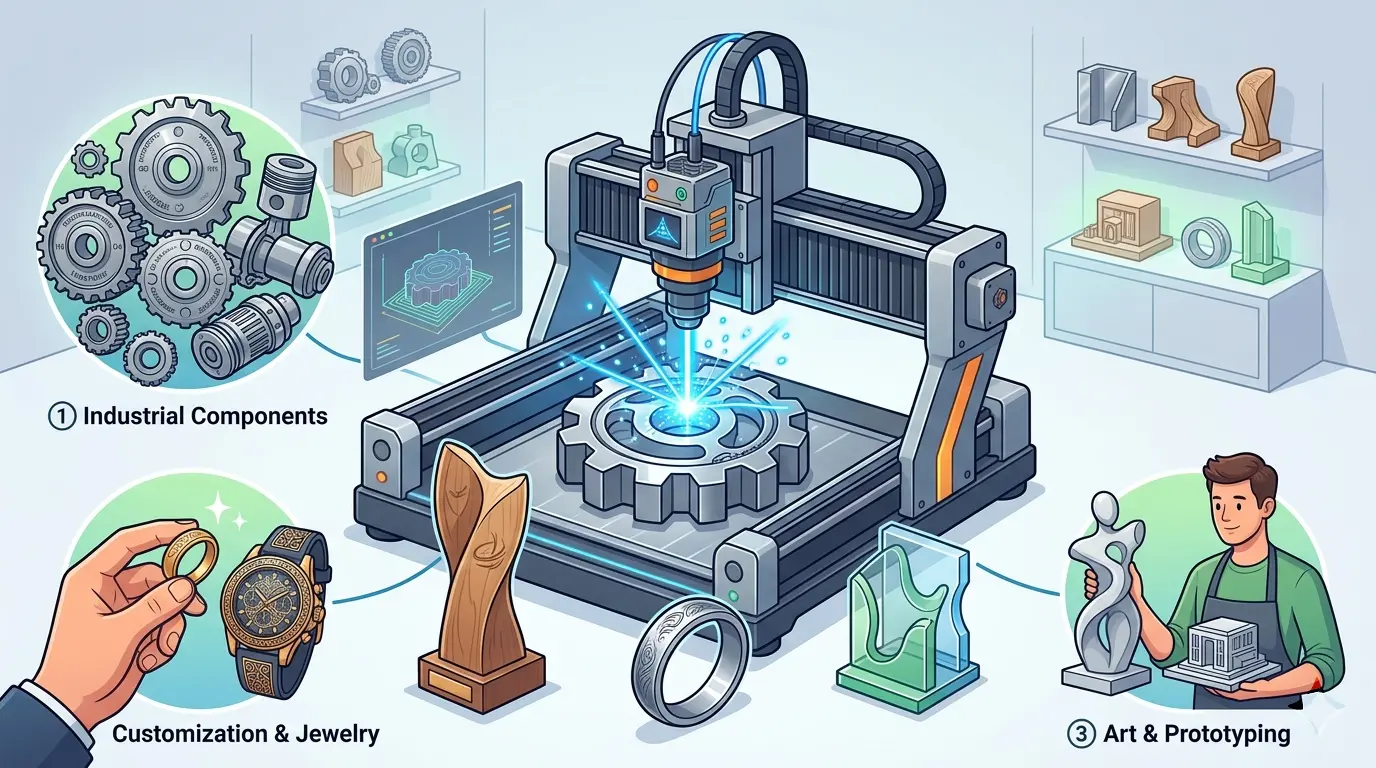
Many buyers first look at a 3D laser engraving machine after a standard flat engraving workflow starts to break down. The parts may no longer be flat. The product may need engraving on a curved face. A decorative panel may need a layered relief effect instead of a simple surface mark. Or the shop may be trying to combine visual detail with a more premium finished look without adding another fully separate process.
That is where the buying question gets more complicated than the name suggests. “3D laser engraving” can describe very different jobs, and those jobs do not place the same demands on the machine. For buyers evaluating laser cutters and engravers for wood, acrylic, and similar non-metallic materials, the important question is not whether a machine can produce a dramatic sample. It is whether the process stays repeatable, commercially usable, and efficient on the actual parts moving through production.
Start by Defining What “3D Laser Engraving” Really Means
In industrial buying conversations, the term often gets used for three different situations:
| Interpretation | What the Shop Is Usually Trying To Do | What Actually Matters Most |
|---|---|---|
| Layered Relief Engraving on a Flat Part | Create depth, texture, or a carved look on a panel or plaque | Depth control, cycle time, surface cleanup, and visual consistency |
| Engraving on a Curved or Cylindrical Surface | Mark or decorate a round, tapered, or partially shaped part | Part rotation, focus stability, fixturing, and repeat positioning |
| Engraving Across an Uneven 3D Form | Follow a contoured surface instead of treating the job like a flat sheet | Surface mapping, height variation tolerance, and the practical limit of focus control |
Those differences matter because a machine that handles cylindrical parts well does not automatically solve free-form surface engraving. A machine that produces attractive shallow relief on wood panels does not automatically replace deeper mechanical carving. And a system that works on one clean sample part may still struggle when height variation, material inconsistency, and batch handling enter the workflow.
Before comparing suppliers or machine formats, buyers should define the exact part family first:
- Is the goal decorative depth on flat panels?
- Are the parts mainly cylindrical or rotationally symmetrical?
- Do the parts have irregular height changes that must be followed during engraving?
- Is the work mostly one-off custom output or repeated production batches?
- Does the process need surface decoration only, or also cutting and shaping in the same cell?
Without those answers, the term “3D laser engraving machine” stays too vague to support a good capital-equipment decision.
Where 3D Laser Engraving Commonly Fits Best
3D laser engraving is usually strongest where visual detail, controlled shallow depth, or shaped-surface decoration adds product value without requiring heavy stock removal.
| Application Area | Why Laser Can Be a Good Fit | What Buyers Should Watch Closely |
|---|---|---|
| Decorative Wood Panels | Supports layered artwork, logos, textures, and relief-style visual effects | Wood grain variation, smoke residue, and longer cycle time on deeper patterns |
| Acrylic Signage and Display Parts | Enables fine surface detail and controlled decorative effects | Heat sensitivity, edge haze, and visibility of even minor surface defects |
| Branded Cylindrical Products | Works well when the job can be indexed or rotated consistently | Runout, part holding, and alignment between the graphic and the real part axis |
| Awards, Presentation Pieces, and Premium Packaging Components | Adds perceived value through layered detail and customized surface design | Throughput may be too slow if the order mix becomes heavily batch-oriented |
| Jigs, Fixtures, and Part Identification on Non-Metallic Components | Useful for readable markings, shallow recesses, and workflow labeling | If the mark must be extremely deep or highly permanent, another process may fit better |
| Architectural or Decorative Surface Panels | Helps create repeatable graphic textures across premium-facing parts | Bed flatness, panel handling, and consistency across larger engraved areas |
The common thread is that the laser is adding information, texture, or controlled shallow depth. That is different from a workflow where the main requirement is aggressive material removal, deep sculpting, or structural machining.
The Main Production Advantages Buyers Usually Want
When 3D laser engraving makes sense, the value is rarely just “the machine can engrave in three dimensions.” The value is usually tied to workflow outcomes.
First, it can reduce tool-contact risk on finished faces. Because the process is non-contact, the shop can add visual detail or branding without introducing cutting-force-related tool marks in the same way a mechanical process might.
Second, it can improve detail repeatability on the right materials. If the parts are held consistently and the surface behavior is predictable, the process can produce more uniform artwork, logos, and surface textures across repeated batches.
Third, it can simplify premium customization. Shops making high-mix decorative parts, branded components, or customer-specific panels often value a process that can switch artwork without the same physical tool change logic required by some mechanical methods.
Fourth, it can consolidate operations when the product family stays inside the laser’s practical range. If a part needs surface engraving plus contour cutting, one laser-based cell may be easier to manage than splitting that work across separate stations.
These benefits are real, but they only hold when the process window is well matched to the part geometry and material behavior. Once that match breaks, the limitations show up quickly.
Where the Limits Show Up Fast
The biggest mistake buyers make is assuming that “3D” means unlimited freedom in depth, geometry, and material type. In production, the constraints are much tighter.
Depth Is Usually the First Reality Check
Laser engraving can create visually convincing depth, but that does not mean it is efficient at deep material removal. As the recess gets deeper, cycle time usually rises, smoke management becomes more important, and the visual quality of the pocket can become harder to keep clean and even.
If the real job is deep carving, cavity creation, or substantial material removal, a router or another mechanical process may carry that workload more efficiently. A laser-based relief effect can look impressive, but the process is not automatically the best fit for sculptural depth.
Surface Following Has Practical Boundaries
Many buyers assume a 3D-capable setup can simply follow any complex shape. In reality, part geometry still matters. Smooth cylindrical parts are one thing. Irregular multi-plane parts, warped panels, or inconsistent molded shapes are another.
Once surface height changes become harder to predict, the process becomes more sensitive to focus stability, part setup, and repeat positioning. If the incoming parts are not controlled well, the engraving quality may shift from one batch to the next even when the same program is used.
Material Behavior Can Undo the Visual Result
Wood, plywood, MDF, acrylic, and similar substrates do not all react the same way under deeper or more decorative engraving patterns.
- Wood Grain Can Make Tone and Depth Look Uneven
- Glue Lines in Plywood Can Change the Visual Texture Unexpectedly
- MDF Can Increase Residue and Cleanup Burden
- Acrylic May Show Heat-Related Cosmetic Defects Faster Than Buyers Expect
This is why a strong-looking demonstration sample is not enough. Buyers need to see what happens when the exact production material is run repeatedly, not only once.
Throughput Can Become the Hidden Cost
A 3D engraving pattern that looks commercially valuable on one piece can still fail the business case if the cycle time is too long for the required order flow. Relief-style jobs, layered fills, and large engraved areas often consume more machine time than buyers initially expect.
That matters most in two situations:
- The Shop Has a Large Batch Requirement With Tight Delivery Windows
- The Same Machine Is Expected To Handle Both Decorative Work and Routine Cutting Jobs
In those cases, one attractive process can turn into a scheduling bottleneck if the laser cell becomes overloaded with long-cycle engraving work.
The Process Factors That Decide Whether a Machine Will Stay Usable
When buyers evaluate 3D laser engraving seriously, they should focus less on general advertising terms and more on the operating conditions that protect repeatable output.
| Factor | Why It Matters | What To Verify in Practice |
|---|---|---|
| Part Fixturing | Shaped and cylindrical work is only as repeatable as the setup method | Check whether the part can be loaded in the same position every time without operator guesswork |
| Focus Management | Small changes in height can soften detail or change engraving appearance | Review sample quality across different part zones, not only the easiest area |
| Surface Mapping or Height Compensation Logic | Helps when the part is not truly flat | Confirm the real tolerance range instead of assuming any uneven surface is acceptable |
| Rotary or Axis Coordination | Critical for cylindrical or rotational parts | Ask whether indexing stays consistent over repeated batches, not just one setup |
| Extraction and Airflow | Deeper or more decorative engraving increases smoke and residue sensitivity | Inspect surrounding surfaces and pocket cleanliness after the job, not just the central design |
| Recipe Control | Different materials and depths need stable repeat settings | Check how quickly operators can recall tested settings by part family |
| Bed and Work Envelope Fit | Large decorative parts can expose consistency problems across the usable area | Review samples from the full intended work size, not a reduced demo blank |
These factors directly affect rework, cleanup, and usable throughput. If they are weak, the machine may still produce a good sample but fail as a daily production asset.
When a Standard Flat Workflow Is Enough and When It Is Not
Not every job marketed as 3D actually requires a fully specialized 3D engraving setup.
If the parts are flat, and the objective is simply to create a layered or carved visual effect on wood or acrylic, a stable flat-bed workflow may already cover the need. In that case, the real buying focus should be consistency, airflow, material handling, and cycle time.
If the parts are cylindrical and standardized, the workflow may depend more on proper rotary handling than on broader free-form 3D capability.
If the parts are irregular, multi-level, or geometrically inconsistent, then the evaluation becomes more demanding. At that point, the buyer should stop thinking in generic terms and assess whether the laser is truly the right process, or whether another method belongs earlier in the manufacturing route.
This is also where it can help to review the broader Pandaxis machinery catalog instead of forcing one laser cell to solve every geometry problem. Some product families are better served by combining processes than by stretching one machine category beyond its efficient range.
A Practical Buying Filter for Industrial Users
Before treating 3D laser engraving as the answer, buyers should pressure-test the workflow with a few simple questions:
- Is the required depth decorative, or is it closer to real material removal?
- Are the parts flat, cylindrical, or irregularly contoured?
- Can the parts be fixtured repeatably without excessive setup time?
- Will the material show residue, haze, or inconsistent tone too easily?
- Is the order mix high-value and lower-volume, or batch-heavy and cycle-time sensitive?
- Does the process need engraving only, or engraving plus cutting in the same production cell?
- Would another machine category handle the deeper shaping work more efficiently?
Those answers usually reveal whether the buyer needs a refined laser workflow, a more specialized shaped-part engraving setup, or a different process altogether.
Practical Summary
3D laser engraving machines make the most sense when the production goal is controlled surface detail, decorative depth, or shaped-surface engraving on parts that can still be held and processed repeatably. They are commonly well suited to premium wood panels, acrylic display components, cylindrical branded products, and other non-metallic applications where visual finish matters as much as geometry.
Their limits appear when buyers expect too much depth, too much shape variation, or too much throughput from a process that is still sensitive to focus, fixturing, material behavior, and cycle time. In other words, the strongest buying decision is usually not about whether a machine can produce a striking sample. It is about whether the process remains stable, economical, and repeatable across the real production mix.