Many fabrication teams start this comparison at the quote stage, when the more important question should have been answered earlier: what does the shipped part need to look like when it leaves the cutting cell?
If your bottleneck is downstream grinding, hole cleanup, fit-up at assembly, or visible edge quality, a rough process match can quietly add labor to every job. If your priority is getting heavy conductive plate cut efficiently for general fabrication, paying for a cleaner process than the product requires can also be the wrong move. Laser cutting and plasma cutting both belong in industrial metal fabrication, but they do not solve the same production problem in the same way.
Start With The Finished Part, Not The Machine Label
When fabricators compare laser and plasma, they are usually not deciding between a good process and a bad one. They are deciding which tradeoff fits the job mix.
In broad industrial use:
- Laser Cutting Is Commonly Chosen When Edge Quality, Detail, And Downstream Fit Matter More
- Plasma Cutting Is Commonly Chosen When Heavy Plate Productivity And Lower Entry Cost Matter More
- Neither Process Is Universally Better Outside Its Real Use Case
That is why the first question should not be, “Which one cuts faster?” The first question should be, “What happens after cutting?”
If the part goes straight to bending, welding, coating, or assembly, cut quality can change labor time much more than buyers expect. If the part is a rough structural blank with acceptable secondary cleanup, the decision can lean in a different direction.
What Laser Cutting Usually Does Better
Laser cutting is commonly evaluated when the part geometry is more demanding and the factory wants a cleaner output from the cutting station itself.
That often includes:
- Smaller Holes, Slots, Tabs, And More Detailed Geometry
- Cleaner Edges With Less Secondary Cleanup On Suitable Jobs
- Better Fit For Assemblies Where Part Accuracy Affects Downstream Welding Or Fastening
- More Consistent Results When The Product Standard Includes Tight Cosmetic Or Functional Expectations
In practical terms, laser cutting often helps reduce grinding, rework, and manual correction when the product mix includes precision brackets, enclosures, tab-and-slot assemblies, decorative metal components, or parts that need to move through the shop with less intervention after cutting.
That does not mean laser is automatically the right answer for every metal fabricator. It means laser often earns its higher process standard when the business is paid for cleaner parts, better repeatability, and smoother downstream flow.
What Plasma Cutting Usually Does Better
Plasma cutting is commonly chosen when the workflow is less sensitive to fine detail and more focused on practical throughput, especially on conductive metals where edge cleanup is already expected in the process plan.
Plasma often makes sense when the workload includes:
- Heavier Plate Or Structural Parts Where Fine Feature Quality Is Not The Main Value Driver
- General Fabrication Blanks That Will Be Welded, Ground, Or Machined Later
- Workflows Where Lower Upfront Investment Matters More Than Premium Edge Finish
- Shops That Need A Practical Cutting Process For Broad Day-To-Day Fabrication Rather Than High-Detail Part Output
For many fabricators, plasma is not a compromise. It is simply the right tool when the job does not justify paying for finer cut quality at the cutting stage. If the part is going to be cleaned, beveled, machined, or heavily welded anyway, plasma can be the more sensible production choice.
Key Differences That Matter On The Shop Floor
| Decision Factor | Laser Cutter | Plasma Cutter | Why It Matters In Production |
|---|---|---|---|
| Edge Condition | Commonly chosen for cleaner edges and less post-cut finishing on suitable jobs | Commonly acceptable when the workflow already allows for more cleanup | Affects grinding time, operator touch time, and paint or weld prep |
| Fine Features | Usually better suited to smaller holes, tighter nests, and finer detail | Usually less attractive for detailed geometry when edge precision is critical | Determines whether the cutting station supports the drawing without rework |
| Heat-Affected Area | Often preferred when lower heat spread and cleaner fit-up matter | Commonly generates a wider thermal effect and rougher edge condition | Influences distortion risk, cleanup, and downstream assembly behavior |
| Thickness Bias | Often strongest where part quality and detail are high priorities | Often attractive where thicker conductive material and rugged part output matter more | Keeps process choice aligned with the actual material mix |
| Secondary Operations | Can reduce manual correction when the process is matched well to the job | Often assumes more grinding, hole cleanup, or edge prep | Changes the true cost per shipped part |
| Upfront Cost Logic | Commonly higher capital commitment justified by cleaner output and less downstream labor | Commonly lower entry cost when rougher cut condition is acceptable | Prevents buyers from comparing quotes without counting labor impact |
| Material Scope | Capability depends on laser source and setup; metal fabricators usually evaluate it for cleaner metal cutting | Limited to electrically conductive metals | Important for shops trying to use one cutting cell across very different material families |
The point of the table is not that one process wins every row. The point is that each row changes the economics of the entire workflow, not just the cutting pass.
The Cost Question Is Usually About The Whole Workflow
This is where many purchasing decisions go off track. Plasma can look like the cheaper answer if the comparison stops at machine price. Laser can look expensive if the quote is reviewed without asking what happens to every part after cutting.
The real comparison is closer to this:
- How Much Labor Is Added After The Cut?
- How Often Do Parts Need Edge Cleanup Or Hole Correction?
- Does Cut Quality Improve Fit-Up Enough To Save Time In Welding Or Assembly?
- Are You Paying For A Premium Process On Jobs That Do Not Reward It?
For example, a fabricator producing simple heavy blanks may not recover much value from a cleaner process if the next operation already includes grinding or machining. But a shop producing detailed sheet components can lose margin quickly when every nest creates manual cleanup before bending or welding.
That is why the cheaper quote is not always the cheaper part.
When Each Process Usually Fits Best
Laser cutting is commonly the better fit when:
- The Product Mix Includes Detailed Profiles, Slots, Tabs, Or Smaller Holes
- Edge Quality Has A Direct Effect On Customer Acceptance Or Assembly Speed
- The Shop Wants To Reduce Manual Cleanup Between Cutting And The Next Operation
- Quoted work depends on repeatable part quality rather than rough-cut throughput alone
Plasma cutting is commonly the better fit when:
- Parts Are More Structural Than Detail-Driven
- The Workflow Already Includes Grinding, Weld Prep, Or Machining After Cutting
- Material thickness and rugged day-to-day fabrication matter more than fine-feature quality
- The factory needs practical productivity without paying for a finish standard the part does not require
The right answer often becomes obvious once the top-selling parts are grouped by quality expectation rather than by material alone.
If Your Shop Also Processes Non-Metal Materials
Some factories use the word “laser” too broadly and accidentally collapse two separate buying decisions into one. Metal laser cutting versus plasma is one comparison. Non-metal laser processing is another.
If your operation also produces acrylic templates, wood fixtures, signs, display elements, or similar parts, that belongs to a different equipment discussion. In those cases, non-metal laser cutters and engravers are commonly evaluated for wood, acrylic, and related substrates rather than for the metal-fabrication tradeoffs discussed above.
Keeping those conversations separate helps prevent a factory from expecting one machine category to solve every cutting problem across the plant.
The Questions That Should Decide The Purchase
Before choosing between laser and plasma, a fabricator should be able to answer these questions clearly:
- What Percentage Of Revenue Comes From Precision Parts Versus Rough Structural Parts?
- How Much Post-Cut Grinding Or Cleanup Is Acceptable In The Current Workflow?
- Do Small Holes, Slot Quality, And Tight Nesting Matter To The Jobs You Quote Most Often?
- Are You Trying To Minimize Capital Cost, Or Minimize Total Labor Per Shipped Part?
- Which Parts Actually Cause Delays In Welding, Assembly, Or Finishing Today?
- Are You Buying For The Work You Run Now, Or For A Credible Shift In Product Mix?
Those answers usually do more to clarify the purchase than any generic feature checklist.
Practical Summary
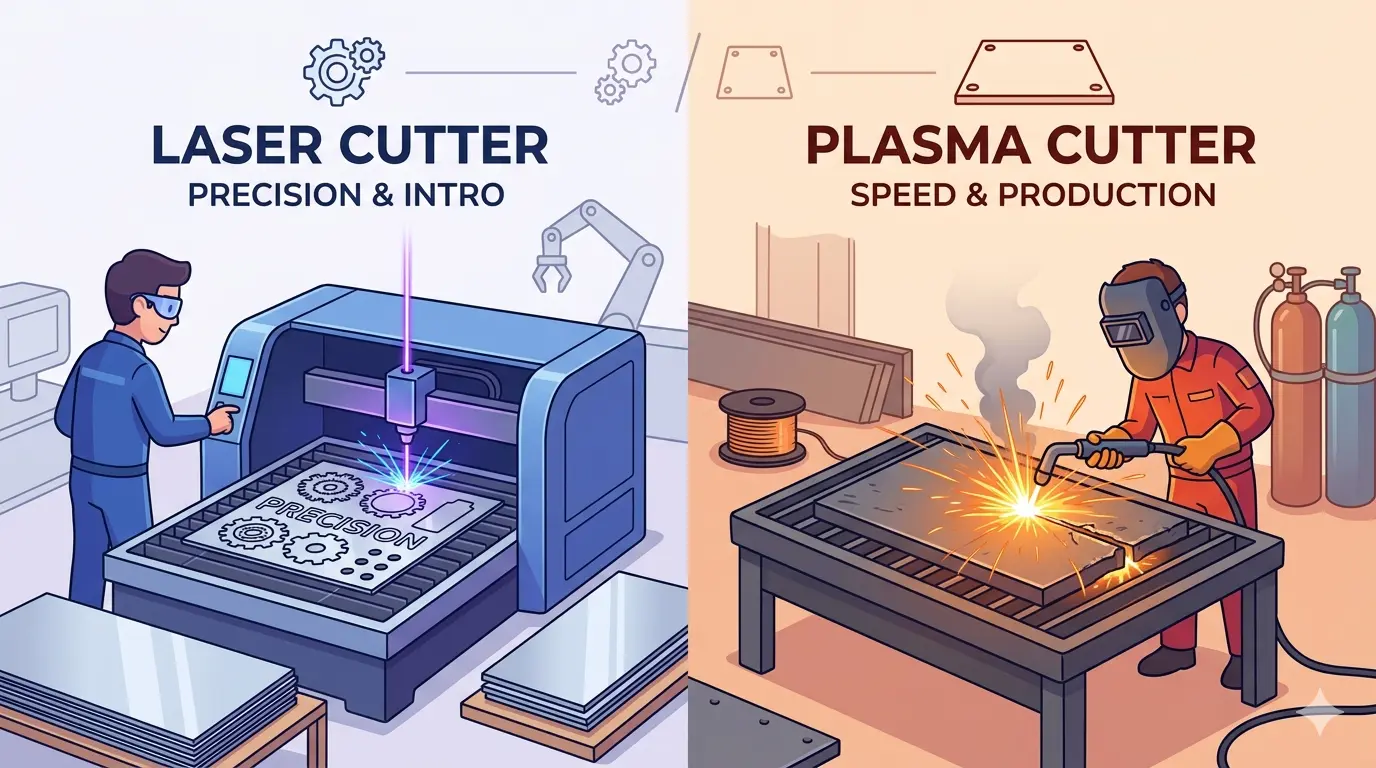
Laser cutter versus plasma cutter is not a simple precision-versus-speed slogan. It is a workflow decision.
Laser cutting is commonly the stronger fit when finer geometry, cleaner edges, and lower downstream correction help the shop ship better parts faster. Plasma cutting is commonly the stronger fit when rugged conductive-metal cutting, heavier work, and practical cost control matter more than premium edge condition.
The better process is the one that fits your real part mix, your acceptable cleanup level, and the production standard your customers are actually paying for. If your factory is planning multiple process lanes beyond this single comparison, a broader review of the Pandaxis product catalog can help separate metal fabrication needs from woodworking, panel processing, stone fabrication, and non-metal laser workflows without forcing one technology decision to carry the whole plant.