Buying a metal laser cutter is rarely just a question of cut quality. For most fabrication shops, the bigger issue is whether the machine can support the part mix, material flow, labor structure, and downstream processes that determine real production output. A machine that looks impressive in a short demonstration can still create problems if it slows job changeovers, struggles with mixed materials, or pushes too much cleanup into bending, welding, or assembly.
That is why fabricators should treat this purchase as a workflow decision first and an equipment decision second. The right machine should help the shop process metal parts more consistently, reduce unnecessary handling, and improve how parts move from raw sheet or tube into finished assemblies.
Start With The Real Work, Not The Sales Demo
One of the most common buying mistakes is judging a metal laser cutter by a polished sample part instead of by the shop’s actual order profile. A fabrication business should begin with its dominant production reality.
That usually means reviewing:
- The Metals The Shop Processes Most Often
- The Usual Thickness Range Across Daily Orders
- Whether The Work Is Mostly Sheet, Tube, Or A Mix Of Both
- How Often Jobs Change During A Shift
- Which Parts Require Tight Fit-Up For Bending, Welding, Or Assembly
- Where The Current Process Loses Time To Manual Handling Or Secondary Operations
Without that information, it is easy to buy around maximum capability claims instead of around the repeat workload that will actually determine return on investment.
Which Type Of Metal Laser Cutter Fits Your Shop
Not every fabricator needs the same machine format. Some shops mainly process flat sheet. Others rely heavily on tube and structural profiles. Some need both, but not necessarily in equal volume.
| Machine Type | Best Fit | Main Strength | Main Tradeoff |
|---|---|---|---|
| Flat Sheet Laser Cutter | Shops focused on sheet-metal blanks, panels, brackets, enclosures, and plate parts | Strong fit for nested sheet production and downstream forming workflows | Does not solve tube or profile processing on its own |
| Tube Laser Cutter | Shops cutting round tube, square tube, rectangular tube, and profile sections | Improves feature cutting and profile preparation before welding or assembly | Limited value if tube work is only occasional |
| Sheet-And-Tube Combo System | Mixed fabrication environments handling both flat parts and profile parts | Broader capability inside one investment decision | Can involve compromise if one side of the workload dominates heavily |
| Higher-Automation Laser Cell | Shops with steady volume, labor constraints, or frequent repeat production | Better supports material flow, loading, unloading, and throughput stability | Adds cost and complexity if the shop is highly variable or low volume |
This matters because the right machine format is often more important than the most aggressive performance headline. A fabricator running mainly nested sheet parts should not buy around profile capability that rarely gets used. A shop built around welded tube assemblies should not evaluate a flat-sheet platform as if it solves the entire production bottleneck.
Why Most Metal Fabricators Focus On Fiber Laser Systems
In modern metal fabrication, fiber laser systems are usually the center of the buying conversation. That is because they are well suited to high-speed metal cutting, efficient processing of common fabrication materials, and production environments that value cleaner workflow integration.
That does not mean every machine comparison should stop at source type alone. The source matters, but the complete machine package matters more. Motion stability, cutting-head control, assist-gas strategy, software usability, and material-handling design all influence whether the machine performs well on actual jobs.
For many buyers, the useful question is not simply whether the machine is a fiber laser. The better question is whether the total system supports the shop’s real work without creating hidden cost in rework, operator dependence, or unstable output.
The Buying Factors That Matter Most
Fabricators usually get better results when they compare machines through a structured production lens.
| Buying Factor | Why It Matters | What To Check |
|---|---|---|
| Material Mix | Different metals place different demands on cut stability, edge condition, and process setup | Review the metals that dominate real orders, not just one demo material |
| Dominant Thickness Range | The machine should match the thickness range that drives daily work | Avoid buying mainly for occasional heavy jobs if most work falls elsewhere |
| Part Geometry | Small holes, sharp corners, dense nesting, and visible edges expose weak process control quickly | Test parts that resemble real production complexity |
| Throughput Stability | High headline speed means little if parts still back up elsewhere | Look at total flow from loading to unloading, not cut speed alone |
| Automation Level | Labor shortages and repeated orders can make automation valuable | Match automation to actual production rhythm rather than prestige |
| Software And Nesting | Programming quality affects material yield, repeatability, and job switching | Evaluate ease of setup, remnant use, and repeat-job handling |
| Maintenance Practicality | Stable output depends on routine care and consistent machine condition | Ask what daily and weekly discipline is required to protect cut quality |
| Service And Training | Laser downtime becomes expensive quickly in a busy fabrication shop | Verify training scope, support response, and consumables availability |
This comparison framework helps prevent the buying process from collapsing into a one-dimensional discussion about power alone.
Power Should Match The Dominant Thickness Range
Many buyers start by asking how much power they need. That is an understandable question, but it often becomes too abstract. The better approach is to ask what thickness range actually dominates the order book and what part quality standard must be maintained inside that range.
If most jobs are thin to medium sheet with repeated nested parts, the machine should be judged on how consistently it handles that workload, not on whether it can occasionally process much heavier material. If thicker plate work is a regular revenue driver, then higher power becomes more central to the investment case.
The mistake is buying for rare maximum demand while underestimating the daily cost of overbuying. A machine selected mainly for exceptional jobs can create unnecessary capital cost if the real business depends on more common fabrication work.
Material Mix Changes The Decision More Than Many Buyers Expect
Fabricators sometimes talk about metal cutting as if all common materials create the same machine demands. In practice, material mix can change how buyers should evaluate edge quality, process stability, assist gas use, and downstream finishing expectations.
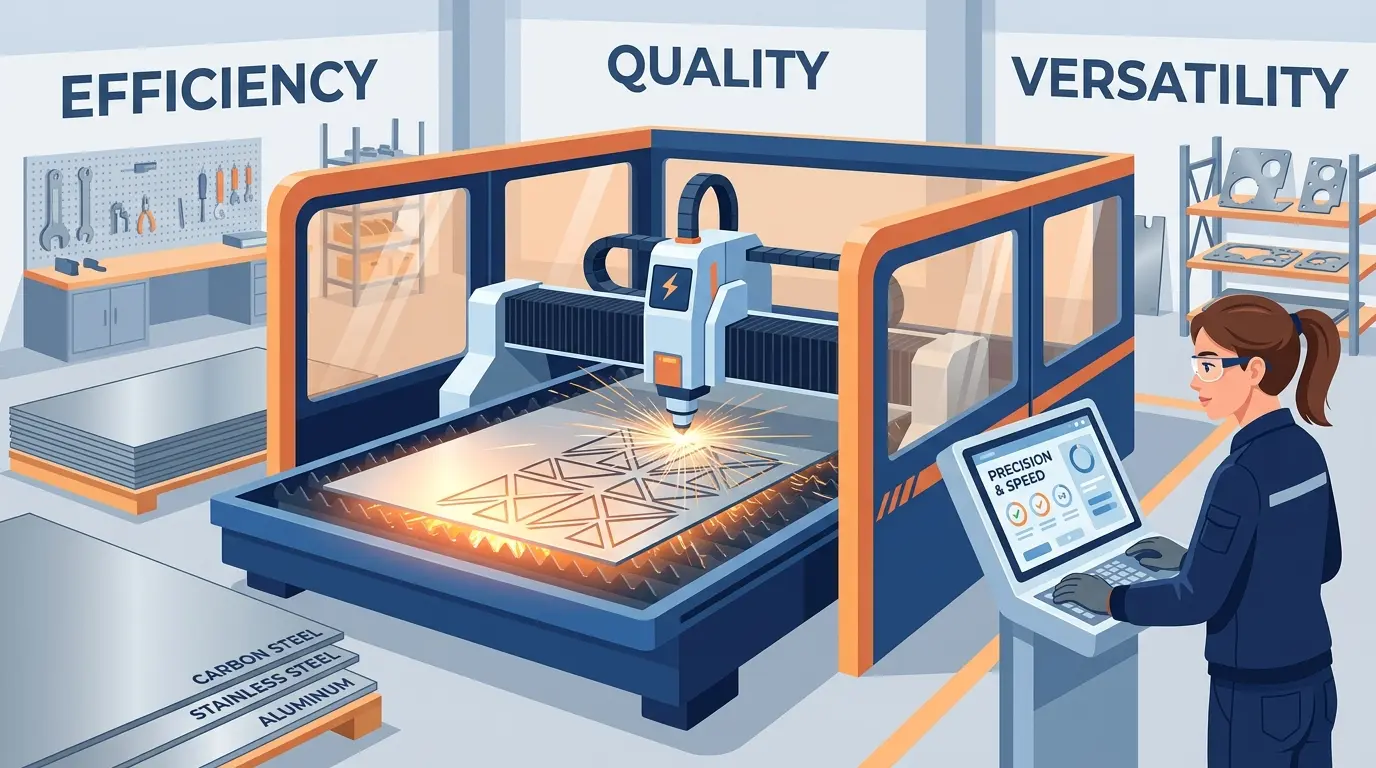
For example, stainless steel often raises expectations around edge appearance and cleanup before bending or welding. Carbon steel may be judged more heavily on throughput and part consistency across larger runs. Aluminum often makes buyers pay closer attention to process control and part stability. Shops that work across multiple materials need a machine that can move between those demands without turning setup changes into a production drag.
That is why buyers should review real part families by material instead of treating the entire metal workload as one category.
Automation And Material Handling Often Decide Real Throughput
A metal laser cutter can have strong cutting performance and still leave the shop disappointed if loading, unloading, sorting, and scrap handling remain inefficient. In real production, fabricators do not ship cut edges alone. They ship complete parts that have to move smoothly into the next stage.
Automation becomes more valuable when the shop faces one or more of these conditions:
- Repeated Production Runs With Similar Part Families
- Labor Bottlenecks Around Material Handling
- Tight Delivery Windows That Punish Idle Machine Time
- Frequent Use Of Large Sheets Or Heavy Material
- A Need To Keep Operators Focused On Programming And Quality Rather Than Constant Handling
That does not mean every shop needs a highly automated cutting cell. A high-mix, lower-volume operation may still prefer a simpler setup if changeovers and flexibility matter more than maximum unattended throughput. The key is to find where the current process is actually losing time.
Software And Nesting Quality Affect Cost Every Day
Laser buyers sometimes underweight software because it is less dramatic than source power or cutting speed. In practice, software quality affects daily economics through nesting efficiency, operator consistency, program reuse, and setup time.
Good software helps a fabrication shop:
- Improve Material Utilization
- Reduce Errors In Repeat Production
- Switch Between Jobs More Smoothly
- Handle Mixed-Part Nests More Predictably
- Reuse Proven Programs Without Excessive Rework
This matters even more when material cost is high or when the shop runs many smaller jobs instead of a few long batches. A weak programming workflow can quietly erase gains that looked strong during equipment evaluation.
Downstream Fit Matters More Than Demo Speed
The best metal laser cutter is not just the one that separates material quickly. It is the one that delivers parts that fit the rest of the factory more cleanly.
That includes questions like:
- Do Parts Move Cleanly Into Bending Without Extra Edge Cleanup?
- Is Weld Fit-Up More Consistent Across Repeated Assemblies?
- Does The Machine Reduce Manual Marking, Drilling, Or Secondary Prep?
- Are Small Parts Easier To Sort And Manage After Cutting?
- Does The Output Support Better Scheduling In The Next Operation?
When fabricators evaluate a laser machine this way, they usually make stronger decisions. The purchase stops being a narrow cutting discussion and becomes a broader production-improvement decision.
Questions To Ask Before Requesting Quotes
Before comparing suppliers, fabricators should prepare a short internal buying brief. That usually produces better recommendations and more realistic quotations.
Ask questions like these:
- Which Metals And Thickness Ranges Drive Most Of Our Revenue?
- Is Our Main Need Sheet Processing, Tube Processing, Or Both?
- Where Do We Lose The Most Time Today: Programming, Loading, Cutting, Sorting, Or Secondary Operations?
- Which Part Families Create The Most Cleanup Or Fit-Up Problems Downstream?
- Do We Need More Automation, Or Do We Need Better Process Stability?
- How Often Do We Change Jobs In A Normal Shift?
- Which Orders Justify Faster Throughput, And Which Ones Demand Better Quality Control?
- What Training And Service Support Will We Need To Protect Daily Output?
Those questions help keep the buying process grounded in the real business instead of in generic feature comparison.
Common Buying Mistakes
Several mistakes show up repeatedly when fabrication shops buy metal laser equipment.
The first is buying for maximum capability instead of dominant workload. If most orders fall into a narrower operating range, that range should shape the decision.
The second is focusing too narrowly on source power. Power matters, but it does not replace the need for strong software, stable motion control, practical maintenance, and good material handling.
The third is judging the machine by cut speed alone. Real throughput depends on the full cycle from raw material loading to finished part removal.
The fourth is underestimating support and training. A laser machine that performs well on paper can still become a weak investment if the shop struggles to keep output stable or resolve process issues quickly.
The fifth is ignoring downstream consequences. A machine that creates more cleanup, more sorting friction, or more inconsistency before bending or welding is not truly improving production.
How To Make The Final Decision
The right metal laser cutter for a fabrication shop is the one that fits the real order book, the dominant material mix, the labor situation, and the downstream workflow that follows cutting. It should help the team process parts more predictably, reduce unnecessary handling, and improve how work moves across the factory floor.
If your shop mainly wins on short lead times, stable quality, and efficient part flow, the best buying decision will usually come from matching the machine to those operational realities instead of chasing the broadest feature list.
For teams comparing laser investment with other factory equipment priorities, the Pandaxis product catalog provides a broader look at industrial machinery categories and production-planning options.