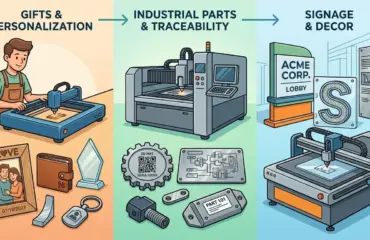
When a buyer asks for a laser engraver for metal parts, the request often sounds clearer than it really is. In production, many of those jobs are not primarily about engraving at all. They are about readable serial numbers, Data Matrix codes, logos, inspection marks, or permanent identification that has to survive handling without slowing the line.
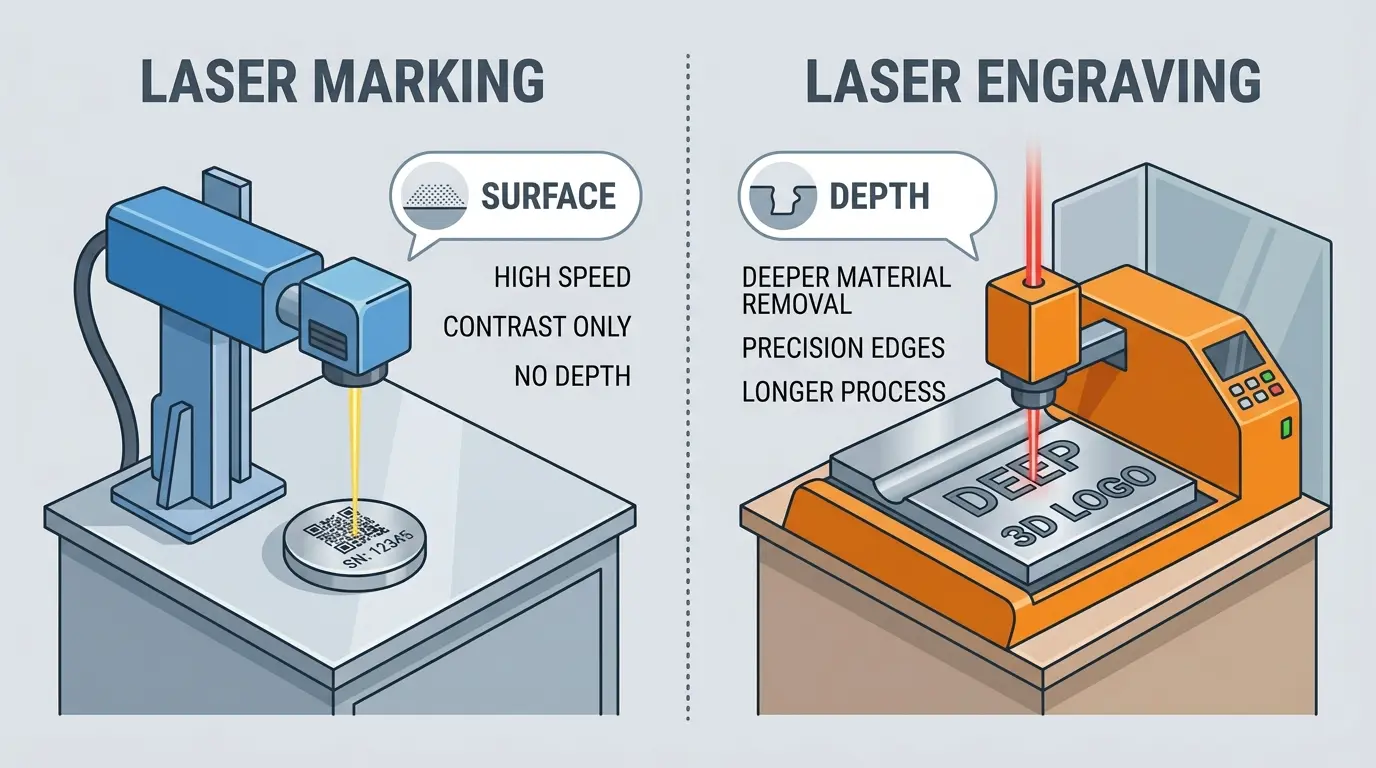
That is why the better question is not which label sounds more industrial. The better question is what the part needs after processing. If the goal is fast, repeatable identification with minimal material removal, a laser marking machine is often the better fit. If the goal is recessed depth, tactile detail, or stronger survival after repainting, blasting, or wear, a laser engraver may be the better choice.
Why This Comparison Gets Blurry So Fast
In real factories, the term laser engraver is often used as a catch-all phrase for almost any laser system that leaves a permanent result on metal. That creates confusion because metal-part workflows usually separate into at least two different priorities:
- Fast Traceability And Identification
- Decorative Or Functional Recessed Depth
- Minimal Surface Disturbance On Finished Parts
- Stronger Physical Survivability After Downstream Processing
Those priorities do not point to the same process window. A system that produces clean, high-contrast codes at production speed may not be the best tool for deeper recessed logos. A system configured for deeper engraving may create more cycle-time burden than a high-volume line can tolerate.
The safest buying approach is to define the required result first, then compare equipment against that result.
What A Laser Marking Machine Usually Does Better On Metal Parts
Laser marking is usually the better fit when the metal part needs a permanent readable result without aggressive material removal. In most industrial workflows, that means the mark is there to support identification, tracking, inspection, branding, or compliance rather than to create noticeable depth.
That usually makes marking a stronger choice for:
- Serial Numbers And Lot Codes
- Data Matrix And Barcode Marking
- High-Mix Production With Variable Data
- Finished Parts That Should Not Show Heavy Recess
- Lines Where Throughput Matters More Than Tactile Depth
From a workflow perspective, marking is often preferred because it can support faster cycle times, lower cleanup burden, and better consistency across repeated jobs. For many metal components, especially when scanner readability or part traceability is the main target, that is the result that matters most.
What A Laser Engraver Usually Does Better On Metal Parts
Laser engraving usually becomes the better option when the job needs visible or tactile depth rather than surface-level contrast alone. On metal parts, that deeper result can matter when the mark must remain obvious after coating, abrasion, polishing, or heavy handling.
That often makes engraving a better fit for:
- Recessed Logos And Name Details
- Tactile Branding Features
- Marks That Must Stay Obvious After Surface Wear
- Parts That May Be Painted Or Finished Later
- Applications Where Depth Carries Functional Or Visual Value
The tradeoff is that deeper engraving usually pushes the workflow toward longer cycle times, tighter process control, and more attention to heat effect, residue, and finish consistency. That does not make engraving worse. It just means it solves a different problem.
Side-By-Side Comparison For Metal-Part Workflows
| Decision Factor | Laser Marking Machine | Laser Engraver |
|---|---|---|
| Main Goal | Readable permanent identification with limited material removal | Recessed detail and stronger physical depth |
| Typical Best Fit | Traceability, codes, simple branding, inspection references | Premium logos, deeper marks, tactile or wear-resistant detail |
| Material Removal | Usually low | Usually higher |
| Cycle-Time Tendency | Usually faster | Usually slower |
| Surface Impact | Lower disturbance on finished parts | Greater visual and physical change to the surface |
| Downstream Fit | Strong for high-volume lines and scanner-based workflows | Strong when depth matters after finishing or wear |
| Buying Risk If Chosen For The Wrong Job | Mark may be readable but not deep enough | Result may be strong but throughput may suffer |
The important pattern is simple: the more the application depends on contrast and speed, the stronger the case for marking. The more it depends on depth and durability through rough downstream conditions, the stronger the case for engraving.
Which One Is Better By Use Case?
| If The Part Needs… | The Better Starting Point Is Usually… | Why |
|---|---|---|
| Scanner-readable UID or Data Matrix codes | Laser marking machine | Readability and throughput usually matter more than depth |
| Batch numbers or serial numbers on finished components | Laser marking machine | Lower surface disturbance is usually the safer fit |
| Decorative recessed logo on a metal housing | Laser engraver | Depth contributes more to appearance and perceived quality |
| Marks that may sit under paint or survive later blasting | Laser engraver | Physical depth usually holds up better than shallow contrast alone |
| Fast marking on a moving production workflow | Laser marking machine | Shorter processing burden usually fits the line better |
| Small-batch premium parts where tactile detail matters | Laser engraver | Surface relief is often part of the product value |
For most everyday metal-part traceability jobs, a laser marking machine is usually the better answer. For metal parts where the customer or process demands stronger depth, engraving becomes the better answer. That is why there is no universal winner.
The Real Selection Question Is Not Marking Versus Engraving
In practice, the real selection question is whether your quality standard is based on readability or depth.
If the quality standard says the code must scan cleanly, remain legible, and fit a high-volume process, marking usually deserves priority. If the quality standard says the mark must remain physically obvious after downstream treatment or wear, engraving usually deserves more weight.
That also means quote comparisons should never stop at machine naming. Buyers should ask each supplier to define the expected outcome clearly:
- Contrast Only Or True Recessed Depth?
- Readability Standard Or Appearance Standard?
- Expected Cycle Time On The Actual Part?
- Surface Condition Used For The Sample?
- Performance Before And After Any Coating, Cleaning, Or Abrasion?
Those questions expose weak quotations faster than arguing over terminology.
When One Factory May Need Both
Some factories try to force one machine to cover both high-speed identification and deeper decorative or durable engraving. That can work in limited cases, but it can also create an awkward compromise where the machine is never truly optimized for either job.
If your plant handles mixed requirements, it often helps to separate the workflow into two decisions: one for production traceability and one for deeper visual or functional engraving. If that evaluation also sits alongside non-metal cutting, engraving, or broader equipment planning, a wider view of the Pandaxis product catalog is more useful than assuming one laser label should cover every process need.
Questions To Settle Before You Buy
Before requesting quotations, buyers should define a few basics clearly:
- Whether The Mark Must Be Scanned, Seen, Or Felt
- Whether The Part Is Raw, Coated, Polished, Or Finished
- Whether The Mark Must Survive Abrasion, Paint, Blasting, Or Heat
- Whether Throughput Or Depth Is The Harder Requirement
- Whether The Sample Should Be Judged For Contrast, Recess, Or Both
Once those answers are clear, the machine decision usually becomes much easier.
Practical Summary
For metal parts, a laser marking machine is usually better when the job is about traceability, readable codes, repeatability, and line speed. A laser engraver is usually better when the job depends on recessed depth, tactile detail, or stronger survival through later wear and finishing.
So which one is better for metal parts? In most production environments, marking is better for identification. Engraving is better for depth. The right choice depends on which of those outcomes actually drives value in your workflow.