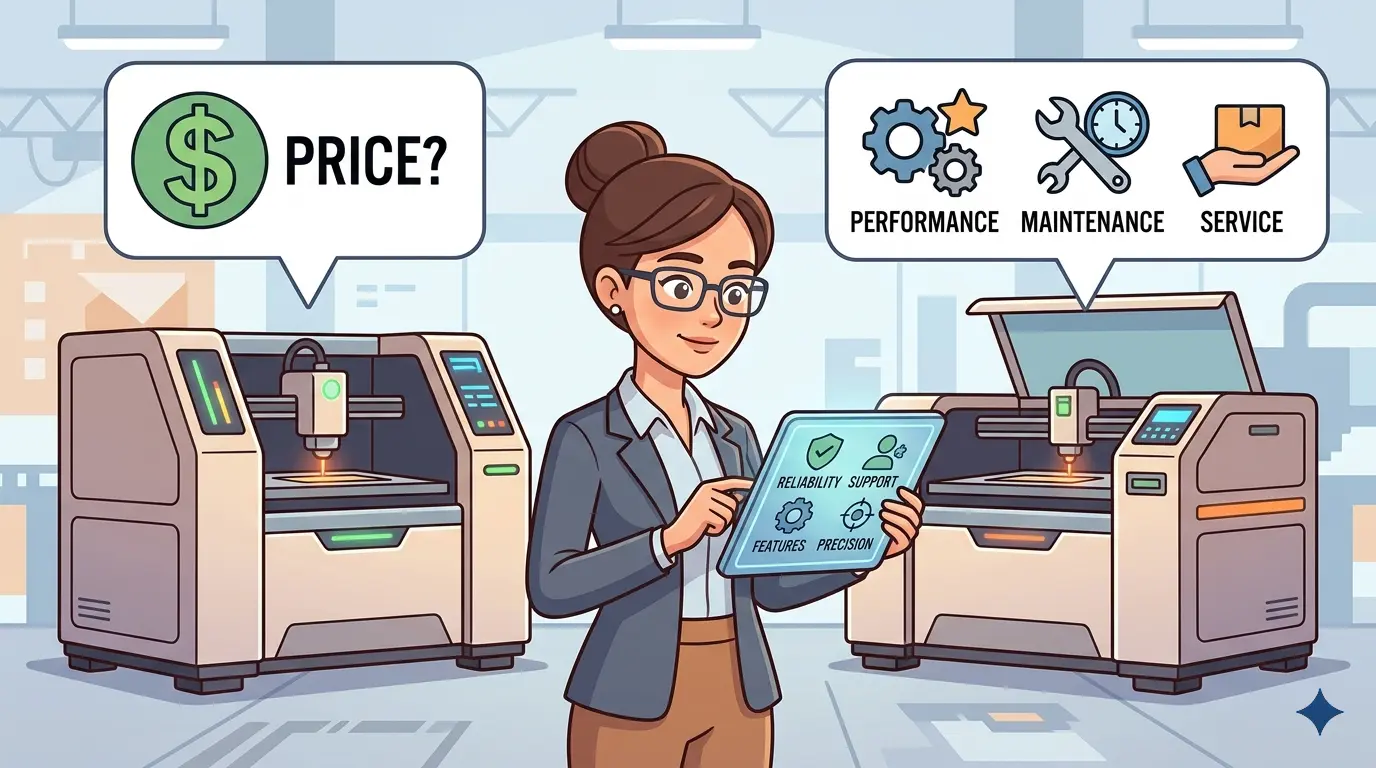
A low quoted price can look attractive until it starts showing up as slower changeovers, inconsistent edge quality, more operator intervention, or downstream rework. Industrial buyers do not feel machine cost only at purchase. They feel it in schedule pressure, scrap, maintenance interruptions, and how well the machine fits the rest of the production flow.
If you are comparing laser cutting machines for sale, the useful question is not simply which machine costs less today. It is which machine gives the best production result for your material mix, part geometry, quality standard, staffing model, and growth plan.
Start With The Job, Not The Quote
Before you compare suppliers, define what the machine must do in normal production rather than in a best-case demo.
- Primary Materials
- Typical Part Sizes And Sheet Formats
- Mix Of Cutting And Engraving Work
- Required Edge Quality Or Surface Appearance
- Daily Job Variety And Changeover Frequency
- Whether The Machine Will Run Stand-Alone Or Inside A Larger Process Cell
Two machines can both be described as laser cutters while serving very different workflows. A buyer producing acrylic signs, decorative wood panels, packaging prototypes, or non-metallic industrial parts is solving a different problem from a fabricator processing metal plate. If your work is centered on wood, acrylic, and similar non-metallic applications, Pandaxis’ laser cutters and engravers category is the relevant reference point rather than a generic all-laser comparison.
Material Match Comes Before Power Claims
Many buyers start with headline specifications because they are easy to compare on a quotation sheet. In practice, material fit comes first.
A machine that is well suited to wood, acrylic, and similar substrates is not automatically the right answer for metal processing, just as a machine selected for metal does not automatically deliver the best result on decorative non-metal work. The real question is whether the laser process, optics, control strategy, and operating setup match the material behavior you deal with every day.
That matters because material mismatch usually shows up in expensive ways:
- Poor Edge Quality That Triggers Manual Cleanup
- Heat Effects That Reduce Finish Consistency
- Unstable Results Across Different Part Geometries
- Slower Throughput Because Operators Must Constantly Adjust Settings
- Higher Scrap On Customer-Facing Parts
For many industrial buyers, the smarter comparison is not maximum capability in theory. It is stable performance on the materials that actually drive revenue.
Compare What A Cheap Quote Often Leaves Out
Price is easy to see. Workflow penalties are not. That is why buyers should compare the machine as a production asset, not as a one-line capital item.
| Comparison Area | What To Check | Why It Matters In Production |
|---|---|---|
| Material Suitability | Ask the supplier to evaluate your real material mix, not only a generic sample set. | Prevents buying a machine optimized for the wrong process. |
| Cut Quality Consistency | Review sample parts from your files and your material. | Shows whether the cut is clean enough for assembly, finishing, or direct shipment. |
| True Throughput | Compare mixed-batch performance, setup time, and recovery after stops. | Real output depends on more than the cut itself. |
| Software And Controls | Check job recall, parameter management, and ease of repeat setup. | Reduces operator dependence and setup loss. |
| Support And Spares | Clarify who handles installation, troubleshooting, and replacement parts. | Downtime can erase a lower purchase price quickly. |
| Operating Cost | Review consumables, maintenance routines, extraction needs, and labor load. | Protects total cost of ownership. |
| Workflow Integration | Look at upstream file prep and downstream cleanup, sanding, assembly, or packaging. | The right machine reduces friction across the whole process. |
This is where many low-price quotes start to look less attractive. The machine may still be a valid choice, but only if the lower price does not shift cost into labor, scrap, or downtime.
Throughput Is More Than The Cutting Cycle
Industrial buyers often hear the word speed when they really need to evaluate output. Those are not the same thing.
A machine can look fast on a short demonstration part and still underperform in real production if:
- Job Setup Takes Too Long
- Operators Struggle To Recall Proven Parameters
- Nesting Or File Preparation Creates Bottlenecks
- Material Loading And Unloading Are Awkward
- The Machine Needs Frequent Small Corrections To Maintain Acceptable Results
True throughput is what the machine delivers over a shift or a week, across mixed jobs, real operator behavior, and normal interruptions. Buyers should ask how the machine performs when the schedule includes small urgent orders, repeat jobs, geometry changes, and different surface expectations.
In many factories, the better machine is not the one with the most aggressive headline claim. It is the one that holds repeatability while keeping job flow smooth.
Cut Quality Should Be Judged At The Next Step
Laser buyers sometimes assess quality only by looking at the edge immediately after cutting. That is too narrow.
The more useful question is what happens next. Does the part go directly to assembly? Does it need polishing, cleaning, sanding, bonding, painting, or visual inspection? A machine that leaves a cleaner, more consistent result can reduce handling time and rework even if its purchase price is not the lowest.
That is why sample evaluation should be tied to the downstream process. Instead of asking whether the cut looks acceptable, ask:
- Does The Part Fit Correctly In Assembly?
- Is Additional Cleanup Required Before Finishing?
- Do Decorative Or Visible Parts Hold A Consistent Appearance?
- Does The Machine Maintain The Same Result Across Repeated Jobs?
For decorative panels, signage, display parts, templates, and branded components, finish quality often matters as much as raw cutting capability. A cheaper machine that creates more manual cleanup is usually not the cheaper production decision.
Software, Controls, And Changeovers Often Decide ROI
In many shops, the real difference between an average laser and a useful laser is not only the beam. It is how easily the team can run repeat work without reinventing the setup.
Buyers should compare:
- How Jobs Are Prepared And Recalled
- How Operators Store And Reuse Proven Parameters
- How Easy It Is To Move Between Repeat Orders And New Designs
- How Much Performance Depends On One Experienced Operator
- How Quickly New Staff Can Reach Stable Output
This matters because changeover friction compounds over time. A machine that is technically capable but difficult to operate can create hidden delays, inconsistent output between shifts, and higher training burden. A more structured control environment often improves throughput by reducing hesitation and variation.
Service Response And Parts Availability Deserve Their Own Cost Line
Machine buyers sometimes treat service as a secondary issue until the first stoppage. That is too late.
When comparing suppliers, ask practical questions:
- Who Handles Installation And Commissioning?
- What Remote Troubleshooting Support Is Available?
- Which Wear Parts Or Consumables Are Routine?
- How Quickly Can Common Replacement Items Be Shipped?
- What Training Is Included For Operators And Maintenance Staff?
These questions matter more in production than they do in a showroom conversation. A lower purchase price can still be the right choice, but only if support, parts access, and maintenance expectations are realistic for your operating model.
When A Lower Price Is Rational And When It Becomes Risky
Not every buyer needs the most advanced configuration. In some situations, a lower-cost machine is a rational decision. The key is understanding where that tradeoff works and where it starts to create operational risk.
| Buyer Situation | A Lower-Priced Option Can Make Sense When | A Higher-Spec Option Usually Pays Back When |
|---|---|---|
| Low-Volume Custom Work | Output is irregular, part volumes are modest, and operators can absorb some setup time. | Delivery pressure is growing and rework or delays are starting to affect margin. |
| Repeat Batch Production | Part families are simple and the process window is stable. | The line depends on predictable throughput and low operator variation. |
| Finish-Sensitive Products | Visual standards are forgiving and minor cleanup is acceptable. | Appearance is customer-facing and manual correction creates labor cost or inconsistency. |
| Labor-Constrained Operations | Skilled operators are already available and can manage process tuning. | The business needs easier training, faster onboarding, and repeatability across shifts. |
This is the honest way to compare more than price. A cheaper machine is not automatically a mistake. It becomes a mistake when its limitations show up in the part quality, staffing requirement, or schedule performance that the business actually relies on.
Evaluate The Machine As Part Of A Production System
Some buyers are not only choosing between one laser model and another. They are deciding where laser processing fits inside a broader equipment plan. In that situation, the wider Pandaxis product catalog can be useful because it places laser systems alongside other production categories instead of treating the purchase as an isolated decision.
That broader view matters because the best equipment choice depends on the full route from file to finished part:
- How Material Arrives And Is Staged
- How Files Are Prepared And Released To Production
- How Operators Handle Loading, Unloading, And Sorting
- What Cleanup Or Finishing Happens After Cutting
- How The Part Moves Into Assembly, Packaging, Or Shipment
A laser that fits the production system well often creates value beyond the cut itself. It can reduce manual handling, improve repeatability, and make the next step easier. That is a stronger basis for comparison than purchase price alone.
Use A Buyer Checklist Before You Ask For Final Quotes
Before you narrow the decision to price, work through a short but disciplined checklist.
- Confirm The Dominant Material And Application Mix.
- Test Sample Parts Using Your Own Files And Real Material.
- Compare Cut Quality Based On The Downstream Process, Not Only Visual First Impressions.
- Evaluate Throughput Across Mixed Jobs, Not Just Demo Conditions.
- Review Software, Job Recall, And Operator Ease Of Use.
- Clarify Service Structure, Spare Parts Access, And Training Scope.
- Compare Total Workflow Cost, Including Cleanup, Labor, Scrap, And Downtime Exposure.
If one supplier only wants to discuss the quote while another is willing to discuss the workflow, the second conversation is usually more valuable even before pricing is finalized.
Final Thoughts
When buyers search for laser cutting machines for sale, price is naturally the first visible filter. It should not be the final decision point.
The stronger comparison looks at material fit, cut quality, real throughput, changeover discipline, service response, and how the machine supports the next step in production. A machine that costs more up front but reduces rework, simplifies operation, and holds stable output often becomes the lower-cost decision over time.
That is how experienced industrial buyers compare more than price: they compare the machine’s place in the workflow, not just its number on the quotation.