A jewelry engraving machine can look impressive in a product demo, but precision buyers usually run into trouble after the machine arrives, not before. A single clean sample on a flat test piece does not prove that the system will hold fine text on a curved ring, keep logo placement consistent on small pendants, or preserve surface quality on finished pieces without creating reject parts.
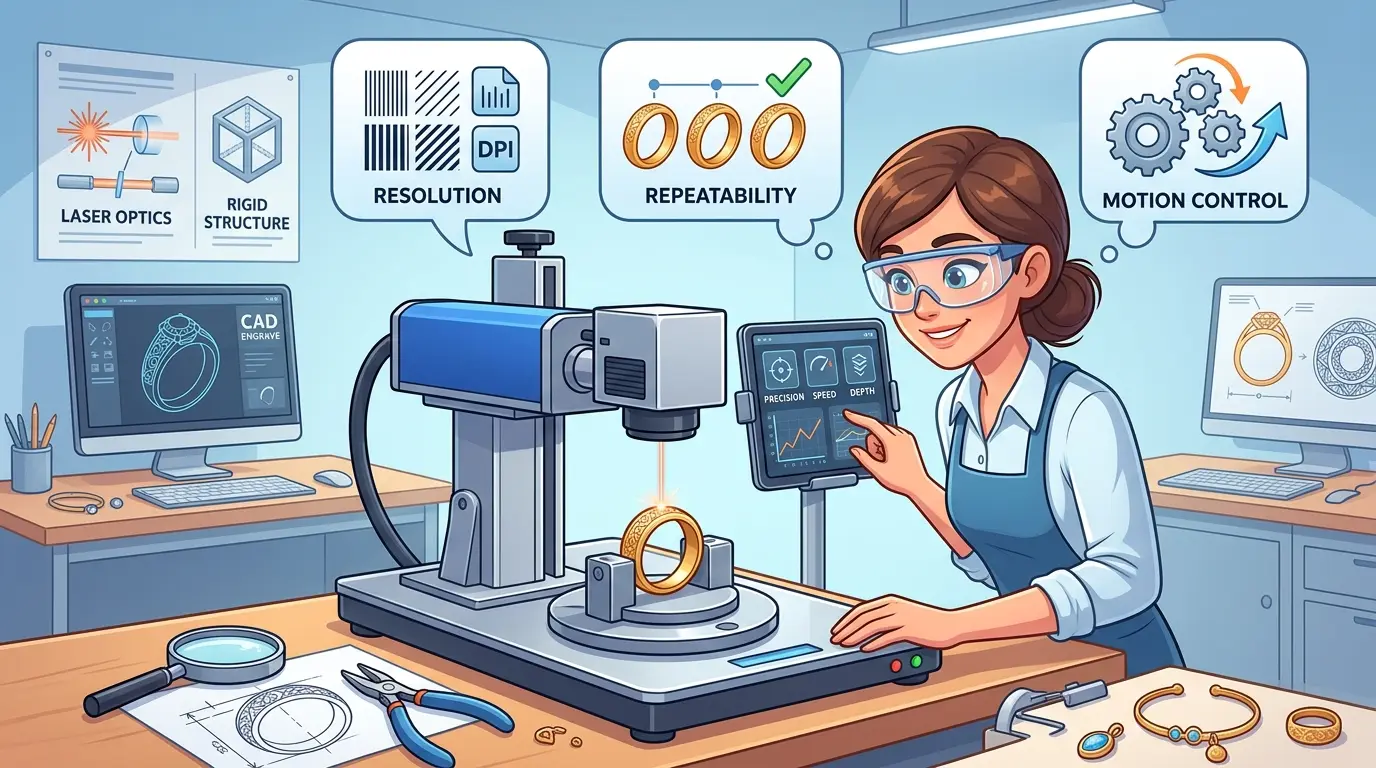
In jewelry work, precision is not just about how small a line can look under perfect conditions. It is about whether the machine can repeat the same result across tiny parts, reflective surfaces, mixed materials, and frequent artwork changes without turning setup, alignment, and rework into the real bottleneck.
Precision Starts With The Job, Not The Machine Label
The phrase “jewelry engraving machine” covers several very different production goals. Buyers usually get better results when they define the job first and the machine category second.
Typical jewelry-related engraving goals include:
- Fine Logos, Hallmarks, And Identification Marks
- Personalized Names, Dates, And Short Text
- Decorative Surface Detailing On Small Parts
- Repeatable Branding Across Batches Of Similar Pieces
- Engraving On Related Display, Packaging, Or Presentation Components
These jobs do not all reward the same machine behavior. Some prioritize ultra-clean line definition. Others prioritize stable placement on curved parts. Some care most about visible aesthetics on finished jewelry, while others care more about repeatable identification and low reject rates. If buyers treat all of these as the same precision problem, they usually end up comparing the wrong things.
What Precision Really Means In Jewelry Production
For industrial buyers, precision should be evaluated as a workflow outcome rather than a brochure claim.
In jewelry applications, that usually means looking at:
- Edge Definition On Very Small Features
- Stable Placement Relative To Part Geometry
- Consistent Contrast Or Engraving Depth Across Repeated Parts
- Low Risk Of Heat-Affected Cosmetic Damage On Finished Surfaces
- Reliable Results On Curved, Small, Or Difficult-To-Hold Pieces
- Repeatability After Re-Clamping, Job Changeover, Or Operator Handoffs
A machine can appear precise when engraving a large flat sample, then lose real production value when the work shifts to rings, bracelets, tags, clasps, pendants, or mixed-size custom orders. That is why buyers should judge precision under the same part-handling conditions they expect in daily production.
A Quick Buyer Decision Table
| Production Scenario | What Precision Actually Means | What Buyers Should Verify | Common Buying Mistake |
|---|---|---|---|
| Small Logos Or Hallmarks On Compact Parts | Clean, readable detail without edge washout | Fine-feature clarity, placement repeatability, and part stability | Judging the machine by a large demo sample instead of the smallest real feature |
| Personalization On Rings Or Bracelets | Reliable alignment on curved surfaces | Curved-part handling, fixture repeatability, and preview accuracy | Assuming flat-part performance will transfer directly to round work |
| Decorative Engraving On Finished Jewelry | Visible quality without surface damage | Surface response, cosmetic consistency, and defect risk after processing | Focusing only on speed while ignoring finish sensitivity |
| Batch Branding Or ID Marking | Same result across many repeated pieces | Job recipe consistency, origin control, and repeat setup performance | Accepting one successful sample as proof of batch stability |
| Mixed Work On Jewelry Packaging Or Display Pieces | Good detail across non-metallic substrates as well as the core jewelry line | Material-fit across acrylic, wood, leather, or coated presentation parts | Buying for one substrate only, then discovering the workflow is broader |
Material Match Changes The Right Precision Standard
Material response is one of the fastest ways to expose a weak buying decision. Jewelry businesses often work with more than one substrate, and each one changes what precision really demands.
Precious metals, plated surfaces, coated tags, acrylic inserts, wood presentation boxes, and leather packaging components do not respond the same way. A process that produces clean, attractive detail on one substrate may create discoloration, poor contrast, shallow definition, or unstable results on another.
That is why material match should be treated as a precision issue, not just an application note. Buyers should ask whether their real workflow is centered on:
- Direct Marking Or Engraving On Jewelry Pieces
- Decorative Work On Finished Surfaces With Tight Cosmetic Standards
- Branding Or Identification Marks That Must Stay Readable And Consistent
- Mixed-Material Production That Includes Packaging, Display, Or Gift Components
For businesses that also personalize wooden boxes, acrylic display inserts, or branded presentation parts, laser cutters and engravers are commonly evaluated for the non-metallic side of the workflow.
The key point is simple: do not assume a precision claim is universal across materials. The right machine choice depends on how the actual substrate behaves in production.
Fixturing And Part Handling Often Decide Real Accuracy
In jewelry work, the part is often harder to hold consistently than it is to engrave. Small dimensions, curved surfaces, reflective finishes, and irregular shapes all increase the risk that theoretical precision gets lost before the process even starts.
Buyers should pay close attention to how the system handles:
- Small-Part Positioning
- Repeatable Referencing From One Piece To The Next
- Curved Or Cylindrical Work Such As Rings And Bracelets
- Changeover Between Different Part Sizes And Fixtures
- Stability During Short-Run Custom Orders
This is where many precision problems begin. If the operator has to re-align every piece by eye, if fixtures shift between jobs, or if round parts cannot be referenced consistently, the machine may still be technically capable while the workflow remains inaccurate.
Good buying decisions usually come from evaluating the entire setup condition, including fixtures, part supports, alignment logic, and how easily a repeat job can be reloaded without drift.
Software Control And Setup Discipline Matter More Than One Good Demo
Jewelry engraving is often low-volume, variation-heavy, and artwork-driven. That means precision buyers should care as much about job control as raw beam or motion claims.
Useful questions include:
- Can Operators Preview Placement Clearly Before Running The Job?
- Can Common Materials And Part Types Be Saved As Repeatable Process Recipes?
- How Easy Is It To Switch Between Personalized Orders Without Rebuilding The Setup Each Time?
- How Stable Is Output When More Than One Operator Uses The System?
- How Much Manual Interpretation Is Required Before Each Job Starts?
In real production, consistent setup discipline protects precision. A machine that depends on frequent manual correction will usually create more variation than the spec sheet suggests. Buyers should therefore evaluate the repeatability of the workflow, not only the capability of the machine head.
Test Precision Under Production Conditions, Not Sample Conditions
The safest buyers do not ask only for a clean sample. They ask for proof that the same result can survive realistic production conditions.
Before buying, it helps to test with real parts and real order logic:
- Run The Same File Across A Short Batch Of Actual Parts Instead Of One Demo Coupon.
- Test The Smallest Text, Finest Line, And Tightest Spacing The Business Really Plans To Sell.
- Check Parts That Sit Near Edges, Curves, Or Difficult Holding Positions.
- Review Surface Quality After Any Cleaning, Handling, Or Downstream Finishing Step.
- Re-Clamp The Part And Repeat The Job To See Whether Origin And Placement Stay Stable.
This kind of testing usually reveals more than an idealized showroom example. It shows whether the machine supports real buyer priorities such as repeatability, cosmetic control, changeover speed, and low rework.
When The Broader Workflow Matters More Than The Engraving Claim
Some jewelry businesses are not buying for engraving alone. They may also need to process display components, packaging elements, branded gift sets, or other non-metallic presentation parts that support the finished sale.
In those cases, the better investment decision may come from looking at workflow coverage rather than chasing the most aggressive precision language in a single machine category. For buyers reviewing several production paths at once, the broader Pandaxis product catalog can be a more useful starting point than treating engraving as an isolated decision.
This matters because the most profitable workflow is not always the one with the strongest single-machine claim. It is often the one that reduces total handling, preserves visible quality, and keeps short-run orders moving without excessive setup friction.
Practical Summary
Precision buyers should not evaluate a jewelry engraving machine by headline claims alone. In real production, the decision usually comes down to five things: whether the machine matches the actual marking goal, whether it behaves well on the real substrate, whether small parts can be held and referenced consistently, whether the setup can be repeated without drift, and whether the result stays clean under daily workflow conditions.
That is why the best buying process starts with the part, the material, and the order pattern rather than the machine label. A system that looks accurate in a demo only becomes a good investment when that precision survives curved pieces, small features, frequent job changes, and the cosmetic standards that jewelry buyers expect.