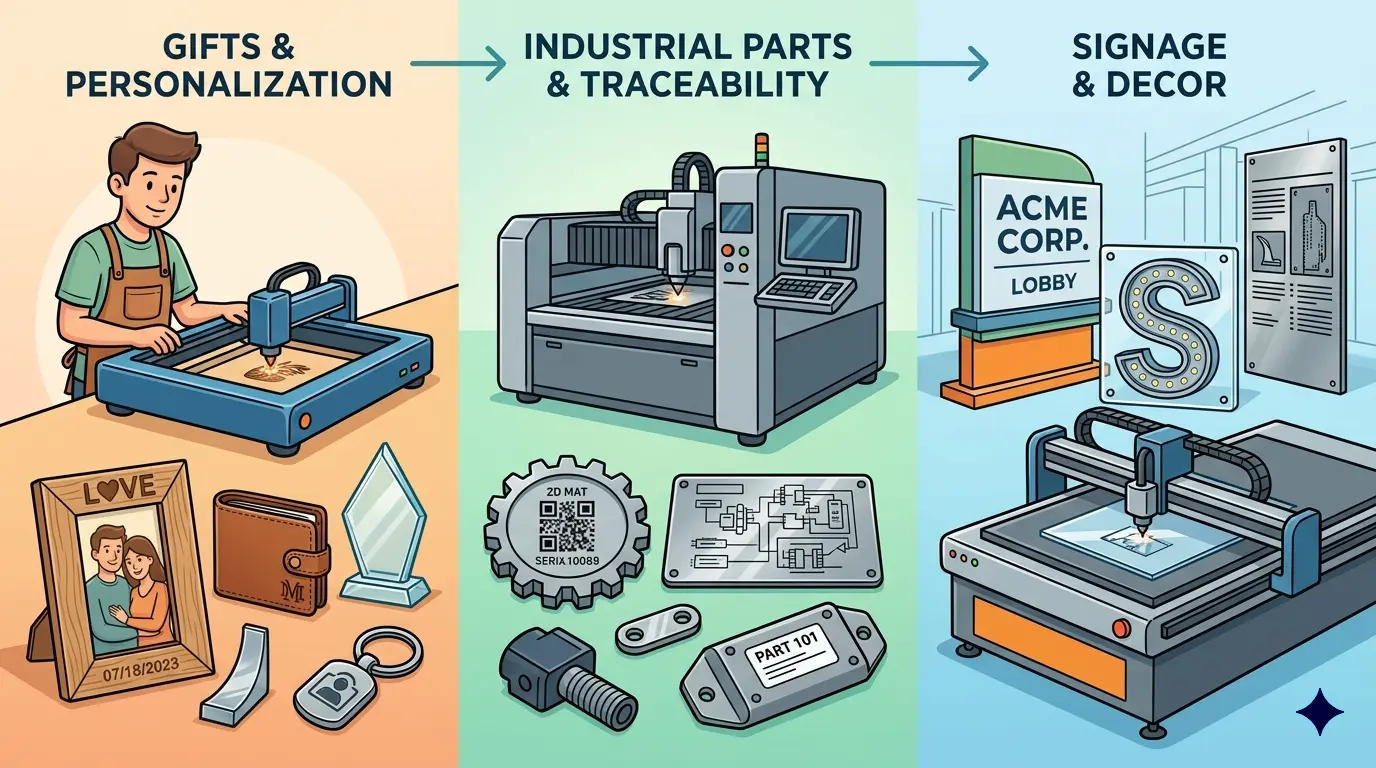
An engraving machine can look versatile in a brochure, but real production value depends on what the shop is actually trying to finish all day. A gift workflow usually rewards flexibility, personalization, and visual appeal. An industrial-parts workflow rewards permanence, repeatability, and traceability. A signage workflow often sits in between, where appearance matters, but so do layout consistency, order variation, and material handling.
That is why the best way to evaluate engraving machine applications is not by starting with the machine alone. It is by starting with the finished product, the order pattern, and the point in the workflow where engraving either creates value or creates delay.
For manufacturers comparing equipment for wood, acrylic, and similar non-metallic work, laser cutters and engravers are commonly evaluated when engraving quality and contour-processing flexibility both matter in the same production cell.
Why Application Fit Matters More Than a Good Sample
Almost any supplier can show a clean engraved sample. What matters in production is whether the same result can be repeated across a full shift, across material variation, and across different job types without turning setup, cleaning, or rework into the real bottleneck.
The application changes what buyers should care about most:
- Gifts Reward Fast Artwork Changes And Attractive Surface Finish
- Industrial Parts Reward Mark Consistency And Process Reliability
- Signage Rewards Readability, Layout Control, And Mixed-Order Flexibility
If these use cases are evaluated as though they all need the same machine behavior, the buyer usually ends up with either underused capability or the wrong compromise.
Application Differences at a Glance
| Application Area | What The Engraving Is Really Doing | Main Workflow Benefit | Main Risk If The Machine Is Mismatched |
|---|---|---|---|
| Gifts | Adding personalization, branding, decorative detail, or presentation value | Faster customization without physical tooling changes | Jobs become too slow or too inconsistent for short-run order volume |
| Industrial Parts | Creating IDs, traceability marks, orientation references, or durable branding | Better repeatability, easier sorting, and clearer downstream control | Marks fail to stay readable, repeatable, or process-stable in daily use |
| Signage | Producing readable text, logos, decorative graphics, and finished-face detail | Cleaner visual output with easier design variation | Cosmetic defects, alignment drift, or weak contrast hurt sellable quality |
The machine may still be similar across all three. What changes is the performance standard.
Gifts: Where Personalization and Presentation Drive Value
Gift production is often the most variation-heavy engraving environment. Orders can be small, artwork changes are frequent, and the visible result usually matters more than raw material-removal speed. The machine earns value when it reduces the friction of customization.
Common gift-oriented applications include:
- Personalized Wooden Boxes And Presentation Cases
- Acrylic Or Wood Keepsakes And Decorative Items
- Branded Corporate Gift Sets
- Seasonal, Event, Or Commemorative Products
- Premium Packaging Components With Decorative Detail
In this environment, the engraving process helps because the shop can move from one name, logo, or artwork file to the next without creating a new physical tool for each order. That makes low- to medium-volume customization more manageable.
The tradeoff is that gift work can punish inconsistency quickly. Surface scorching, uneven contrast, or small alignment errors show up immediately because the product is judged as a finished object, not as an internal factory component. That means material presentation, placement repeatability, and surface cleanliness matter as much as the engraving path itself.
Gift applications are usually a strong fit when the business wins orders through variation, short-run responsiveness, and visible product presentation.
Industrial Parts: Where Repeatability Matters More Than Decoration
Industrial-part engraving is usually less about aesthetics and more about function. The mark may need to identify a component, support traceability, guide assembly, separate batches, or apply durable branding that remains useful after the part moves further downstream.
Typical industrial-part applications can include:
- Serial Numbers And Part Identification
- Orientation Marks For Assembly
- Branding On Housings, Covers, Or Tags
- Batch References And Internal Tracking Marks
- Simple Functional Graphics Or Instruction Marking
Here, the critical question is not whether the mark looks impressive on one sample. It is whether the process holds steady across repeated parts and supports the next step in production.
In industrial workflows, buyers usually care most about:
- Mark Consistency Across The Batch
- Reliable Placement On Repeated Part Geometries
- Legibility After Handling, Cleaning, Or Assembly
- Stable Throughput Without Constant Recipe Adjustment
- Low Risk Of Rework From Incomplete Or Unclear Marks
This is also where material reality starts to matter more. Some industrial parts fit easily into non-metallic engraving workflows. Others may involve coated, treated, or metal-based components that require a different selection process and more careful application testing. In those cases, the buyer should evaluate the marking goal, the substrate response, and the permanence requirement first rather than assume all industrial-part engraving behaves like gift or signage work.
Signage: Where Visual Clarity and Mixed-Order Efficiency Meet
Signage combines the visual pressure of gift work with the order complexity of commercial production. A sign has to look right, but it also has to be produced on schedule, often across multiple sizes, layouts, or branding versions.
Common signage applications include:
- Indoor Brand Signage
- Wayfinding Panels
- Retail Display Graphics
- Decorative Wall Features
- Acrylic, Wood, Or Laminated Sign Components
In signage production, engraving earns its place when it helps the shop maintain readable text, clean logo detail, and consistent placement across repeat jobs without a long setup loop each time artwork changes.
This is often where a combined cut-and-engrave workflow becomes valuable. If the same job requires shaped blanks, cut lettering, or engraved face detail, the shop may gain more by reducing handoffs between operations than by optimizing engraving in isolation.
The main caution is that signage defects are highly visible. Weak contrast, off-position graphics, uneven fill areas, or surface staining immediately reduce the commercial quality of the part. That makes extraction, job setup discipline, and material consistency essential in sign work.
What Changes in Machine Evaluation Across These Three Use Cases
The same engraving platform can be acceptable for all three application families, but each one exposes a different weakness.
Gift workflows expose weakness in:
- Changeover Speed
- Small-Batch Efficiency
- Cosmetic Consistency
- Personalization Accuracy
Industrial-part workflows expose weakness in:
- Positioning Repeatability
- Functional Legibility
- Process Stability
- Downstream Traceability Reliability
Signage workflows expose weakness in:
- Text And Graphic Clarity
- Panel-to-Panel Consistency
- Artwork Alignment
- Mixed-Job Scheduling Efficiency
That is why machine evaluation should be application-led. A shop that mainly handles gifts may accept lower raw throughput if customization flexibility is high. A shop focused on industrial parts may care less about decorative nuance and more about reliable mark repeatability. A sign producer may need a balance of visual quality and workflow flexibility because both matter to sellable output.
When Engraving Should Not Be the Only Decision Point
Some buyers ask for an engraving machine when the workflow problem is actually larger than engraving.
That happens when:
- The Job Depends More On Shape Cutting Than Surface Marking
- The Required Detail Is Secondary To Panel Breakdown Or Blanking
- Deep Relief Removal Matters More Than Surface Graphics
- The Shop Needs A Mixed Process Cell Rather Than A Marking-Only Station
In those cases, the better evaluation may be broader equipment planning rather than engraving alone. For teams comparing engraving needs against other production steps, the Pandaxis product catalog gives a broader view of machine categories and workflow fit.
How To Decide Which Application Profile Matches Your Shop
Before buying, it helps to review the real order mix instead of the most attractive sample job.
Ask these questions:
- Do Most Orders Need Custom Names, Logos, Or Decorative Variation?
- Are Marks Primarily For Customers To See Or For Operators To Use?
- Does The Process Need High Visual Finish Or High Functional Repeatability?
- How Often Do Artwork Files Change?
- Is The Engraving Cell Delaying Output, Or Is Another Upstream Step The Real Bottleneck?
- Does The Same Product Family Also Need Cutting In The Same Workflow?
These questions usually reveal whether the dominant application profile is gift production, industrial-part marking, signage work, or a mixed-use environment that needs balanced flexibility.
Practical Summary
Engraving machine applications in gifts, industrial parts, and signage are not just three market segments. They are three different workflow logics.
Gift work is driven by personalization, presentation, and fast design changes. Industrial-part work is driven by repeatability, legibility, and process control. Signage work is driven by visual clarity, customer-facing finish, and the ability to handle mixed commercial orders efficiently.
The machine may appear similar across all three, but the right choice depends on which outcome matters most in daily production. If buyers start with the workflow instead of the label, they usually make a better equipment decision and avoid paying for the wrong kind of versatility.