
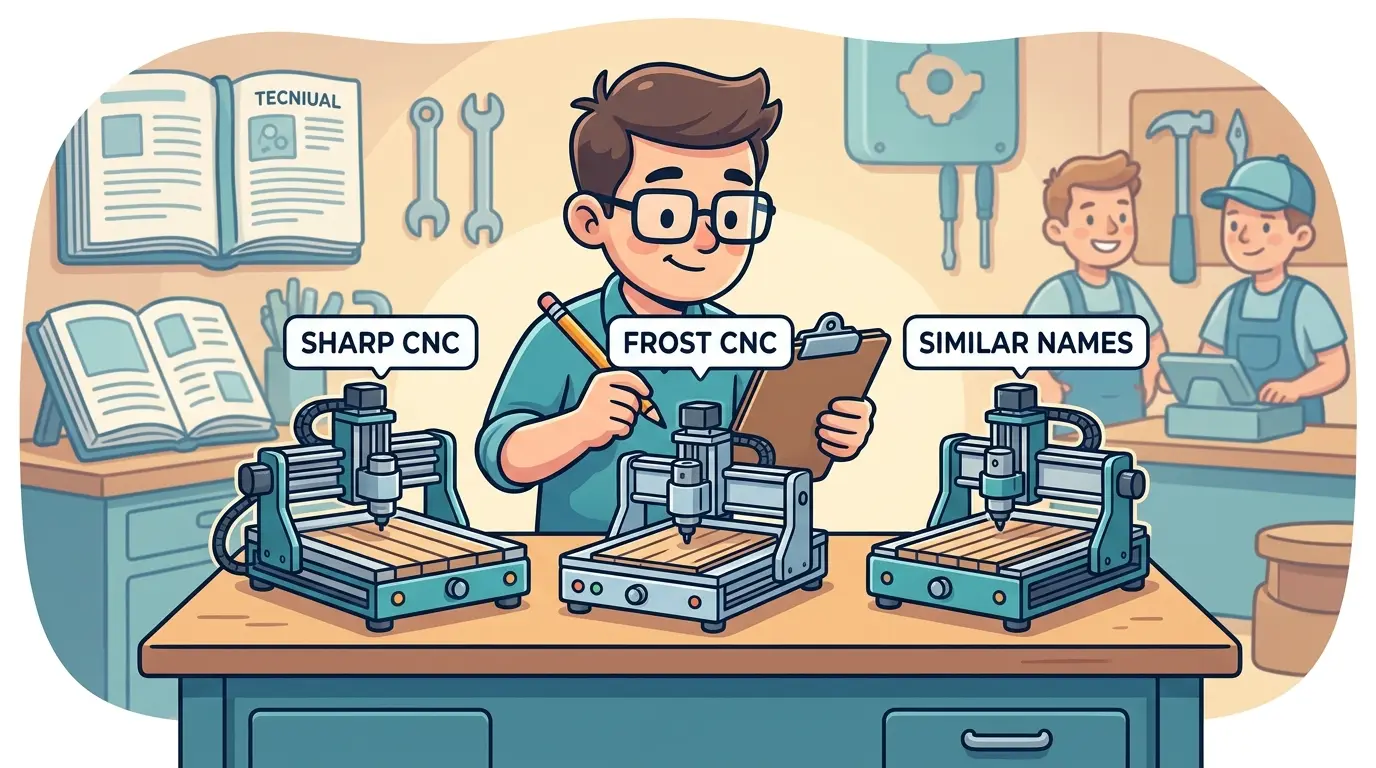
Low-visibility CNC router names appear constantly in search results, reseller pages, marketplace catalogs, and regional export listings. Some of them point to real manufacturers or at least to real machine platforms with consistent configurations. Others are little more than labels attached to generic imports, lightly customized builds, or listings with very little support depth behind them. That is why buyers should not treat a long-tail brand name as proof of a meaningful supplier category.
A name such as Sharp CNC, Frost CNC, or another low-visibility label is not the decision. It is only the start of the investigation. The practical task is to determine what machine is actually being offered, who remains responsible for it after the deposit clears, and whether the router fits the material, dust, hold-down, and service demands of the intended woodworking process.
The Search Term Is Usually The Least Reliable Part Of The Offer
Many buyers unconsciously treat search visibility as a form of legitimacy. It is not. Search results reward keyword targeting, reseller effort, marketplace optimization, and recycled descriptions just as easily as they reward true manufacturing depth. A low-visibility router name may still point to a usable machine, but that conclusion has to be earned through evidence.
That means moving quickly beyond the label itself. What is the actual platform? Who assembled it? What control system does it use? What spindle and hold-down strategy are really being quoted? What manuals exist? Can the seller explain the machine in operating language instead of generic phrases about accuracy and stability?
If those questions do not produce clear answers, the brand name is functioning only as an internet handle, not as a trustworthy buying reference.
Start By Classifying The Seller Before Classifying The Router
One of the biggest mistakes in long-tail router buying is evaluating the machine photo before evaluating the seller role. Buyers should establish whether they are dealing with a manufacturer, an authorized reseller, a trading company, a sourcing intermediary, or simply a marketplace operator. That distinction changes the support path more than many technical details do.
If the seller is not clearly responsible for after-sales support, spare parts, documentation, and problem escalation, the machine becomes much riskier regardless of the quoted specification. Buyers should ask who supplies replacement parts, who answers commissioning questions, and who responds when something arrives incomplete or under-documented.
Support uncertainty may be acceptable for low-risk experimentation. It is rarely acceptable when the router is expected to carry meaningful shop output.
Router Evaluation Has To Stay Router-Specific
A router is not simply a moving frame with a spindle. In woodworking and panel processing, it lives inside a system of sheet handling, vacuum hold-down, dust extraction, tooling, spoilboard management, and downstream part quality. That means long-tail router evaluation should stay focused on router reality, not generic CNC language.
Ask how the machine handles hold-down. Ask how vacuum zoning is configured. Ask what dust collection access is designed into the machine. Ask how the spindle and tooling approach fit the materials you actually expect to cut. Ask how frame rigidity aligns with those materials and with the finish quality the job requires.
Many weak listings avoid these details because they are harder to explain than bed size and travel. But in woodworking production, those details decide whether the router is genuinely usable.
If The Seller Cannot Describe The Cell, The Seller Probably Cannot Support The Cell
A strong router supplier can usually talk through the whole cell with some confidence. Not only the frame, but vacuum logic, spoilboard expectations, dust collection interface, typical tooling, control flow, and the way the machine fits the intended work. A weak supplier tends to stay at the level of dimensions and broad promises.
This difference matters because routers are system machines. They do not perform in isolation. If the seller cannot explain the system around the spindle, the risk shifts back to the buyer very quickly. Some buyers can absorb that risk. Many cannot. The earlier that becomes visible, the better the shortlist becomes.
Demand Evidence That Would Survive Internal Procurement Review
Because long-tail names often lack broad market reputation, evidence matters more. Ask for real machine photos, cabinet photos, manual excerpts, electrical cabinet details when relevant, part lists, cut samples that match your materials, and references that resemble the intended workload as closely as possible. If the router is being quoted for panel work, references that only show soft foam or decorative samples are not enough.
This is also where documentation quality should be examined carefully. Are the machine details coherent across quote, photos, and technical documents? Does the seller identify the control platform clearly? Is the spindle package described precisely? Is the vacuum or hold-down approach defined well enough to judge whether it fits the job?
Evidence does not need to be glamorous. It needs to be specific enough that another person inside your company could review it and reach the same conclusion.
Sample Cuts And Reference Calls Matter More With Obscure Names
If the seller can provide references, ask for references that resemble your workload rather than generic success stories. A router running occasional signage work does not automatically validate steady cabinet production. A clean demo sample cut does not prove hold-down stability, dust endurance, or repeatable daily accuracy on the material you care about.
This is why buyers should treat references and samples as workflow evidence rather than marketing theater. The useful question is not whether the machine can produce one attractive result. The useful question is whether it can support the intended process with manageable risk over time.
Where possible, ask questions a production user would ask. What happens during spoilboard maintenance? How often are vacuum leaks a problem? What parts actually wear first? How stable is accuracy through ordinary shop dust and daily use? Answers like these reveal more than another polished cut sample.
Compare Long-Tail Listings By Scope, Not By Optimism
Low-visibility names often appear in clusters of similar-looking listings. Buyers should assume that many of them omit or blur important differences. Compare them on scope, not just on price. What is actually included? Which control is named? What spindle details are explicit? Is the vacuum package defined or merely implied? Are training, installation support, spare parts, or service commitments written clearly?
This matters most when the price spread looks surprisingly wide. Low price can reflect honest simplification, but it can also reflect missing scope. If one listing is far cheaper, find out what is absent before calling it value.
The same comparison discipline used on established equipment still applies here. Buyers who need a sharper framework for that step should review how to compare CNC machine listings without missing critical details, because obscure branding does not reduce the need for scope discipline.
The Router Frame Is Not The Whole Cost Story
Low-visibility routers often look affordable because the listing focuses on the frame and spindle while leaving the support system vague. But woodworking routers only become reliable when extraction, tooling, hold-down upkeep, software flow, operator routines, and spoilboard maintenance are treated as part of the working cell. Buyers who ignore those integration costs may think they found a bargain when they have only delayed a portion of the total investment.
This is why the safer comparison is not between one frame price and another. It is between one working router cell and another. That perspective usually exposes whether the low-visibility option is genuinely economical or only initially cheap.
It also makes the decision easier to explain internally. A cheap frame can look attractive in isolation. Once the full working cell is considered, the difference between low initial price and low total risk becomes clearer.
Use A Screening Sequence Instead Of Browsing Endlessly
One quiet risk with low-visibility router names is spending too long in search mode and not enough time in screening mode. Buyers keep opening new tabs, comparing wording, and collecting impressions instead of forcing the process into documents, photos, references, and direct technical answers. That creates the illusion of due diligence without actually reducing uncertainty.
The smarter move is to use a screening sequence.
- Identify the seller role.
- Lock the exact machine scope.
- Verify router-specific system details.
- Request documentation and real evidence.
- Decide whether the offer is clear enough to stay on the shortlist.
Once a candidate fails one of those steps, stop enriching the file with more internet impressions. Move on. Obscure-name buying gets safer when the process shifts from discovery to proof.
A Low-Visibility Import Can Still Be Reasonable Under Tight Conditions
A long-tail router can still be a reasonable purchase when the buyer understands the machine category, has internal technical support, can accept some ownership of configuration and recovery, and is using the machine in a role where downtime will not create major commercial damage. In that environment, the value may come from acceptable mechanical function at a lower acquisition cost.
This usually works best when expectations are narrow and controlled. A shop exploring non-critical workloads, training staff, adding supplementary capacity, or experimenting with selected projects may accept more uncertainty than a plant depending on the router as a central production node.
The key is that the risk is chosen deliberately instead of discovered after purchase. Long-tail names are not automatically bad. They are simply less forgiven when the buyer pretends the support risk is not there.
The More Formal The Workflow, The Less Tolerance You Should Have For Brand Ambiguity
If the router is expected to feed cabinet production, nested sheet processing, custom panel flow, or an organized woodworking line, vendor clarity becomes much more important. Buyers in that situation are usually better served by category-led industrial suppliers with stronger workflow fit and cleaner support alignment. Long-tail names can still be compared, but the threshold for accepting uncertainty should be much higher.
This is where clear category structure helps. Buyers comparing industrial routing decisions should work from product family logic, not search-term ambiguity. A useful starting point is to review how to screen unknown and niche CNC brands before taking them seriously. When the purchase is closer to factory-direct sourcing, the better discipline is understanding what to verify before committing to a factory-direct machinery deal. And if the team needs a cleaner category-led starting point instead of another obscure search result, the broader Pandaxis machinery lineup gives a more stable frame for routing choices.
Build An Evidence File Before You Start Negotiating Price
One practical habit improves long-tail buying more than many buyers expect: build an evidence file before negotiating price. Put the quote, machine photos, technical scope, seller identity, support promises, sample details, and reference notes into one review packet. Then read that packet as if another person inside the company had to approve the purchase without your verbal explanation.
This step exposes weak offers quickly. If the packet still depends on assumptions, vague vacuum descriptions, missing scope items, or unclear support roles, the offer is not ready for commercial discussion. Price negotiation should come after supplier clarity, not before it. Otherwise buyers end up haggling over an under-defined machine and mistaking a lower number for lower risk.
Obscure-name machines become easier to judge when the documentation is forced into one visible file. Either the offer becomes clearer, or it reveals that the brand label was doing more work than the evidence ever could.
A Simple Internal Rule Prevents Many Bad Shortlists
One useful internal rule is this: if two people inside your company cannot describe the same low-visibility router the same way after reviewing the quote, the offer is not clear enough yet. That test works because it forces the documentation to stand on its own. If the offer still depends on one person remembering what the seller “probably meant,” it is not ready for budget approval or deposit discussion.
This rule is especially helpful in smaller shops where the owner researches the equipment but someone else may later have to install, run, or troubleshoot it. Clarity should transfer. If it does not transfer, the brand is still functioning as a vague label rather than a real supplier reference.
The Brand Name Should Never Be The Strongest Part Of The Offer
Low-visibility router names are not buying conclusions. They are prompts for deeper verification. Buyers should identify the real platform, confirm the seller’s role, evaluate router-specific system details such as vacuum and dust strategy, and compare listings by scope instead of by excitement.
If the evidence is thin, the brand is not “emerging.” It is simply under-verified. In that case, the safest decision is to stop calling it a supplier option until the machine can be understood as a real production asset rather than as a search result.