Most factories do not feel this decision at the purchasing desk first. They feel it later, when exposed cabinet edges start chipping in handling, when low-cost shelves still need to look clean after assembly, or when a product line needs a better finish but the edge material is still chosen only on roll cost.
PVC and melamine edge banding are both widely used in cabinet and panel furniture production. Both can work well when they match the substrate, the product tier, and the way the line is actually run. The real question is not which one is better in general. It is which one creates the better balance of durability, appearance, workflow stability, and material cost for the products your factory builds every day.
Start With the Finished Product, Not the Edge Roll Cost
Edge banding should be selected from the product requirement backward. A factory making budget office storage in dry interior conditions does not need the same edge performance as a producer building kitchen cabinetry, retail fixtures, or frequently handled furniture components.
Before choosing, clarify where the edge really has to perform:
- Will The Edge Be Exposed To Frequent Contact, Cleaning, Or Moisture?
- Does The Product Need A Thicker, More Substantial Finished Edge?
- Are Most Parts Straight And Low-Stress, Or Do Corners And Handling Damage Matter?
- Is Tight Decorative Matching More Important Than Higher Impact Resistance?
- Is The Goal To Control Material Cost On Large Volumes, Or To Reduce Rework On Exposed Parts?
Once those conditions are clear, PVC and melamine stop looking like interchangeable options.
What PVC Edge Banding Is Best At
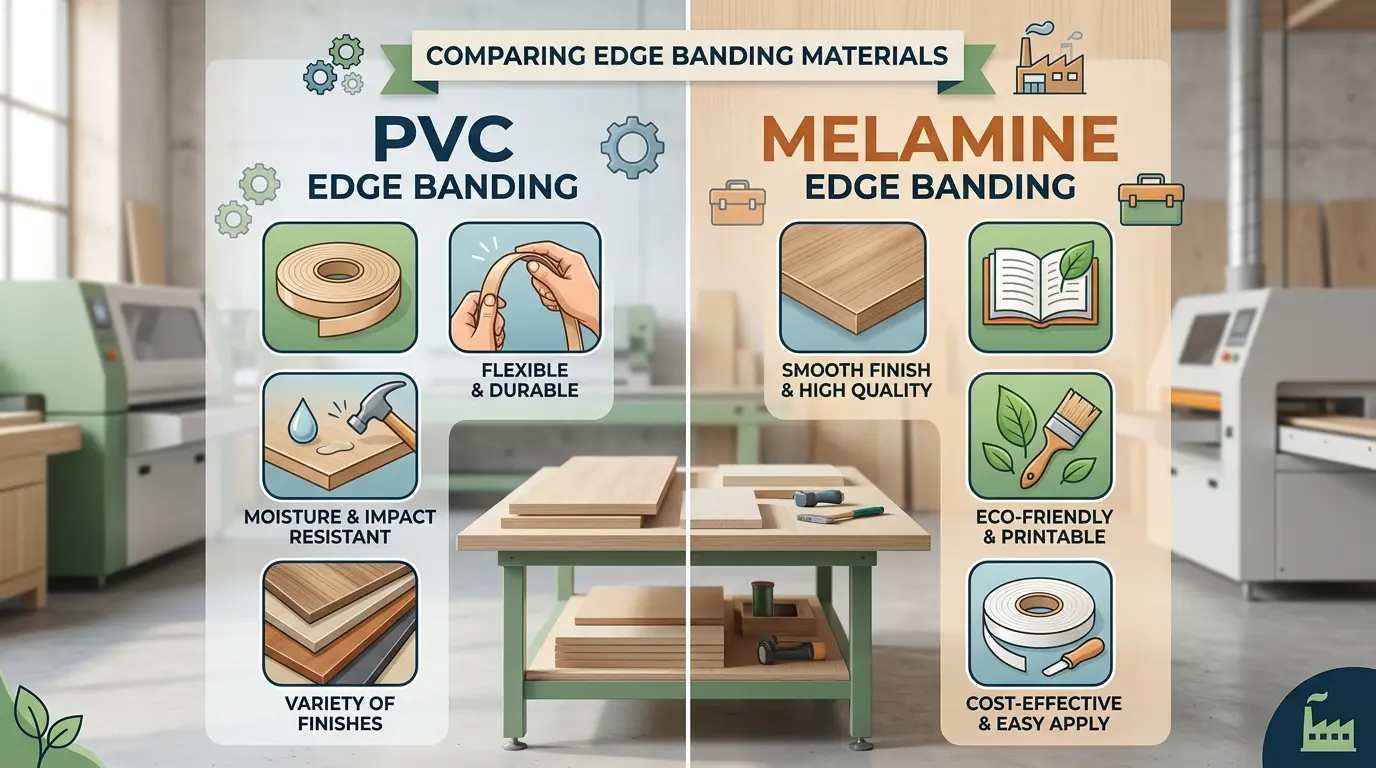
PVC edge banding is commonly selected when the edge needs to do more than simply cover the substrate. It is usually the stronger fit for parts that are visible, frequently touched, or more exposed to wear during transport, installation, and daily use.
In practical production terms, PVC is often chosen for:
- Better Resistance To Edge Chipping During Handling And Assembly
- A More Durable Finish On Doors, End Panels, Shelves, And Other Exposed Parts
- Thicker Edge Looks That Help The Panel Feel More Substantial
- Softer Or More Refined Finished Edges When Corner Finishing Matters
- Applications Where Moisture Resistance And Long-Term Appearance Matter More
That does not mean PVC is automatically the right answer for every panel. It means it usually gives the factory more room to protect the edge and support a higher finish standard.
The tradeoff is straightforward. PVC usually costs more than melamine edge material, and the added performance may not create real value on every component. If the edge is rarely seen, rarely touched, and not exposed to demanding conditions, the upgrade may be unnecessary.
What Melamine Edge Banding Is Best At
Melamine edge banding is commonly chosen when the goal is economical, clean-looking edge coverage on straight panel components, especially where visual blending with melamine-faced board matters and edge stress is relatively low.
It is often a practical fit for:
- Cost-Sensitive Cabinet And Furniture Production
- Interior Cabinet Components And Lower-Wear Parts
- Straight Edges On Panels That Do Not Need A Thicker Decorative Border
- Projects Where A Close Surface-Match Appearance Matters
- High-Volume Runs Where Cost Control Is A Major Decision Factor
Melamine can work well when the product is built around efficient panel processing and the edge is not expected to absorb much abuse. In the right use case, it helps the factory keep the material package lean without sacrificing a neat finished look.
Its limits are just as important as its strengths. Melamine edges are usually less forgiving when parts see repeated impact, moisture, rough transport, or higher finish expectations. When the edge is thin and the part will be handled hard, any weakness tends to become visible faster.
Side-by-Side Decision Table
| Decision Factor | PVC Edge Banding | Melamine Edge Banding |
|---|---|---|
| Best Fit | Exposed, higher-wear, or higher-finish parts | Straight, lower-wear, cost-sensitive panel parts |
| Durability | Commonly stronger against chipping and daily handling | Usually better for lighter-duty use |
| Moisture Resistance | Commonly preferred where edge protection matters more | Better suited to drier, lower-stress environments |
| Visual Effect | Supports a thicker, more substantial edge look | Often blends well with melamine-faced panels |
| Corner And Radius Flexibility | Usually the better fit when edge shaping or softer finishing matters | Generally strongest on straight, simple edges |
| Material Cost Priority | Chosen when performance justifies higher material spend | Chosen when cost efficiency is a primary driver |
| Typical Product Fit | Kitchen cabinetry, retail fixtures, frequently handled furniture, exposed panels | Cabinet interiors, office storage, economical furniture lines, lower-stress components |
The table shows why the decision should not be reduced to price alone. One material is usually chosen to protect the product and support a stronger finish standard. The other is usually chosen to keep edge coverage economical where the edge does not need the same level of protection.
How the Choice Affects the Edge Banding Workflow
This decision does not live only in purchasing. It shows up in panel preparation, glue application, trimming quality, corner finishing, and rework rate.
Factories aiming for higher finish consistency often review whether their edgebanders and edge-preparation process actually match the material they want to run.
PVC is often selected where the finish target is higher, which means pre-milling quality, glue-line stability, and clean trimming matter more because the edge is being judged as part of the finished product. Melamine can also look clean and efficient, but it usually depends more heavily on a flat, accurate substrate edge and stable process control because thinner edge material hides less.
In other words, neither material fixes poor preparation. PVC may be somewhat more forgiving visually in some applications, but rough panel edges, weak adhesion, or unstable trimming settings will still create visible problems. Melamine simply makes those problems show sooner.
When PVC Usually Makes More Sense
PVC is often the better fit if:
- The Product Has Highly Visible And Frequently Touched Edges.
- Handling Damage During Transport, Assembly, Or Installation Creates Rework.
- The Finished Panel Needs A Thicker Or More Premium Edge Appearance.
- The Product Will Face Cleaning, Moisture, Or Harder Daily Use.
- Softer Edge Feel Or Better Corner Finishing Adds Real Product Value.
In these situations, the higher material spend is often easier to justify because it supports durability, finish quality, and lower downstream correction.
When Melamine Usually Makes More Sense
Melamine is often the better fit if:
- Most Parts Are Straight, Economical, And Built For Lower-Stress Use.
- The Edge Needs To Visually Match Melamine-Faced Panels At Controlled Cost.
- The Product Mix Includes Many Interior Cabinet Components Or Less Exposed Parts.
- Large Volumes Make Material Cost A Major Planning Variable.
- Premium Edge Thickness Or Higher Impact Protection Does Not Change The Product’s Market Fit.
In those cases, melamine can be the more efficient choice because it keeps the edge package aligned with the actual performance requirement instead of overbuilding the part.
A Mixed Material Strategy Often Makes More Sense
Many factories do not need to standardize on one edge material across the whole catalog. A mixed strategy is often more practical.
PVC may make more sense on doors, open shelving, exposed end panels, counters, retail fixtures, and other parts that absorb wear or define the visual quality of the product. Melamine may make more sense on cabinet interiors, hidden carcass parts, lower-stress shelves, and straight-edge components where tight cost control matters more than added edge durability.
That kind of split strategy helps a factory spend more where the customer will actually feel the difference, while keeping overall material cost under control.
Practical Summary
Choose PVC edge banding when the product needs stronger edge protection, a more durable finish, or a thicker and more substantial visual result on exposed components. Choose melamine edge banding when the product is more cost-sensitive, the edges are simpler and lower-stress, and close visual matching to melamine-faced panels matters more than added impact resistance.
For many manufacturers, the best answer is not one material across the whole line. It is using PVC where wear, finish quality, and handling damage matter most, and using melamine where the edge only needs to stay clean, economical, and consistent. The better fit is the one that matches the real demands of the finished product, not just the lowest edge roll price.