In automated cabinet, wardrobe, and panel-furniture production, drilling problems rarely appear as a discussion about hole count alone. They show up as hinge plates that do not align cleanly, connectors that fight assembly, shelf-pin patterns that require rechecking, and operators stopping the line because the right part arrived with the wrong orientation or the wrong program.
That is why CNC drilling should be integrated as a line-design decision, not treated as an isolated machine purchase. The real objective is not only to automate hole processing. It is to make sure the drilling cell supports part flow, preserves reference accuracy, and delivers components that move into hardware fitting and assembly with less manual correction.
Why CNC Drilling Integration Is Really About Reference Control
Cutting creates the part outline, but drilling often determines whether that part will assemble quickly and repeatably. A cabinet side panel can look correct after sizing and still fail later if hole locations, handed orientation, or datum references are inconsistent.
This is why CNC drilling integration starts with reference control. The drilling station must receive parts in a condition that allows programs to run against stable assumptions about:
- Finished Part Dimensions
- Face And Edge Orientation
- Left-Hand And Right-Hand Part Identity
- Hardware Pattern Logic
- Batch Sequence Into The Next Operation
If those conditions are weak, the drilling cell can process parts automatically while still passing uncertainty downstream. Automation then increases volume without improving line stability.
Where CNC Drilling Usually Sits In The Production Flow
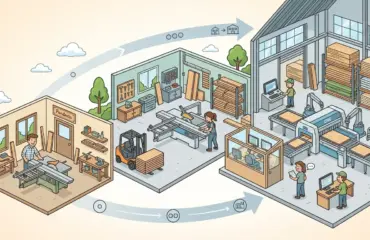
In many automated woodworking lines, CNC drilling sits between front-end part preparation and final assembly-related operations. The exact position depends on the product mix, the datum strategy, and whether the factory drills on raw cut parts or after edge processing.
The typical production logic often looks like this:
- Raw Panels Are Sized On A Front-End Cutting System.
- Parts Are Identified, Sorted, And Released By Batch.
- Edges Are Processed If The Workflow Requires Finished Reference Edges Before Hole Making.
- Parts Enter The CNC Drilling Cell In A Controlled Orientation.
- Hardware-Ready Components Move Into Fitting, Kitting, Or Assembly.
There is no universal rule that drilling must always happen before or after edge banding. Some factories prefer to drill after final edge condition is established so the reference geometry matches the finished part. Others place drilling earlier when the product structure and process discipline support that sequence. The better choice is the one that protects dimensional logic and reduces downstream correction.
Define The Upstream Conditions Before Automating The Drilling Cell
Factories often focus on the drilling machine itself and underestimate the conditions that must already be stable before the cell can perform well. In practice, upstream discipline usually decides whether drilling automation reduces labor or simply concentrates mistakes faster.
The most important upstream conditions are usually:
- Part Identification: Every panel should reach the drilling cell with unambiguous job, pattern, and handed information.
- Dimensional Consistency: Parts should arrive with stable sizing so hole programs are not compensating for front-end variation.
- Surface And Edge Readiness: If edge quality or panel condition still changes from batch to batch, drilling accuracy alone will not stabilize final fit.
- Release Logic: Mixed-priority rush jobs can break batch order and create program confusion.
- Orientation Discipline: Face-up, face-down, left-right, and front-back handling rules must be obvious and repeatable.
Without those controls, even a technically capable drilling station can become a high-speed sorting problem.
Choose The Right Drilling Strategy For The Line
Factories evaluating boring and drilling machines should first decide whether drilling belongs in a dedicated automated cell, in a simpler repetitive-hole station, or inside a more integrated CNC process.
| Drilling Approach | Best Fit | Main Strength | Main Tradeoff |
|---|---|---|---|
| Dedicated CNC Drilling Cell | Medium- To High-Volume cabinet and panel-furniture lines with repeatable hardware logic | Supports controlled hole processing as a distinct, automatable station | Requires stronger part tracking and batch discipline between stations |
| Multi-Spindle Or Pattern-Focused Boring Setup | Repetitive product families with stable hole patterns | Efficient for repeatable drilling tasks and routine cabinet-hole preparation | Less flexible when product variation or program complexity rises |
| Integrated CNC Nesting With Drilling | Mixed product lines that combine cutting, routing, and drilling in one front-end process | Reduces handoffs by combining operations on one platform | Can add complexity when the line mainly needs simple, fast, repeatable downstream drilling |
This choice matters because the best drilling solution is not always the most automated-looking one. A dedicated station is often valuable when the factory needs clearer line balance, more predictable sequencing, and reliable hardware-hole preparation after cutting. A more integrated process can make sense when product geometry, routing, and drilling are closely connected and separate handoffs would create more complexity than they remove.
Build The Data And Part-Tracking Logic Before You Chase Speed
Automated drilling only works cleanly when the right program is matched to the right part at the right moment. That sounds obvious, but many factories still rely on weak manual interpretation between cutting, edging, sorting, and drilling.
The stronger approach is to define the information flow first:
- How Parts Are Identified When They Leave The Front End
- How The Drilling Cell Confirms Program Selection
- How Left-Hand And Right-Hand Components Are Separated
- How Reworked Or Recut Panels Are Reintroduced Without Corrupting The Batch
- How The Line Flags Exceptions Instead Of Hiding Them Inside Production
Whether a factory uses labels, digital job instructions, barcode-driven routing, or another tracking method, the principle stays the same: program matching must be harder to get wrong than to get right.
This is also where an upstream CNC nesting machine may change the integration strategy. If cutting, routing, and some drilling are already combined at the front of the line, the remaining dedicated drilling requirement may be smaller and more specific. If the front end is mainly about rectangular panel sizing, a dedicated downstream drilling cell often becomes easier to justify.
Align Drilling With Cutting And Edge Processing, Not Against Them
In many factories, drilling instability does not begin inside the drilling station. It begins when the rest of the line sends the cell parts in the wrong sequence, with weak reference quality, or without enough buffering to keep flow controlled.
That is why drilling integration should be coordinated with the stations that feed it. If the line starts with panel saws, the sizing stage should release parts in a logic that downstream drilling can actually absorb. If parts move through edgebanders before hole making, edge quality and sequence discipline should support the drilling datum rather than create variation around it.
The real goal is not to make each machine independently faster. It is to make the transfer between stations more predictable. In practice, that usually means:
- Cutting Releases Parts In A Sequence The Drilling Cell Can Recognize
- Edge Processing Does Not Randomize Part Order
- Buffering Prevents Starvation And Overfeeding At The Drilling Station
- Exceptions Are Isolated Early Instead Of Being Mixed Back Into The Main Flow
- Operators Spend Less Time Verifying Which Part Should Run Next
When those links are weak, drilling automation tends to expose the line’s coordination problems rather than solve them.
The Integration Points That Usually Determine Payback
When production teams say a CNC drilling cell improved the line, they are often describing gains in these practical integration points rather than in drilling speed alone.
| Integration Point | Why It Matters | What Happens If It Is Weak |
|---|---|---|
| Part Orientation Control | Protects left-right logic, face selection, and reference consistency | Parts run with the correct program logic but the wrong physical orientation |
| Batch Release Discipline | Keeps drilling aligned with actual production order | Operators sort and reinterpret batches manually |
| Buffering Before The Cell | Smooths the handoff from faster or slower upstream stations | The cell waits unpredictably or becomes buried in mixed parts |
| Program Matching | Ensures each component receives the intended hole pattern | Good parts are misdrilled because identity control is weak |
| Exception Handling | Separates damaged, recut, or suspect parts from routine flow | One abnormal part disrupts the whole batch and creates confusion |
| Downstream Assembly Feedback | Confirms whether hole accuracy is solving real fit issues | The line keeps repeating the same hardware and assembly corrections |
These are the points that usually determine whether drilling automation improves throughput, repeatability, and assembly readiness, or merely shifts labor into checking and correction.
Common Integration Mistakes In Automated Woodworking Lines
The most common mistakes are usually process mistakes, not drilling-head problems.
Typical failures include:
- Automating Drilling Before Part Identification Rules Are Reliable.
- Letting Mixed Product Families Enter The Cell Without Clear Batch Separation.
- Ignoring Handed Parts Until Assembly Complaints Force A Correction.
- Measuring Success Only By Cycle Speed Instead Of Assembly Fit And Rework Rates.
- Placing The Drilling Cell Where It Inherits Unresolved Variation From Cutting Or Edge Processing.
- Adding Automation Without Defining How Exceptions, Re-Cuts, And Damaged Parts Rejoin The Line.
These problems matter because drilling is usually a precision-dependent station inside a larger flow. If the surrounding workflow is disorganized, more automation can make the disorder harder to contain.
What Good CNC Drilling Integration Looks Like On The Floor
When CNC drilling is integrated well, the change is visible in the behavior of the entire line. Operators spend less time reading part intent by eye. Hardware-hole patterns arrive at assembly with fewer surprises. Supervisors can see where flow breaks down instead of discovering problems only after assembly starts.
Good integration often looks like this:
- Parts Reach The Drilling Cell In The Planned Sequence.
- Orientation Rules Are Clear Enough That Wrong-Side Processing Becomes Rare.
- Hole Patterns Match The Actual Product Family Without Manual Reinterpretation.
- Drilled Components Move Into Hardware Fitting And Assembly With Fewer Corrections.
- Rework Becomes Easier To Trace Back To The Real Source Instead Of Being Blamed On The Last Station.
That is the real benchmark. The best drilling integration does not only produce holes more automatically. It helps the entire woodworking line become easier to run, easier to balance, and more predictable at assembly.
Practical Summary
Integrating CNC drilling into an automated woodworking line is mainly a question of workflow discipline, reference stability, and part identity control. The drilling station creates the most value when the factory decides where it belongs in the process, matches it to the right product mix, and builds the handoff logic around it before chasing headline output.
For panel-furniture and cabinet manufacturers, that usually means aligning drilling with cutting, edge processing, part tracking, and assembly needs as one connected system. When that happens, CNC drilling can improve hardware fit, reduce rework, and support cleaner daily flow. When it is added as an isolated upgrade, it can just as easily create a faster path for the same old mistakes.