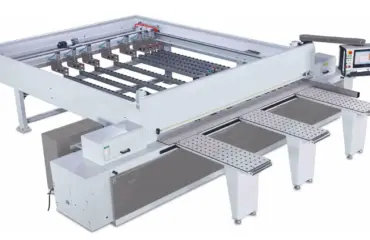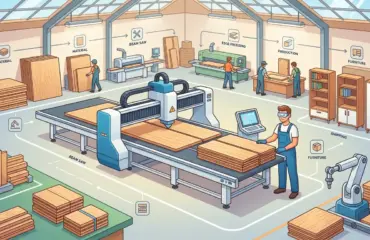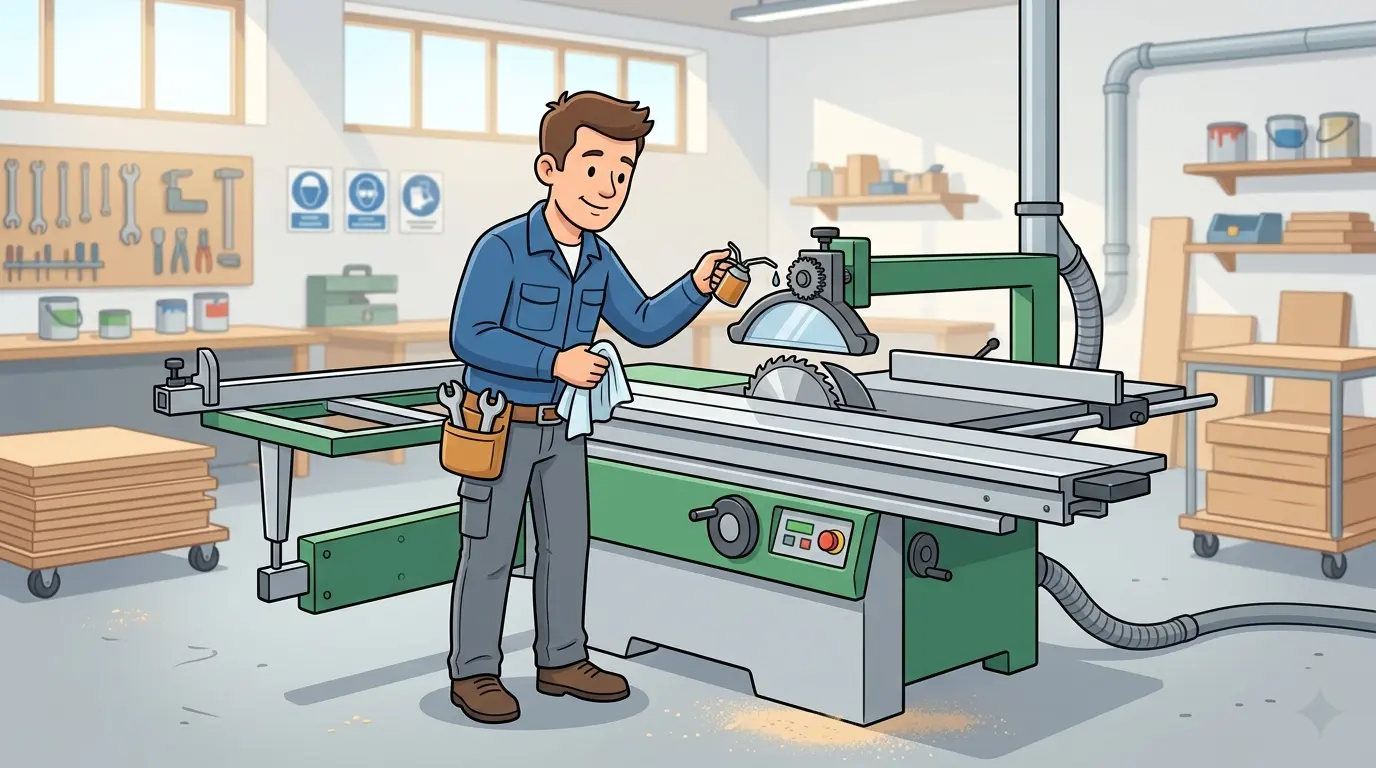
In panel-based furniture production, cutting accuracy rarely disappears all at once. It usually drifts. A little dust buildup under the work support, a blade that should have been changed earlier, or a hold-down system that no longer applies consistent pressure can all turn into size variation, edge defects, and downstream rework.
That is why a panel saw maintenance checklist should be treated as a precision-control routine, not just an uptime routine. For factories that depend on panel saws to feed edge banding, drilling, and assembly, preventive maintenance helps protect repeatability long before a visible breakdown forces attention.
Why Maintenance Affects Precision More Than Most Shops Expect
When a panel saw starts producing inconsistent parts, the root cause is not always a major mechanical failure. More often, accuracy drops because several smaller conditions build up at the same time:
- Dust and chips interfere with smooth panel support or positioning.
- Blade wear reduces cut quality and increases stress on the cutting system.
- Clamping or pressure inconsistency allows slight panel movement during cutting.
- Guide, alignment, or stop-position drift affects repeatability over time.
- Vibration, contamination, or missed lubrication accelerates wear in moving parts.
The result is usually felt across the workflow. Edge quality becomes less stable. Hole positions no longer align as cleanly with finished parts. Assembly teams spend more time correcting variation that should have been prevented at the cutting stage.
A Practical Maintenance Checklist by Frequency
| Frequency | Main Focus | Why It Matters for Precision |
|---|---|---|
| Daily | Cleaning, blade condition, visible abnormalities, sample-cut consistency | Prevents contamination and obvious quality drift from entering production |
| Weekly | Moving-part inspection, clamping reliability, extraction performance | Helps catch wear or instability before it affects repeatability |
| Monthly | Alignment checks, lubrication review, wear-point inspection | Protects dimensional consistency over longer production cycles |
| Quarterly or Scheduled Service | Calibration, deeper mechanical inspection, consumable replacement planning | Reduces accumulated drift and protects long-term cutting accuracy |
Daily Checks Before Production Starts
Daily maintenance should focus on the conditions most likely to affect that day’s output.
- Clean chips and fine dust from the worktable, support surfaces, pressure areas, and operator-accessible cutting zones.
- Check that the blade is clean, properly mounted, and not showing obvious wear, damage, or buildup.
- Listen for unusual noise or vibration during startup or first cuts.
- Confirm that dust extraction is functioning effectively and not allowing debris to collect around key support or cutting areas.
- Verify that clamps, pressure devices, or hold-down systems are moving freely and contacting the material consistently.
- Run a control cut or first-piece verification to confirm clean edges, stable dimensions, and acceptable squareness.
These checks are simple, but they prevent one of the most expensive maintenance mistakes in production: treating the first batch of saleable parts as a test run.
Weekly Inspection Points That Protect Repeatability
Weekly maintenance is a better time to look beyond visible cleanliness and focus on how the machine is behaving.
- Inspect guide paths, sliding surfaces, and accessible moving components for contamination or abnormal wear.
- Check blade fastening points and inspect for looseness, residue, or mounting issues.
- Review clamp or pressure-beam contact surfaces for dirt, damage, or uneven contact.
- Inspect hoses, cables, sensors, and covers in exposed areas for wear, dust accumulation, or interference.
- Confirm that stops, references, and positioning surfaces remain clean and stable.
- On machines equipped with a scoring unit, verify that cut quality remains balanced and that edge performance has not started to deteriorate.
The weekly objective is not to disassemble the machine unnecessarily. It is to find the small sources of instability that daily cleaning alone will not catch.
Monthly Checks for Alignment and Wear
If daily and weekly routines protect short-term quality, monthly checks help protect long-term accuracy.
- Verify repeatability with control cuts using the same reference method each time.
- Check cut squareness and dimensional consistency against the shop’s normal quality standard.
- Inspect accessible wear points in the saw carriage, guides, stops, and material support areas.
- Review lubrication points according to the machine manufacturer’s instructions.
- Inspect drive-related components that are intended for routine service access.
- Check whether hold-down or positioning systems are still applying consistent force and moving smoothly.
This is also the right time to compare maintenance observations with production symptoms. If the shop has seen more recuts, more chipping, or more fitting correction at assembly, the monthly inspection should look for the mechanical reason behind that change.
Scheduled Service Tasks That Should Not Be Delayed
Some maintenance work should not wait until quality becomes visibly unacceptable.
- Recalibrate alignment and reference positions at the intervals recommended for the machine and production load.
- Replace blades and other wear-sensitive consumables before they create repeated edge or size problems.
- Review extraction performance if dust buildup has become harder to control.
- Inspect components related to motion stability, vibration, and positioning accuracy during scheduled service windows.
- Confirm that machine guards, covers, and protective systems still allow the machine to operate cleanly and consistently.
Shops often delay these tasks because the machine is still running. That is usually the wrong threshold. A panel saw can remain operational while already losing the precision needed for efficient downstream processing.
Warning Signs That the Machine Is Losing Precision
Operators usually see the symptoms before maintenance records show a pattern. The key is to treat those symptoms as maintenance signals rather than operator complaints.
| Symptom | Likely Area to Check First | Production Risk |
|---|---|---|
| More edge chipping than usual | Blade condition, scoring relationship if equipped, material support cleanliness | Lower finish quality and more rework before edge processing |
| Dimensions begin to vary between repeated parts | Alignment, stops, positioning surfaces, panel movement during clamping | Assembly mismatch and slower part sorting |
| Rougher cut quality or increased noise | Blade wear, contamination, mounting condition, vibration sources | Faster wear and reduced consistency |
| Panels appear to shift or mark under hold-down | Clamp or pressure contact condition, contamination, uneven pressure | Loss of squareness and visible quality issues |
| Repeat cuts require more operator correction | Drift in setup references, wear in guiding or support areas | Hidden labor cost and unstable throughput |
When these symptoms appear, the right response is not only to correct the current batch. It is to identify what changed in the machine condition that allowed the issue to appear.
How to Make the Checklist Work on the Shop Floor
A maintenance checklist only protects long-term precision if it becomes part of production discipline.
- Assign clear ownership for daily, weekly, and scheduled tasks.
- Use the same reference checks each time so results can be compared over time.
- Record recurring symptoms such as chipping, size drift, or vibration instead of treating them as isolated events.
- Link maintenance observations to downstream issues in edge banding, drilling, and assembly.
- Follow the machine manual for lubrication, adjustment, and lockout procedures before any maintenance beyond routine external cleaning and inspection.
The goal is consistency. A shorter checklist used reliably is more valuable than a detailed checklist that nobody follows until quality has already slipped.
Practical Summary
A strong panel saw machine maintenance checklist is less about doing more tasks and more about protecting the conditions that keep cutting stable: clean support surfaces, sound blade condition, reliable clamping, controlled vibration, and regular alignment review.
For long-term precision, the most effective shops do not wait for visible failure. They use daily cleaning, weekly inspection, and scheduled calibration to keep small deviations from turning into large production losses. In panel processing, that discipline helps preserve cut quality, repeatability, and smoother flow through the rest of the factory.