In stone fabrication, the wrong machine purchase rarely looks wrong on day one. The problem shows up later, when cutouts slow down slab flow, edge quality depends too heavily on operator technique, expensive material gets reworked, or the CNC sits idle because the shop bought capability that does not match its actual jobs.
That is why a stone CNC machine should be bought as a workflow decision rather than a feature checklist. For countertop fabricators and architectural stone shops, the right machine helps improve routing precision, profile consistency, repeatability, and throughput between slab cutting, machining, finishing, and installation prep. The wrong machine simply moves the bottleneck from one station to another.
Start With The Bottleneck, Not The Machine Label
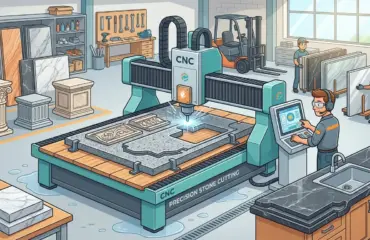
A stone CNC machine is commonly used for programmed operations such as routing, cutouts, edge shaping, carving, and other repeatable machining tasks in quartz, marble, and granite fabrication. But the buying process should begin with the production problem you need to solve.
For many fabricators, the real issues are usually things like:
- Inconsistent Countertop Cutouts Or Feature Placement
- Too Much Hand Correction On Edges And Profiles
- Slow Flow Between Slab Cutting And Final Finishing
- Variable Results Across Operators Or Shifts
- Rework On High-Value Parts Because Fit Or Finish Is Not Stable
If those are the daily constraints, then the CNC purchase is less about adding automation for its own sake and more about creating a more predictable fabrication process.
What A Stone CNC Should Improve In The Workflow
The value of a stone CNC is not that it performs a programmed operation. The value is that it helps the shop perform that operation more consistently, with less variation and less dependence on manual correction.
When evaluating stone CNC machines, fabricators usually get the clearest picture by asking where the machine creates practical gains such as:
- More Repeatable Cutouts And Machined Features
- More Consistent Edge Profiles From Part To Part
- Less Manual Rework Before Final Polishing Or Installation
- Smoother Flow For Repeated Countertop And Vanity Jobs
- Better Process Control On Parts That Need Accurate Fit
That does not mean a stone CNC replaces every other fabrication step. Slab sizing, handling, polishing, inspection, and installation prep still need to be aligned. The CNC matters most when it strengthens the middle of the process instead of being expected to solve every production weakness around it.
Different Shop Models Need Different CNC Priorities
Two fabricators can both work with stone and still need very different CNC setups. The difference is usually driven less by the material category itself and more by job mix, repeatability requirements, and how standardized the workflow already is.
| Shop Model | What Usually Matters Most | Where A Stone CNC Helps Most | Tradeoff To Watch |
|---|---|---|---|
| Countertop fabricators with repeated kitchen and bath work | Stable throughput, repeatable cutouts, edge consistency, lower rework | Keeps recurring part families more consistent and less operator-dependent | A highly capable machine can be underused if the work is mostly straightforward and repetitive |
| Mixed-production shops handling both standard and custom work | Flexible programming, changeover practicality, broad operation fit | Supports varied jobs without relying entirely on manual routing and shaping | Complexity increases if the shop changes job types constantly without disciplined process planning |
| Architectural stone fabricators doing more bespoke pieces | Accuracy on custom geometry, finish-sensitive parts, repeatable feature placement | Helps with programmed detail work where manual inconsistency is costly | If volumes are low and every part is unique, setup discipline becomes just as important as machine capability |
The main point is simple: the best machine is the one that fits the way the shop actually runs. A fabricator producing repeated countertop programs has different priorities from a business machining decorative or project-specific pieces.
Stone CNC Versus Other Fabrication Methods
A stone CNC is not universally better than every other fabrication method. It is better in the situations where programmed repeatability, profile consistency, and reduced hand correction matter enough to justify the investment and process discipline.
| Method | Best Fit | Workflow Advantage | Limitation |
|---|---|---|---|
| Stone CNC workflow | Shops that need repeatable machining, profile consistency, and more stable output across repeated jobs | Improves consistency on machined operations and reduces dependence on manual variation | Requires part planning, programming discipline, and line balance to deliver full value |
| Saw-led workflow with manual secondary processing | Shops where most value still sits in slab sizing and simpler downstream work | Lower process complexity for straightforward jobs and smaller operations | Manual secondary work can become a bottleneck as volume or finish expectations rise |
| Manual routing, profiling, and finishing stations | Lower-volume or highly variable work where flexibility matters more than repeatable cycle flow | High adaptability for one-off adjustments and special cases | Quality and speed can vary significantly with operator technique and workload |
For many fabricators, the real question is not whether a stone CNC can do more. It is whether the shop has enough repeated machining work, enough rework pressure, or enough quality sensitivity for that additional process control to matter commercially.
Material Mix Changes The Buying Logic
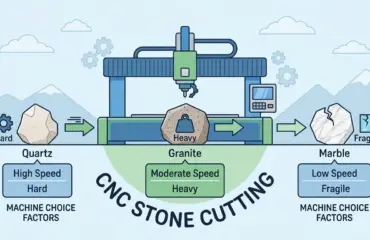
Stone fabrication is not one uniform production environment. Quartz, granite, and marble jobs can place different demands on workflow, finish expectations, and how much variation the shop can tolerate.
Quartz-focused countertop shops often care most about repeatability across repeated part families, especially where sink areas, edge details, and installation fit need to stay consistent from one job to the next. Granite work may put more pressure on machining strategy, process stability, and how the shop manages expensive material through multiple steps. Marble and more decorative work can make edge finish, detail quality, and downstream touch-up more important than headline throughput.
That means the right buying decision is rarely just about choosing a machine category. It is about matching the CNC to the materials and job types that consume the most labor, cause the most defects, or create the most delivery risk in your current workflow.
Buying Criteria That Actually Matter
Most strong buying decisions come down to a short list of practical questions.
| Buying Criterion | Why It Matters | What To Clarify Before Buying |
|---|---|---|
| Job Repetition | Repeated programs create more value from programmed machining consistency | How much of your workload comes from similar countertop, vanity, or recurring project parts? |
| Rework Pressure | Shows whether inconsistency is already costing labor and material | How often are edges, cutouts, or machined features corrected by hand after the main process? |
| Finish Standard | Determines how much profile quality and repeatability affect the final product value | Are customers paying mainly for basic fabrication, or for visibly cleaner and more consistent finished parts? |
| Product Mix | Affects whether the machine should favor standardized output or flexible changeovers | Is the shop mostly repeat work, mostly custom work, or a mix of both? |
| Upstream And Downstream Balance | Prevents one machine from outrunning the rest of the shop | Will slab cutting, handling, polishing, and inspection support the output of the CNC workflow? |
| Operator Dependence | Reveals whether the current process is too dependent on individual skill | Are results stable across shifts, or do good parts depend too heavily on who is running the job? |
| Scrap Risk | High-value material makes process variation more expensive | Which operations create the most costly mistakes today? |
| Growth Direction | Keeps the purchase aligned with future demand, not only current jobs | Are you preparing for more volume, more complexity, or higher finish expectations over time? |
These questions usually lead to a better decision than comparing isolated headline specifications without a clear process context.
When A Stone CNC Creates The Most Value
A stone CNC usually delivers the strongest return when one or more of the following conditions are already true:
- The Shop Runs Repeated Machining Patterns Across Many Jobs
- Manual Routing Or Profiling Is Creating A Quality Bottleneck
- Rework On Expensive Material Is Too Common
- Installation Fit Depends On More Repeatable Machined Features
- The Business Needs More Stable Output Across Operators And Shifts
In those cases, the machine is not just adding capability. It is helping standardize an operation that may already be limiting margin, throughput, or finish quality.
By contrast, if the shop handles mostly simple one-off jobs with limited programmed machining and low rework pressure, a more advanced CNC purchase can become harder to justify. More capability is not automatically more value if the day-to-day workflow does not use it.
Common Buying Mistakes
Fabricators usually regret a stone CNC purchase for one of a few predictable reasons:
- Buying For Maximum Capability Instead Of The Real Bottleneck
- Expecting The CNC To Replace Every Other Fabrication Step
- Underestimating The Importance Of Programming And Process Discipline
- Ignoring How Material Handling Affects Overall Throughput
- Overbuying For Rare Complex Jobs While Most Work Remains Straightforward
- Evaluating The Machine In Isolation Instead Of As Part Of The Full Fabrication Flow
One of the most common mistakes is assuming that automation alone guarantees better output. In practice, the gains come when the CNC is integrated into a stable workflow with clear upstream preparation and realistic downstream capacity.
Practical Summary
For fabricators, a stone CNC machine should be selected according to workflow fit, not brochure ambition. The right machine helps improve routing precision, feature repeatability, profile consistency, and overall process stability where those outcomes actually matter to margin and delivery. The wrong machine adds cost without solving the real cause of delay, rework, or variation.
If your operation depends on repeatable machining across recurring countertop or architectural stone work, a stone CNC can be a strong step toward cleaner output and less manual correction. If your work is more variable, lower volume, or less dependent on programmed machining, the buying decision should stay tightly connected to the real production constraint rather than the broadest possible machine category.
The practical rule is simple: buy the machine that solves the part of the fabrication workflow that is already costing time, consistency, or material, and be honest about whether your shop will use that capability every day.