The upgrade question usually appears before the current setup fully breaks down. Panels may still leave the line with acceptable edges on good days, but the factory starts seeing a different pattern: operators spend more time touching up glue lines, visible parts need extra polishing, repeated cabinet jobs begin stacking up in front of the machine, and downstream departments stop trusting the output to be consistent without rechecking it.
That is usually the real signal. An edgebanding upgrade is rarely just about replacing an older machine with a newer one. It is about deciding when the current process no longer matches the finish standard, labor model, and production rhythm the business now needs.
Start With Workflow Pressure, Not Machine Age
An older edgebanding setup is not automatically the wrong one. In many smaller shops or mixed-production environments, a simpler process can still be the most practical fit. If daily output is varied, volumes are modest, and the finish expectation allows for some manual intervention, keeping the current setup may remain the rational choice.
The upgrade window usually opens when the production model changes.
That often happens when:
- More daily work shifts toward repeated cabinet, wardrobe, or modular furniture parts
- The business is asked to deliver a cleaner visible finish with less manual correction
- Labor pressure increases around edge finishing, scraping, trimming, or corner treatment
- Downstream operations need steadier part flow with fewer surprises
- Management wants output quality to depend less on one experienced operator
At that point, the edgebanding process stops being a stand-alone finishing step. It becomes part of a larger production-control problem.
The Clearest Signs The Upgrade Window Has Opened
The most useful upgrade signals usually come from the floor rather than from the machine brochure.
| What You Are Seeing On The Floor | What It Usually Means | What Kind Of Upgrade Is Worth Examining |
|---|---|---|
| Glue-line appearance varies from panel to panel | Edge preparation or process stability is too inconsistent | A more controlled process, often including pre-milling or better integrated finishing |
| Operators spend too much time scraping, polishing, or correcting finished edges | The line is not producing a ready-for-next-step part consistently enough | A more complete edgebanding process with less dependence on manual rework |
| Repeated cabinet runs create a queue in front of the edgebander | The machine or process no longer matches batch-production demand | A more automatic, production-oriented edgebanding setup |
| Quality holds only when one experienced operator is present | Process performance depends too heavily on individual technique | A more repeatable setup designed to reduce operator dependency |
| Visible panels look acceptable at the machine but trigger corrections during assembly | Edge quality is not stable enough for downstream fit and appearance expectations | Better edge preparation, trimming consistency, and finish control |
| More product lines now require higher finish expectations on exposed components | The original process was built for a lower cosmetic standard | An upgrade aligned with visible-finish production rather than utility-grade output |
If several of these signals are appearing at the same time, the issue is usually not that the current machine is simply old. It is that the business is now asking the edgebanding station to behave like a more advanced production process than it was originally set up to support.
What An Edgebanding Upgrade Actually Means
An upgrade does not always mean jumping straight to the largest or most complex solution. In practice, factories often evaluate different levels of change depending on where the friction really sits.
For example, a shop comparing edgebanders is usually not just asking, “Which machine is newer?” It is asking which process change will remove the most daily friction.
In practical terms, the upgrade path often falls into one of these categories:
- Moving To Better Edge Preparation
- Adding More Complete Finishing On The Line
- Moving From Operator-Paced Output To More Automatic Batch Processing
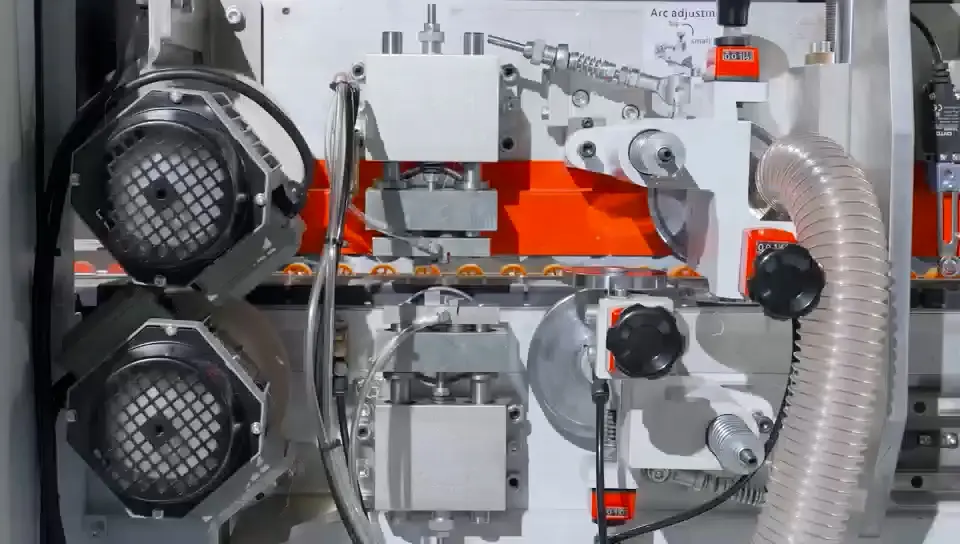
Better edge preparation matters when incoming panel edges are not giving the banding process a reliable starting surface. If saw-cut edges vary enough to affect glue-line appearance or adhesion consistency, a process that includes pre-milling is commonly considered because it helps create a more uniform edge before banding.
More complete finishing matters when the machine is applying edge material adequately, but visible parts still require too much manual touch-up. In that situation, the goal is not just to apply the edge. It is to leave the panel closer to finished condition, with less secondary work around corners, trimming, or visible transitions.
More automatic batch processing matters when the problem is no longer isolated finish quality but production pace. If the shop is running repeated rectangular parts all day and the edgebanding station has become the constraint, management usually begins evaluating a setup that is better suited to stable, repeated throughput rather than intermittent operator-led flow.
Match The Upgrade To The Real Constraint
The wrong upgrade usually happens when a factory buys for general ambition instead of the specific problem it is trying to solve.
| Primary Constraint | Upgrade Path Commonly Considered | Why It Fits |
|---|---|---|
| Inconsistent panel-edge condition entering the banding stage | Pre-milling-oriented edgebanding process | It helps give the edge application stage a more consistent starting point |
| Excessive manual touch-up after banding | More complete on-line finishing, often including corner treatment | It reduces labor consumed by post-process correction |
| Repeated cabinet jobs overwhelm the current station | A more automatic edgebanding process | It is better aligned with batch production and steadier output demand |
| Quality varies sharply by operator or by shift | A process built around repeatability rather than manual compensation | It helps standardize output across normal working conditions |
| Mixed work still dominates daily output | Targeted process improvement instead of a full production-line jump | It protects flexibility where a heavily standardized solution may not pay back |
This is why the upgrade decision should stay tied to workflow evidence. A factory with edge-prep problems needs a different answer from one with labor-intensive finishing. A factory with a throughput bottleneck needs a different answer from one with mostly custom, irregular work.
Where The Upgrade Usually Pays Back First
The most visible benefit is not always raw speed. In many factories, the first payoff shows up in fewer corrections and more predictable flow.
An upgraded edgebanding process often creates value through:
- Fewer Manual Touch-Ups On Visible Components
- More Consistent Glue-Line Appearance Across Batches
- Lower Rework Before Drilling, Assembly, Or Final Inspection
- Better Stability When Volumes Rise Or Product Mix Concentrates Around Repeated Parts
- Less Dependence On One Highly Experienced Operator To Hold Quality Together
That matters because edge quality problems rarely stay isolated at the edgebander. Once rework starts appearing, it affects staging, drilling schedules, assembly fit, packing rhythm, and the credibility of delivery planning. A process improvement at the edge station is often valuable because it removes uncertainty from the rest of the line.
When You Should Not Upgrade Yet
Not every factory that feels pressure at the edge station should move immediately to a larger or more capable edgebanding setup.
Holding back may still be the smarter decision if:
- The Real Bottleneck Is Upstream Cutting, Sorting, Or Material Staging
- Daily Output Is Still Highly Custom, Irregular, Or Change-Heavy
- Visible-Finish Demand Is Still Limited Relative To Total Production
- Process Discipline Around Part Identification And Batch Flow Is Still Weak
- The Current Machine Is Underperforming Mainly Because Of Maintenance, Setup Practice, Or Inconsistent Input Quality
This is an important discipline point. A better edgebander will not fix poor panel sizing, confused part flow, weak maintenance habits, or disorganized staging by itself. If the process around the machine is unstable, a capital upgrade can still leave the same daily frustration in place.
Ask The Operational Questions Before You Commit
Before upgrading, it helps to frame the decision in production terms rather than machine terms.
- Is The Current Problem Mainly Finish Quality, Labor Consumption, Or Throughput?
- Are Incoming Panel Edges Stable Enough For The Finish Standard We Need?
- Does Too Much Value Still Depend On Manual Touch-Up After Banding?
- Is The Edgebanding Station Now Slowing Repeated Cabinet Or Furniture Work?
- Would A More Repeatable Process Reduce Corrections In Downstream Operations Enough To Justify The Investment?
- Are We Standardized Enough In Batch Flow To Benefit From A More Production-Oriented Solution?
If the answers point toward repeatable work, higher visible-finish expectations, ongoing manual correction, and a need for steadier daily flow, the upgrade case becomes much stronger.
Practical Summary
Upgrade your edgebanding process when the cost of inconsistency becomes higher than the cost of improving the system. The clearest signals are usually visible on the floor: too much touch-up labor, too much finish variation, too much dependence on operator skill, or too much pressure when repeated jobs move through the line.
The right upgrade is not always the biggest machine. It is the process change that best matches the real constraint, whether that means better edge preparation, more complete on-line finishing, or a more automatic setup for batch production. The practical goal is simple: send panels downstream with edge quality and flow stability that no longer need to be rescued by the next department.