When hole processing starts slowing cabinet assembly, the drilling cell is no longer a minor support station. It becomes a production constraint. Misaligned connector holes, inconsistent shelf-pin rows, and repeated setup changes can all create rework that shows up much later in assembly. That is why the difference between a CNC drilling machine and a boring machine matters.
For buyers comparing boring and drilling machines, the short answer is this: a boring machine is usually the stronger fit for repeated, fixed hole patterns, while a CNC drilling machine is usually the stronger fit when part variety is high and pattern changes happen constantly. Both machines create holes. The real difference is how they fit the workflow around those holes.
Why The Terms Often Get Mixed Together
In woodworking and panel furniture production, “boring” and “drilling” are often used almost interchangeably because both refer to making holes in a workpiece. That overlap is real, but the machines are usually positioned differently on the production floor.
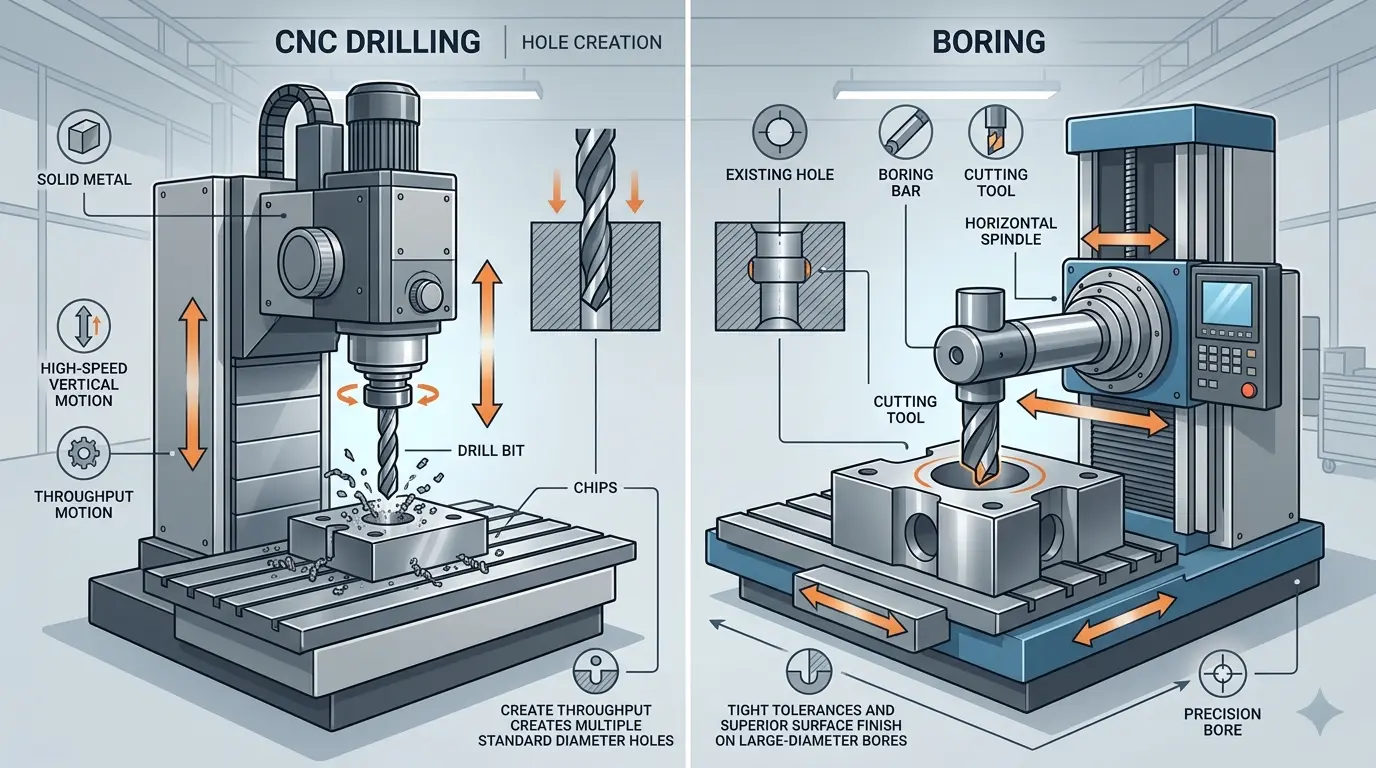
A boring machine commonly refers to row-boring or multi-spindle equipment used for repeated hole positions such as shelf-pin lines, hinge-related drilling, connector-hole patterns, and other standardized cabinet-part processing. A CNC drilling machine usually refers to a programmable drilling center that can place holes according to a digital part program rather than a mostly fixed mechanical setup.
That is why buyers sometimes hear conflicting descriptions from different suppliers. In some cases, a supplier may even use “CNC boring” and “CNC drilling” to describe closely related equipment. The more useful distinction is not the label alone. It is whether the machine is optimized for fixed-pattern efficiency or programmable flexibility.
What A Boring Machine Usually Does Best
A boring machine is commonly selected when the factory runs stable part families with predictable hole layouts. Its strength is not complexity. Its strength is repeated accuracy in a familiar pattern.
That usually fits workflows such as:
- Cabinet Side Panels With Standard Shelf-Pin Rows
- Repeated Connector Or Confirmat Hole Layouts
- Drawer Components With Stable Drilling Patterns
- Panel Furniture Production Built Around 32 mm System Logic
In those conditions, a boring machine can be highly effective because the setup discipline stays consistent. Once the workpiece format and drilling logic are stable, the machine helps keep output predictable without forcing the team to rebuild drilling instructions for every order.
This is why a boring machine should not be treated as an outdated option by default. In a standardized production environment, simpler process logic can reduce setup loss, keep training easier, and support steady output with less day-to-day adjustment.
What A CNC Drilling Machine Adds To The Workflow
A CNC drilling machine is usually chosen when the drilling station needs to adapt quickly to changing jobs, different panel dimensions, or more complex hole-group variation. Its value comes from program-driven positioning rather than fixed-pattern repetition alone.
That often makes it better suited to:
- Frequent SKU Changes Or Custom Orders
- Mixed Batches With Different Hole Patterns Across Similar Parts
- Faster Changeovers Between Part Families
- Reduced Manual Layout And Less Repeated Mechanical Adjustment
- Stronger Alignment Between Digital Production Planning And Hole Processing
The practical gain is not automation for its own sake. It is better control over pattern changes. When the part mix shifts often, a CNC drilling machine can help the factory protect repeatability without forcing the operator to rebuild stops, re-check spacing manually, or accept too much setup drift from one job to the next.
Side-By-Side Comparison
| Production Factor | Boring Machine | CNC Drilling Machine | Stronger Fit |
|---|---|---|---|
| Repeated Fixed Hole Patterns | Usually efficient because the setup remains stable across many similar parts | Can handle the work, but much of the flexibility may be underused | Boring Machine |
| Mixed Batch Flexibility | Usually weaker when patterns change frequently | Usually stronger because programs can change faster than mechanical setups | CNC Drilling Machine |
| Setup And Changeover | Often simple for stable jobs, but more disruptive when layouts vary | Usually better when the part family changes often | CNC Drilling Machine |
| Operator Dependence | More dependent on correct setup discipline and consistent positioning | Usually reduces repeated layout decisions once the program is prepared | CNC Drilling Machine |
| Standard Cabinet Output | Commonly a strong fit for repetitive cabinet-part drilling | Also suitable, especially if product variety keeps increasing | Depends On Job Mix |
| Complex Hole Variation Across Part Families | Usually less convenient when the pattern logic changes often | Commonly better suited to varied drilling requirements | CNC Drilling Machine |
The table shows the real tradeoff clearly. A boring machine usually wins when the hole pattern is stable enough to justify a repeated setup. A CNC drilling machine usually wins when the factory loses more time to changeovers than to drilling itself.
How The Difference Shows Up In Assembly And Rework
Buyers often focus on the drilling station alone, but the real effect appears downstream. Hole-processing quality matters because it affects how easily the next steps come together.
When the machine type fits the workflow, the results usually show up as:
- Better Hardware Alignment During Assembly
- Less Manual Re-Checking Of Left And Right Panels
- Cleaner Fit For Connectors, Slides, And Hinges
- Fewer Assembly Delays Caused By Hole-Position Errors
- More Predictable Part Flow Into Hardware Insertion And Final Assembly
A boring machine supports those outcomes when the production line is standardized enough to benefit from stable repetition. A CNC drilling machine supports those outcomes when many part variants still need to arrive at assembly with the same repeatability.
When A Boring Machine Is Usually The Better Choice
A boring machine usually makes more sense when:
- The factory produces repeated cabinet or drawer parts with stable hole spacing.
- Most drilling work follows standard hardware logic rather than frequent custom variation.
- The team wants a straightforward drilling station with predictable daily routines.
- The main bottleneck is repeated volume, not constant pattern change.
- Additional programming flexibility would add more complexity than practical value.
In that kind of environment, fixed-pattern efficiency can outperform broader flexibility because the workflow does not need to change often enough to justify a more adaptable system.
When A CNC Drilling Machine Is Usually The Better Choice
A CNC drilling machine usually makes more sense when:
- Order mix changes frequently from one batch to the next.
- The shop handles custom furniture, semi-custom cabinetry, or many SKU variations.
- Hole groups differ often across similar-looking parts.
- Setup time is being lost every time the part pattern changes.
- The drilling station needs to match a more digital, program-driven production model.
In those conditions, the ability to change drilling logic without rebuilding the process around manual setup can protect both throughput and assembly accuracy.
The Buying Mistake That Causes The Most Confusion
The most common mistake is comparing these machines as though one drills and the other bores, then assuming the technical gap is larger than it really is. In practice, both machines are part of the same hole-processing decision space. The more useful comparison is between fixed-pattern efficiency and programmable flexibility.
Another common mistake is buying for the most advanced-looking option instead of the most suitable production model. A CNC drilling machine is not automatically the better investment if the factory mostly runs standardized parts with stable patterns. The reverse is also true. Shops with frequent custom orders often stay with fixed-pattern boring equipment too long, then absorb the cost through manual adjustment, slower changeovers, and preventable assembly corrections.
The Real Decision Is About Workflow, Not Vocabulary
The best machine choice depends on what the drilling station is expected to remove from the workflow.
If the main goal is steady output on repeated cabinet parts, a boring machine may be the cleaner answer because it supports straightforward, repeatable production. If the main goal is adapting quickly to changing part programs without losing hole accuracy, a CNC drilling machine usually offers the better fit.
That is why this comparison should be judged against the full process rather than the machine name alone. The question is not simply which machine makes holes. The question is which machine helps the factory move parts into assembly with less setup loss, less alignment trouble, and less downstream correction.
Practical Summary
A boring machine and a CNC drilling machine are not opposites in the sense of one being modern and the other obsolete. They solve different versions of the same production problem.
If your factory runs repeated drilling patterns on stable cabinet parts, a boring machine is often the more practical choice because it keeps the process simple and repeatable. If your factory handles frequent order changes, mixed batches, and hole-pattern variation, a CNC drilling machine is often the stronger choice because it protects changeover speed and repeatability at the same time.
The right decision comes down to one issue: whether your drilling cell needs fixed-pattern efficiency or program-driven flexibility. Once that is clear, the difference between the two machine types becomes much easier to evaluate.