The phrase “better” only becomes useful once a shop defines the real job. For light wood engraving, both CO2 and diode systems can be workable. For acrylic cutting, repeatable output, and mixed-material production, the decision usually becomes much less balanced. A diode machine may look attractive because the entry cost is lower and the footprint is simpler, but daily production often exposes limits that a one-piece demo does not show.
For buyers evaluating laser cutters and engravers for wood, acrylic, and similar non-metal applications, the more useful question is not which source sounds more advanced. The more useful question is which source fits the material behavior, finish standard, and throughput target of the actual workflow.
The First Question Is Whether Acrylic Is Core or Occasional
If acrylic is a core production material, CO2 is usually the stronger benchmark. That is especially true when the shop produces clear acrylic signs, display parts, decorative panels, covers, or retail components where edge appearance matters. Clear acrylic commonly aligns well with CO2 processing, while many diode setups are more limited and are often better suited to darker, opaque, or surface-treated acrylic rather than clear sheet.
If wood is the main material and acrylic only appears occasionally, the decision can change. A diode laser may still be acceptable for light engraving work, thin wood parts, prototypes, or small-batch customized products where the real priority is low entry cost rather than faster production output.
That is why this comparison should start with the order mix:
- If Clear Acrylic Parts Drive Revenue, CO2 usually deserves priority.
- If Thin Wood Engraving and Small Personalized Orders Dominate, Diode may still be enough.
- If The Shop Must Switch Between Wood and Acrylic Regularly, CO2 is usually easier to justify.
What Actually Changes Between CO2 and Diode in Production
The difference is not only the beam source. The difference shows up in how the machine behaves when the shop needs stable cutting, repeatable engraving, and less operator compromise.
| Decision Factor | CO2 Laser | Diode Laser | Workflow Effect |
|---|---|---|---|
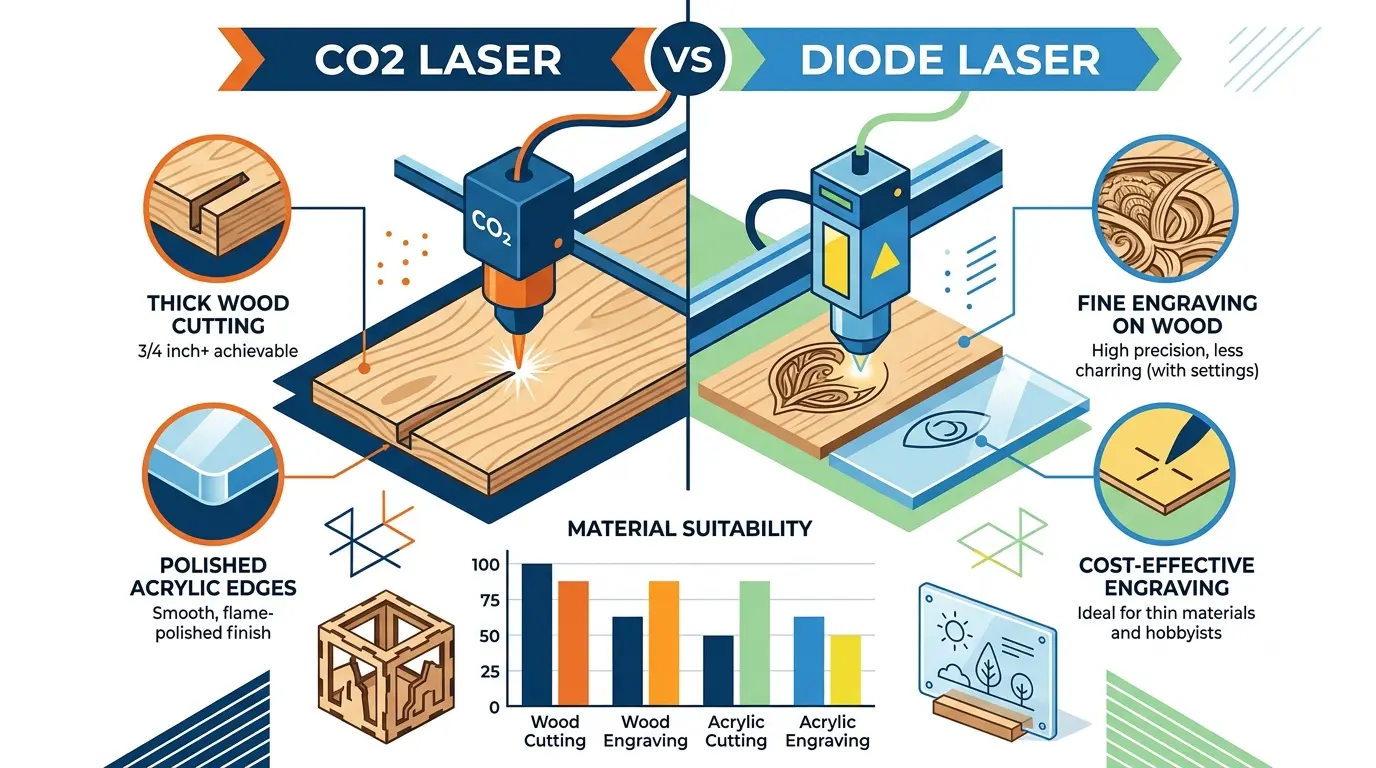
| Wood Engraving | Commonly strong for clean engraving across a wider range of wood-based materials | Often useful for lighter engraving and smaller-format work | Both can work, but production scale changes the result |
| Wood Cutting | Usually better suited to faster cut-through and broader non-metal cutting demands | Often more limited to thinner wood or slower processing | CO2 usually protects throughput better |
| Clear Acrylic | Commonly a strong fit | Often limited or impractical without special workarounds | Clear acrylic usually pushes the decision toward CO2 |
| Dark or Opaque Acrylic | Commonly workable | Sometimes workable depending on material and setup | Diode may be acceptable for narrower acrylic use cases |
| Mixed Wood and Acrylic Jobs | Usually more flexible for a broader non-metal queue | More likely to force material-specific compromises | CO2 is usually easier to standardize |
| Entry Cost and Footprint | Usually higher system cost and more supporting infrastructure | Usually lower barrier to entry and smaller footprint | Diode can make sense when budget is the main constraint |
| Production Throughput | Commonly stronger for recurring work | Often better suited to lighter-duty or slower-paced work | The labor cost gap can widen over time |
The practical takeaway is simple: diode and CO2 do not fail in the same place. Diode usually reaches its limit when the shop asks for more speed, more acrylic capability, or more consistency across a varied queue. CO2 usually becomes harder to justify only when the work stays light enough that the extra capability does not get used.
Where CO2 Laser Usually Wins
CO2 usually becomes the better production choice when the shop needs one machine to do more than decorative engraving.
The first advantage is acrylic compatibility. If the finished part must look clean coming off the bed, especially in clear acrylic, CO2 is usually the safer path. That matters in display fabrication, signage, branded fixtures, protective covers, and decorative panels where the edge is part of the finished appearance rather than just a hidden process step.
The second advantage is cut-through productivity on wood and similar non-metal sheets. When shops move from samples to repeated jobs, the value of CO2 is not only that it can cut wood. It is that it commonly handles wood cutting with a wider production window, which helps the team spend less time forcing marginal settings to work.
The third advantage is mixed-material stability. Many production teams do not run wood all week and acrylic the next week. They move between different part families, different finish expectations, and different delivery deadlines. In that situation, a CO2 system is often easier to organize around repeatable recipes and more predictable results.
CO2 is commonly the stronger fit when the workflow includes:
- Clear Acrylic Parts With Visual Edge Requirements
- Thicker or More Demanding Wood Cutting Jobs
- Mixed Cutting and Engraving on the Same Non-Metal Line
- Repeated Production Batches Rather Than Occasional Samples
Where Diode Laser Still Makes Sense
Diode should not be dismissed just because CO2 is usually stronger in acrylic and higher-throughput cutting. It still has real use cases.
The most obvious one is low-cost entry. A shop testing demand for customized wood products, small engraved items, prototypes, educational use, or light personalization may not need the broader capability of a CO2 system on day one. If the queue is mostly engraving and the material range is narrow, diode can be a practical starting point.
Diode can also make sense when the business values compact setup more than production speed. Smaller workspaces, occasional use, and lower-duty workflows can all favor a simpler machine footprint.
It is commonly more reasonable to consider diode when the work looks like this:
- Small-Batch Wood Engraving
- Thin Wood Blanks or Decorative Panels
- Prototype Work Rather Than Repeated Shift Production
- Limited Budget Validation Before a Larger Equipment Purchase
The important discipline is to avoid asking a diode workflow to behave like a CO2 workflow. Once the job requires broader acrylic capability, faster order turnover, or more reliable cutting across wood and acrylic together, the original cost savings can erode quickly.
The Hidden Cost Is Often Operator Time, Not Only Machine Price
Many buying decisions get framed too narrowly around machine price. In practice, the bigger cost can be the amount of operator attention required to keep acceptable parts moving.
With diode, that hidden cost often appears as slower cutting, more passes, narrower acrylic compatibility, more trial-and-error around settings, or more jobs that are technically possible but not commercially efficient. That does not make diode a bad choice. It simply means its best use case is narrower.
With CO2, the tradeoff is different. The investment is usually higher, and the system commonly asks for more infrastructure discipline around extraction, cooling, and routine maintenance. But if the workload is already commercial and recurring, that larger system cost may be easier to recover because the workflow loses less time to compromise.
This is why the real comparison is often:
- Lower Upfront Cost but More Limited Production Window
- Higher Upfront Cost but Broader Commercial Use Case
Shops that misread this tradeoff often choose based on acquisition comfort rather than output economics.
Which One Is Better for Common Wood and Acrylic Scenarios?
The clearest answer usually comes from the job type rather than from the machine label.
| Production Scenario | Better Fit | Why |
|---|---|---|
| Clear Acrylic Display Parts | CO2 Laser | Clear acrylic usually aligns far better with CO2 processing |
| Dark or Opaque Acrylic Samples | Depends, Often CO2 | Diode may work in narrower cases, but CO2 is usually more flexible |
| Small Custom Wood Engraving | Diode Laser Can Be Enough | Entry cost and compact setup may matter more than throughput |
| Repeated Wood Cutting for Commercial Orders | CO2 Laser | Faster and more reliable cut-through usually matters more than lower entry price |
| Mixed Wood and Acrylic Production | CO2 Laser | One broader non-metal workflow is usually easier to manage |
| Budget-Constrained Proof of Demand | Diode Laser | Can make sense when the goal is market testing rather than full-scale output |
If the article has to be reduced to one production rule, it is this: for wood alone, the answer can still depend. For acrylic plus wood together, CO2 is usually the better production tool.
The Better Choice Depends on What “Better” Means in Your Shop
Some teams mean lower entry cost when they say “better.” Others mean better edge quality, better delivery reliability, or better good-part output by the end of the shift. Those are not the same decision.
If “better” means:
- Lower Acquisition Cost: Diode may win.
- Better Clear Acrylic Capability: CO2 usually wins.
- Better Mixed Wood and Acrylic Flexibility: CO2 usually wins.
- Better Fit for Light Engraving and Early-Stage Testing: Diode may be enough.
- Better Throughput for Commercial Non-Metal Work: CO2 usually wins.
That framing is more useful than searching for a universal winner because it connects the purchase to the real business constraint.
Practical Summary
CO2 laser and diode laser systems are not interchangeable just because both can process some wood-based materials. The difference becomes much clearer once acrylic enters the workflow or the shop moves from occasional jobs into repeated commercial production.
If the work is mainly small-format wood engraving, early-stage product testing, or low-volume customization, a diode laser may be a practical and financially sensible starting point. If the work includes clear acrylic, more demanding wood cutting, faster order turnover, or routine switching between wood and acrylic, CO2 is usually the better production answer.
For most buyers comparing wood and acrylic together rather than separately, the safer conclusion is straightforward: diode can be enough for narrower entry-level use, but CO2 is usually the stronger fit for serious non-metal production.