The phrase best laser engraver sounds straightforward, but it usually pushes buyers toward the least useful part of the decision: brand reputation, demo videos, and isolated sample photos. In production, the better question is whether a machine can hold engraving clarity, repeatability, and usable throughput across the materials and job types your factory actually runs.
For buyers evaluating laser cutters and engravers for wood, acrylic, and similar non-metallic applications, performance should be judged by workflow stability rather than by logo recognition. A machine becomes “best” only when it matches the real workload, maintains consistent quality over time, and produces more acceptable parts with less operator correction.
Stop Asking Which Brand Is Best Before You Define the Job
Brand bias usually enters the buying process too early. Buyers compare supplier names before they define what the machine must do all week, all month, and across changing jobs.
Start with operational questions instead:
- What Materials Will Consume Most of the Machine Hours?
- Is The Main Goal Fine Engraving Detail, Contour Cutting, Or Both?
- Are Surface Appearance And Edge Cleanliness Customer-Facing?
- How Often Do Jobs Change Across Shifts?
- Is The Workflow High-Mix Custom Work Or Repeated Batch Production?
- How Much Output Is Lost Today To Setup Delay, Cleanup, Or Rework?
Without those answers, buyers often reward the machine that looks fastest in a short demonstration rather than the one that stays productive in daily use.
Performance Starts With Material Fit
There is no single best laser engraver across every industrial application. A machine that performs well on acrylic signage may not be the most practical fit for engraved wood panels, layered decorative products, or mixed-material short runs. Material behavior changes the importance of airflow, focus stability, recipe control, surface cleanliness, and acceptable thermal effect.
That is why material fit should be evaluated before any broader comparison of machine reputation. For non-metallic workflows, the real concern is not whether the machine can produce one good sample. It is whether it can keep results stable when material batches, part geometry, and production pacing start to vary.
If your workload extends beyond non-metallic engraving and cutting, that should be treated as a separate process-selection question rather than folded into one vague “best machine” discussion.
The Performance Criteria That Matter More Than Brand Reputation
The most useful comparison is not Brand A versus Brand B. It is performance area versus workflow requirement.
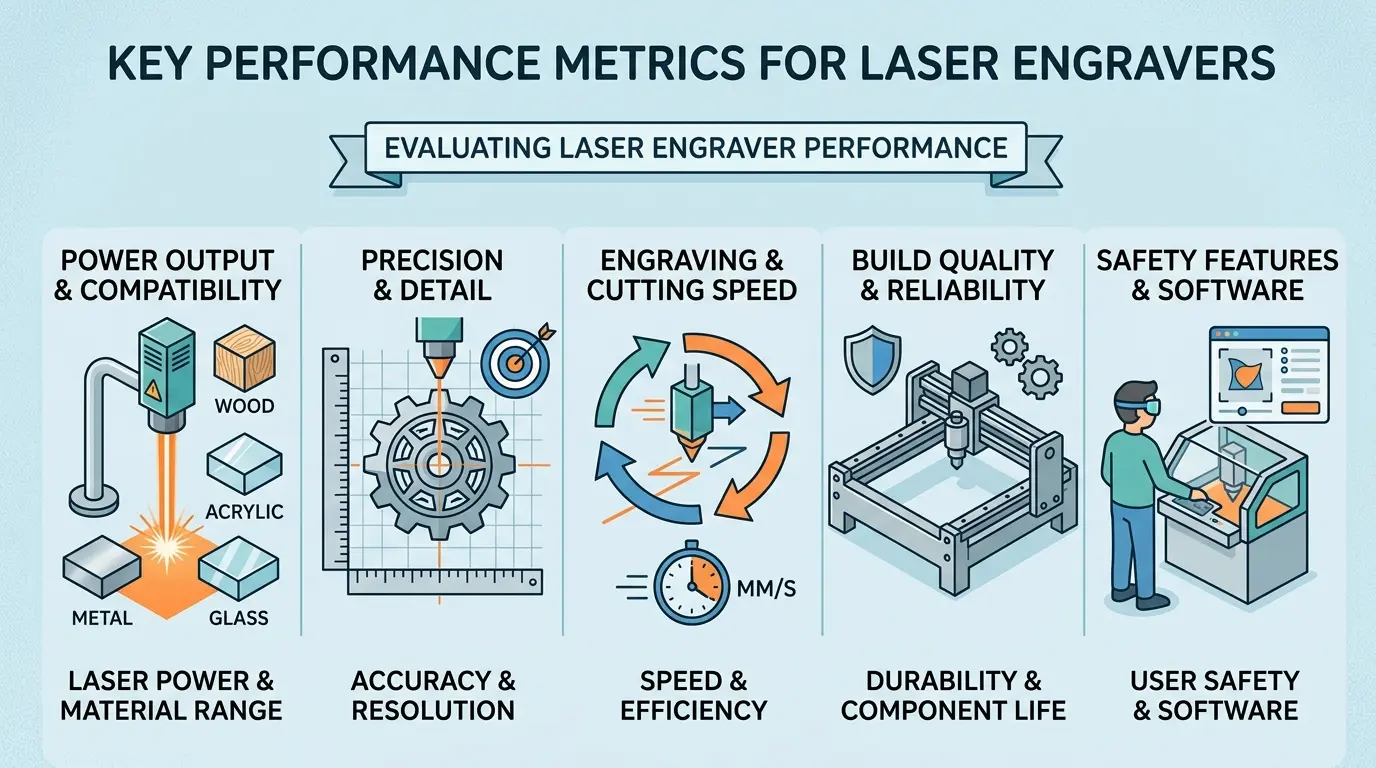
| Evaluation Area | What Buyers Should Inspect | Why It Matters in Production | Common Brand-Bias Mistake |
|---|---|---|---|
| Material Compatibility | Review the actual materials, thickness ranges, coatings, and finish expectations in your queue | A machine that looks strong on one substrate may drift in quality on another | Assuming a strong demo on one sample proves broad application fit |
| Engraving Clarity and Edge Quality | Check line sharpness, filled-area consistency, corner definition, residue, and surrounding surface cleanliness | Finished appearance often determines whether parts ship or go to rework | Judging quality from close-up marketing photos instead of repeated test output |
| Repeatability Across the Bed | Compare parts produced from different locations on the work surface | Inconsistent results across the table reduce usable yield and operator confidence | Accepting one centered sample as proof of full-bed consistency |
| Stable Throughput Under Real Jobs | Measure output across a normal production file, not only short demonstration patterns | Net output depends on fewer pauses, less cleanup, and less intervention | Focusing only on visible head speed |
| Airflow and Extraction Control | Inspect smoke removal, residue buildup, and quality drift during longer runs | Poor extraction affects appearance, maintenance load, and repeatability | Treating extraction as a secondary accessory instead of a production variable |
| Software and Job Recall | Test recipe storage, file handling, repeat-job recall, and operator usability | Better job control shortens changeovers and reduces setup variability | Assuming software is interchangeable because the machine hardware looks similar |
| Maintenance Accessibility | Review how easily daily cleaning and inspection points can be reached | Machines that are harder to maintain often lose consistency faster in real use | Ignoring service practicality until after installation |
| Workflow Fit | Decide whether the machine is mainly engraving, mainly cutting, or handling both in one queue | The right configuration depends on the production mix, not on abstract rankings | Buying the most talked-about machine instead of the most suitable one |
Use a Repeatable Test Method, Not a Showroom Impression
The best way to reduce brand bias is to standardize how you evaluate performance. That means bringing the same logic to every supplier conversation.
A stronger evaluation method usually includes:
- Running A Real Production File Instead Of A Generic Demo Pattern
- Testing More Than One Material Family If Your Workflow Requires It
- Repeating The Same Job In Multiple Table Positions
- Reviewing Both First-Part Appearance And Late-Run Consistency
- Checking Cleanup Time, Not Only Raw Processing Time
- Asking How Settings Are Recalled And Standardized For Repeat Work
This approach changes the conversation from “Which supplier sounds strongest?” to “Which machine holds acceptable output with the least instability?” That is a much better buying question.
Evaluate Net Throughput, Not Peak Motion
In laser engraving, buyers often overvalue speed because speed is easy to display. But peak motion does not equal real productivity.
Net throughput is shaped by the entire cycle:
- Material Loading and Positioning
- File Setup and Recipe Selection
- Engraving or Cutting Stability During the Job
- Surface Cleanup and Inspection
- Scrap Handling or Part Removal
- Preparation for the Next Batch
The more stable machine often wins the shift even if its headline motion looks less aggressive in a demo. If operators stop less often, adjust less often, and reject fewer parts, the factory gets more usable output.
Watch for Quality Drift, Not Just First-Pass Quality
Many machines can produce a clean first result under controlled conditions. The bigger question is where performance starts to drift.
During evaluation, buyers should watch for:
- Variation In Engraving Contrast Across Repeated Parts
- More Residue Or Staining As the Run Continues
- Edge Appearance Changing Near the Outer Work Area
- Fine Details Softening On More Complex Patterns
- Increased Need for Operator Intervention After Short Production Time
Quality drift is one of the clearest signs that a machine may look strong in a sample review but perform less confidently in production. The best laser engraver for an industrial workflow is usually the one that stays predictable longer, not the one that creates the most impressive first piece.
Decide Whether You Need a Dedicated Engraving Workflow or a Mixed One
Another source of buying confusion is treating every laser application as though it needs the same machine behavior. Some factories mainly care about engraving detail and branding consistency. Others need one system to handle both engraved content and shaped cutting in the same queue.
That difference matters because the evaluation priorities change:
- A Detail-Driven Engraving Workflow Puts More Weight On Precision, Surface Appearance, And Repeatability
- A Mixed Engraving-And-Cutting Workflow Puts More Weight On Versatility, Job Switching, And Stable Material Handling
- A High-Mix Custom Workflow Puts More Weight On Software Simplicity And Changeover Control
- A Repeated Batch Workflow Puts More Weight On Recipe Recall And Long-Run Stability
When buyers skip this step, they often compare suppliers on generalized claims instead of comparing machines against the real production role they must fill.
The Best Machine Is the One That Produces the Least Friction
In practice, the strongest buying logic is not about prestige. It is about friction.
Ask which machine creates less friction in the daily workflow:
- Less Setup Drift
- Less Cleanup Burden
- Less Variation Between Operators
- Less Quality Drift Across the Work Area
- Less Rework From Inconsistent Engraving Or Cutting Results
- Less Downtime Caused By Hard-To-Access Maintenance Points
That is how factories move from subjective preference to objective evaluation. A machine that reduces friction usually improves both productivity and output quality, even when its selling story is less dramatic.
Practical Summary
The best laser engraver is not the one with the strongest brand recognition. It is the one that matches your material mix, maintains engraving quality across repeated jobs, supports stable throughput, and fits the real workflow without creating extra cleanup, setup variation, or avoidable rework.
If buyers want to remove brand bias from the decision, the fix is simple: define the production role first, compare performance by repeatable criteria, and judge machines by how reliably they turn everyday jobs into acceptable finished parts. That is the evaluation standard that matters more than any logo.