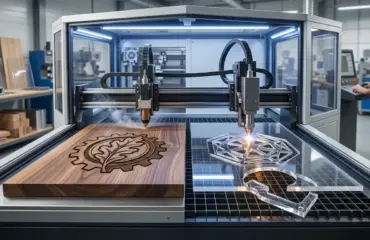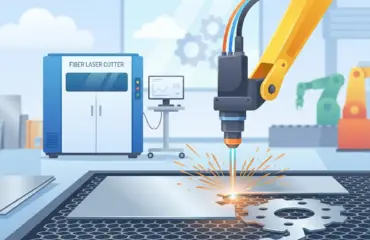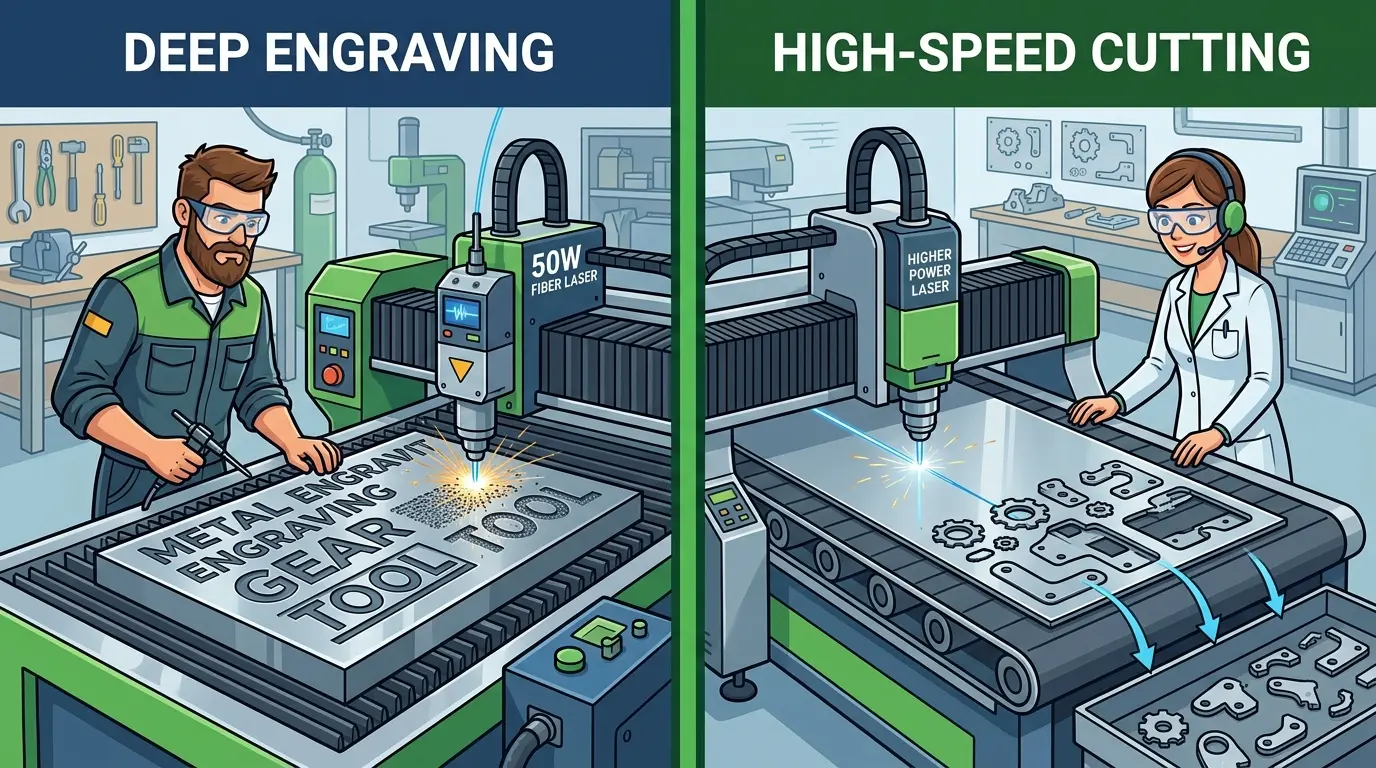
In many factories, the wrong laser-power decision does not fail on the sample plate. It fails later, when cycle times drag, small codes lose edge definition, thin parts show too much heat, or the buyer pays for output the line never actually uses. That is why the real question is rarely whether higher power sounds more capable. The real question is whether the production requirement justifies it.
For most industrial marking and engraving workflows, a 50W fiber laser is often the point where capability becomes commercially useful rather than merely entry-level. It is commonly strong enough for traceability codes, logos, serial numbers, part IDs, and many routine engraving tasks on metal parts. Higher-power fiber lasers start to make sense when the factory needs more throughput, deeper engraving, larger marked areas, or more margin on demanding materials and duty cycles. But more power does not automatically mean better marks.
Start With the Process, Not Just the Watt Number
Before comparing 50W with higher-power fiber lasers, buyers should confirm that they are comparing the same process class.
If the factory is evaluating direct part marking, serial coding, logo marking, tooling identification, or moderate engraving, then a 50W versus higher-power comparison is useful. If the real requirement is metal sheet cutting, tube cutting, welding, or cleaning, that is no longer a simple power upgrade decision. It is a move into a different machine category, with different optics, motion systems, safety requirements, and workflow economics.
So the useful version of this question is usually: within industrial marking or engraving, is 50W enough, or is higher power justified by the production target?
50W vs Higher-Power Fiber Laser at a Glance
| Decision Factor | 50W Fiber Laser | Higher-Power Fiber Laser | What Usually Decides the Better Fit |
|---|---|---|---|
| Typical Role | General industrial marking, coding, logos, part IDs, and light-to-moderate engraving | Higher-throughput marking, deeper engraving, larger filled areas, and more demanding production pace | Whether the shop needs readable marks or materially heavier output |
| Throughput Potential | Often strong for standard traceability and mixed-batch work | Commonly better when mark time itself is becoming the bottleneck | Whether the station must keep pace with machining, assembly, or automated transfer |
| Fine Detail Control | Often easier to tune for small text and precise codes | Can still perform well, but process tuning may become less forgiving | Feature size, contrast requirement, and tolerance for heat buildup |
| Material Removal | Suited to many routine engraving tasks | Usually better for deeper or faster engraving passes | Required depth, texture, and cycle time per part |
| Large-Area Fill | Capable, but may take longer on broad graphics or dense fill patterns | Often more attractive when larger mark areas must move quickly | Mark size and total area processed per shift |
| Investment Logic | Usually fits buyers who want capability without oversizing the cell | Makes more sense when output demand clearly justifies the jump | Real production bottleneck, not headline wattage |
| Main Risk if Misapplied | The station may become too slow for line-rate targets | The shop may pay for excess capacity and still struggle with mark quality if tuning is weak | Whether the real problem is power, fixturing, software, or cell design |
When a 50W Fiber Laser Is Usually the Better Choice
A 50W fiber laser is often the more rational choice when the factory’s core need is repeatable identification rather than aggressive material removal. In many production environments, that covers the majority of daily marking work.
This usually includes:
- Permanent Part IDs And Serial Numbers
- Data Matrix, QR, And Traceability Codes
- Logos, Labels, And Branding Marks On Metal Components
- Tool, Fixture, And Workholding Identification
- Fine Text Or Compact Graphics Where Edge Definition Matters
In these cases, the workflow outcome often matters more than the raw power figure. A 50W system can help the plant maintain readable codes, stable contrast, and repeatable positioning without turning the process into a difficult heat-management exercise. For many buyers, that is the real win: reliable output that operators can hold across shifts.
A 50W platform can also be a good fit when the marking cell is not the main pacing constraint. If operators are still loading parts manually, verifying codes one by one, or moving between many short-run jobs, jumping to higher power may not change the overall output nearly as much as expected. The factory may gain more from better fixturing, barcode workflow integration, or part presentation discipline than from a larger power source.
When Higher Power Starts To Pay Off
Higher-power fiber lasers usually become attractive when the plant has already proven that the marking process itself is the bottleneck.
That often happens in situations such as:
- The Line Needs Shorter Mark Time To Keep Pace With Upstream Production
- The Job Requires Deeper Engraving Or More Noticeable Material Removal
- The Mark Area Is Large Enough That Fill Time Is Hurting Output
- The Factory Runs Long Shifts Or Heavier Duty Cycles And Needs More Throughput Margin
- The Same Station Must Handle A Broader Range of Demanding Applications Without Constant Compromise
In those environments, higher power can improve more than speed alone. It can help reduce cycle-time pressure, support larger graphics or filled marks more efficiently, and create more production headroom when volume rises. That matters most when the mark is tied directly to takt time, automation flow, or downstream release.
But the better business case appears only when the rest of the cell is ready. If loading, unloading, data handling, or inspection remains slow, a higher-power laser may spend much of the shift waiting on the same bottlenecks that limited the 50W system.
Why More Power Does Not Automatically Mean Better Mark Quality
This is the part buyers often underestimate.
Higher power can improve productivity, but mark quality is not controlled by wattage alone. Small codes, fine strokes, cosmetic logos, and contrast-sensitive marks depend on process stability. Pulse behavior, spot quality, optics selection, motion control, focal consistency, and part presentation all influence the result.
If power rises without the process being tuned properly, several problems can appear:
- Heat Input Can Become Harder To Control On Thin Or Sensitive Parts
- Fine Text And Dense Codes May Lose Crispness
- Surface Discoloration Can Become Less Predictable
- Deep Or Fast Passes May Look Stronger But Reduce Cosmetic Consistency
- Operators May Have Less Forgiveness In Daily Setup And Job Changeover
That is why some factories find that a well-tuned 50W system produces better routine marks than a poorly tuned higher-power unit. The stronger system is only better when the application actually needs the extra output and the team can control it consistently.
Questions Buyers Should Answer Before Moving Above 50W
| Buying Question | Why It Matters | What the Answer Usually Points Toward |
|---|---|---|
| Is Mark Time Really the Bottleneck? | If the delay comes from loading, verification, or data flow, more power may not fix the problem | Stay with 50W or improve the cell first |
| Do You Need Deeper Engraving, or Just Readable Marks? | Many jobs need clean contrast, not aggressive removal | Readable marks usually keep the case for 50W strong |
| How Large Are the Typical Marks? | Broad fill areas and larger graphics can change the economics quickly | Larger marked areas often strengthen the case for higher power |
| How Fine Is the Required Detail? | Small text and compact codes can be more sensitive to process control than to raw power | Fine-detail work often favors a stable, well-controlled setup over oversizing |
| How Stable Is Part Presentation? | Higher output only helps if the part reaches the focal zone consistently | Weak fixturing can erase the benefit of more power |
| Are You Comparing Marking With a Different Laser Process Altogether? | A cutting or welding requirement changes the whole machine-class decision | Reframe the purchase instead of treating it as a wattage upgrade |
These questions help buyers avoid a common mistake: buying a stronger source before proving that source power is the real production constraint.
A Practical Rule for Choosing Between 50W and Higher Power
If the factory mainly needs permanent identification, clean traceability marks, fine detail, and dependable day-to-day marking on metal parts, 50W is often the right baseline. It usually gives enough capability for serious industrial work without forcing the buyer into a more expensive or less forgiving process window than the application requires.
If the factory has already defined a real need for faster cycle times, deeper engraving, broader mark coverage, or heavier-duty output, then higher power may be justified. In that case, the extra wattage is not being purchased as a marketing upgrade. It is being purchased as a workflow tool.
And if the requirement has shifted from marking into metal cutting or another higher-energy process, the right move is not simply to “go above 50W.” The right move is to evaluate a different production platform with the right cell design around it.
For buyers planning laser investment alongside broader equipment decisions, the Pandaxis product catalog offers a wider view of adjacent industrial machinery categories.
Practical Summary
The better choice between a 50W fiber laser and a higher-power fiber laser depends less on the headline watt number than on the real production job. A 50W system is often the right answer for industrial marking, coding, and many routine engraving tasks where consistency, detail, and reasonable throughput matter most. Higher power becomes more valuable when the factory has a proven need for more output, more depth, larger marked areas, or more process headroom.
So the safest buying logic is simple: define the mark, define the bottleneck, then size the laser around that reality. If the job is standard traceability and controlled engraving, 50W is often enough. If the mark station is already limiting production, higher power may earn its place. If the process is no longer really marking at all, step back and treat it as a different machine decision entirely.