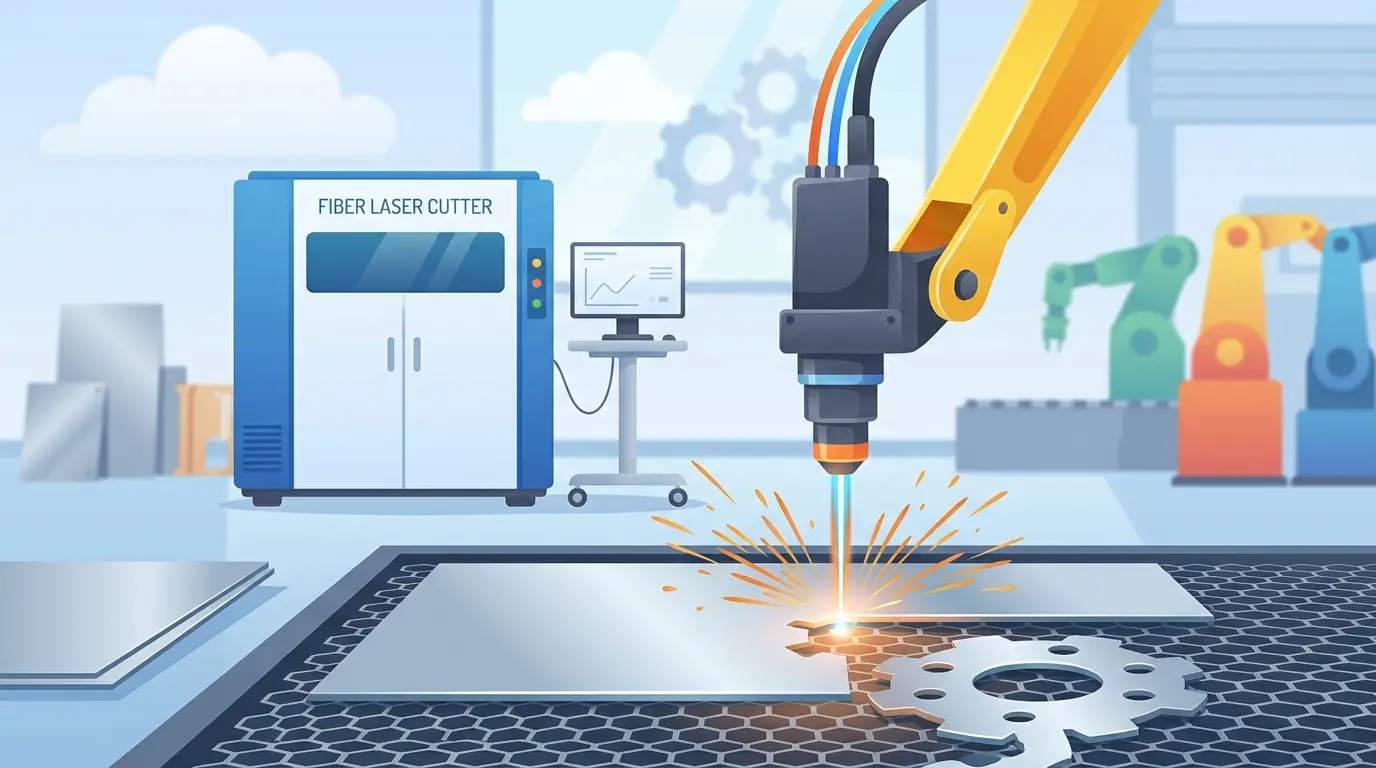
In sheet metal production, the value of a fiber laser machine is not just that it can cut metal. The real value is how well it supports part accuracy, nesting efficiency, edge quality, and production flow across a wide range of jobs. For fabrication shops under pressure to reduce rework, shorten lead times, and handle more part variation, fiber laser processing is often evaluated as a way to make cutting more predictable rather than simply faster.
That matters because sheet metal processing is rarely a single-step operation. Cutting quality affects bending, welding, hardware insertion, coating, assembly, and final inspection. When buyers assess fiber laser machine applications, they should look beyond the cut itself and focus on where the machine improves the total workflow.
Why Fiber Laser Technology Fits Modern Sheet Metal Work
Fiber laser systems are commonly discussed in sheet metal processing because many fabrication environments need a combination of precision, repeatability, flexible programming, and clean part geometry. In high-mix manufacturing, those qualities matter as much as raw throughput.
Compared with older, more rigid cutting workflows, fiber laser processing is often favored when the shop needs to move quickly between different part shapes, material types, and order quantities without excessive tooling changes. That makes it especially relevant in facilities where job variation is high and scheduling flexibility affects profitability.
The Most Common Fiber Laser Machine Applications
Fiber laser machines can support many sheet metal workflows, but some applications stand out because they benefit directly from accurate contour cutting, clean pierce control, and efficient nesting.
| Application Area | Typical Part Types | What Buyers Usually Care About | Why Fiber Laser Fits |
|---|---|---|---|
| Electrical Enclosures | Cabinets, doors, mounting plates, covers | Hole accuracy, clean slots, repeatable bends downstream | Consistent cut geometry helps assembly and hardware fit |
| HVAC Components | Panels, ducts, flanges, brackets | Throughput, material utilization, batch consistency | Nested cutting supports repetitive production efficiently |
| Kitchen and Food Equipment | Stainless panels, housings, fabricated assemblies | Edge quality, dimensional consistency, visible-part finish | Clean profiles matter before welding and finishing |
| General Fabrication | Brackets, frames, gussets, machine covers | Flexibility across many part types | High-mix job shops benefit from fast program changes |
| Elevator and Building Components | Panels, supports, trim parts, structural accessories | Repeatability, lot consistency, downstream forming | Stable cut quality reduces variability between batches |
| Agricultural and Industrial Equipment Parts | Guards, covers, support parts, formed components | Durable part geometry, production efficiency | Complex shapes can be processed without hard tooling |
This variety is one reason fiber laser systems are often seen as a production platform rather than a single-purpose cutter.
Application 1: High-Mix Job Shop Production
One of the strongest applications for a fiber laser machine is high-mix sheet metal work. Job shops often move between different customer drawings, material types, and part quantities in the same shift. In that environment, the machine must handle frequent program changes without turning setup time into the main bottleneck.
Fiber laser processing is well suited to this kind of work because it supports fast transitions between geometries and lets shops process many part families on one cutting platform. For buyers serving a wide customer base, that flexibility can matter more than any single application headline.
Application 2: Precision Parts for Bending and Assembly
Many sheet metal parts are not finished when they leave the cutting table. They move into press braking, spot welding, hardware insertion, or final assembly. In those cases, cutting accuracy is valuable because it helps the next process stay stable.
This is why fiber laser machines are commonly used for:
- Folded enclosure parts
- Mounting panels with tight hole placement requirements
- Brackets that must align consistently in assembly
- Cover panels where slot and tab relationships affect fit-up
The practical advantage is not only a clean cut. It is the reduction of downstream correction work when parts arrive in a more repeatable condition.
Application 3: Stainless Steel Fabrication
Stainless sheet metal work often raises the standard for cut appearance and downstream finishing. Buyers producing visible fabricated parts, food equipment, or architectural components usually care more about edge condition, distortion control, and part consistency than buyers focused only on heavy structural work.
Fiber laser machines are often evaluated in stainless applications where the shop wants better control over part geometry before brushing, polishing, welding, or assembly. When the part will remain visible in the final product, cutting quality influences not only productivity but also perceived product value.
Application 4: Carbon Steel Parts in Daily Production
Carbon steel remains a core material in many sheet metal plants, especially where brackets, supports, cabinets, guards, and equipment parts are produced at scale. In these workflows, fiber laser applications are often judged on reliability, nesting efficiency, and how well the machine supports daily throughput targets.
For many fabricators, the advantage is that one platform can support routine production parts without relying on dedicated hard tooling for every geometry change. That becomes especially useful when production volumes are meaningful but order variation still exists.
Application 5: Short-Run and Custom Manufacturing
Short-run work is another area where fiber laser systems often make sense. Custom fabricators, prototype teams, and mixed-production shops need to process new part designs without building specialized tooling for each revision.
In these applications, the machine helps by making design changes easier to absorb. If the drawing changes, the shop usually updates programming rather than redesigning the entire cutting process. That can improve quoting responsiveness and make custom work more manageable operationally.
Application 6: Nested Sheet Utilization and Material Control
Material usage is a major concern in sheet metal processing because waste affects every order, not just large contracts. Fiber laser machines are often valuable in environments where intelligent nesting and cut planning can improve sheet yield.
This application is less visible than a finished part, but it matters financially. Better nesting can help reduce scrap, improve cost control, and make order planning more stable across repeated jobs. For factories handling expensive materials or variable order sizes, this becomes a meaningful operational advantage.
Where Fiber Laser Machines Improve Workflow Most
Fiber laser applications are strongest when the buyer is trying to improve the overall cutting stage inside a broader production line. The machine is most valuable when it supports measurable gains such as:
- More stable part accuracy before bending
- Less manual cleanup before welding or finishing
- Faster transition between different jobs
- Better nesting and sheet utilization
- More predictable part output across shifts
- Reduced dependence on dedicated tooling for part variation
These improvements matter most in facilities where cutting is a production bottleneck or where inconsistent cut quality creates hidden problems downstream.
When Fiber Laser Is Not the Whole Answer
A fiber laser machine can improve many parts of sheet metal processing, but buyers should avoid treating it as a universal fix. If the real bottleneck is poor scheduling, weak material handling, slow unloading, disorganized part sorting, or downstream forming capacity, the laser alone will not solve the problem.
That is why strong buyers evaluate the machine in context. They ask how it will fit loading, unloading, bending, welding, coating, and assembly instead of evaluating cut samples in isolation.
Questions Buyers Should Ask Before Choosing a Machine
Before selecting a fiber laser system for sheet metal work, buyers should define the application mix clearly.
Use questions like these:
- Are we mainly running repeat production parts, custom work, or a mix of both?
- Which materials dominate our real order flow?
- Which downstream processes are most sensitive to cutting accuracy?
- Is our main goal higher throughput, better edge quality, less rework, or better material utilization?
- How much job variation do we handle each week?
- Will the machine run as a standalone cell or as part of a more automated production layout?
- What service and support level do we need to protect production continuity?
These questions help separate a good demonstration result from a machine that fits real factory conditions.
How To Think About Fiber Laser Applications Strategically
The best way to understand fiber laser machine applications in sheet metal processing is to look at them through workflow impact rather than through a single material or part category. The technology is most useful where production teams need precise cutting, efficient nesting, and flexible response to changing job demands.
For shops evaluating broader equipment investment priorities alongside sheet metal cutting, the Pandaxis product catalog provides a broader view of industrial machinery categories and production-focused equipment planning.
In practice, fiber laser machines fit best where sheet metal operations need a balance of precision, flexibility, and repeatable production output. The strongest investment decisions come from matching the machine to the real part mix, not to the most impressive headline claim.