If the production target is rigid acrylic parts rather than a broad mix of soft display materials, this comparison is usually decided by edge quality, contour precision, and how much downstream finishing the shop can tolerate. That is why the real question is not whether both machines can touch acrylic in some form. It is whether the chosen process fits the way acrylic actually behaves in daily production.
In many shops, the answer becomes clear once the parts move beyond a sample cut. Acrylic is often selected because it must look clean, hold shape accurately, and leave the cutting stage with as little manual correction as possible. Under those conditions, laser and knife workflows behave very differently.
The First Decision Is Whether You Are Really Buying for Acrylic or for Mixed Materials
This comparison often gets framed too broadly. A shop may search for an acrylic laser cutter and a CNC knife cutter at the same time, but the two machines usually solve different bottlenecks.
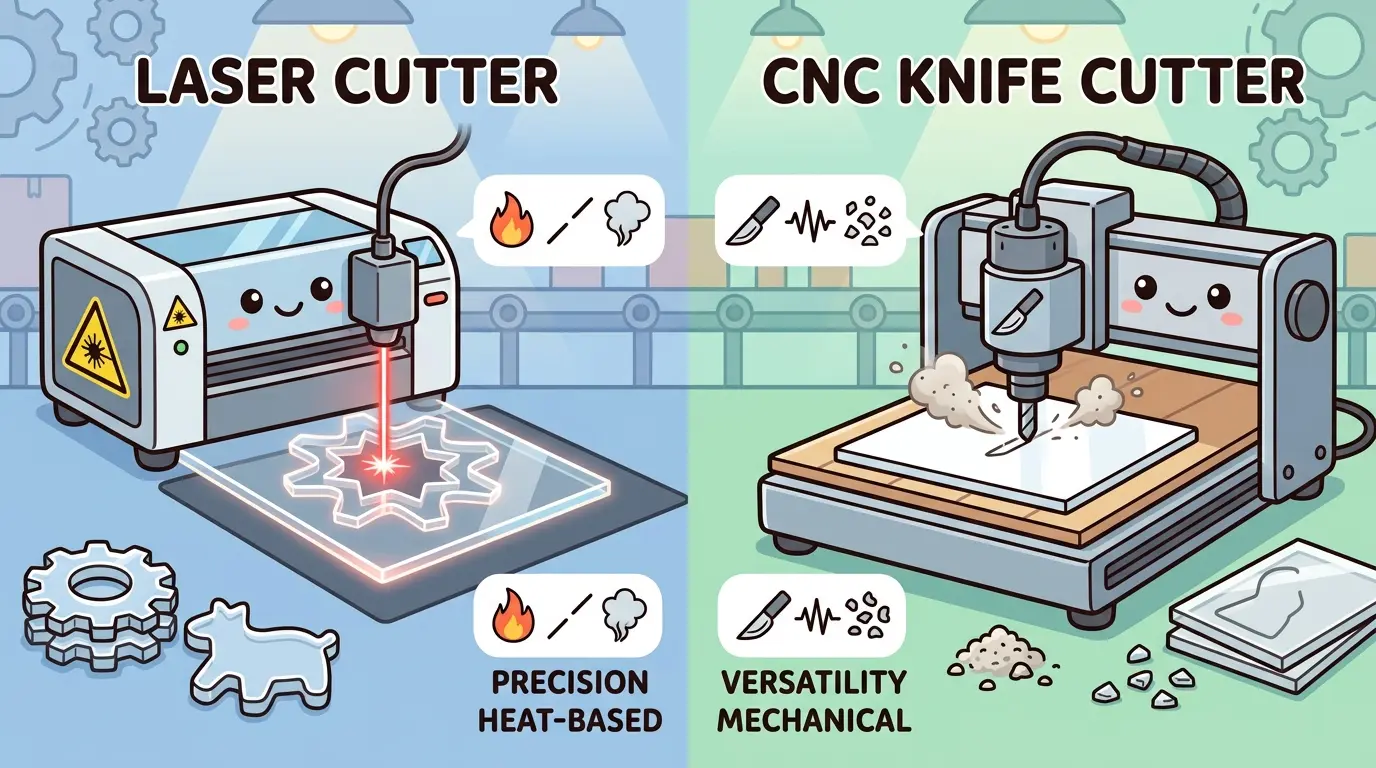
For buyers evaluating laser cutters and engravers for acrylic and similar non-metallic materials, laser is commonly considered when the cut itself must contribute to the finished appearance of the part. A CNC knife cutter is more often evaluated when one table must handle a wider range of softer or printed substrates, rapid sample making, or packaging and display materials that do not benefit from thermal cutting.
So before comparing machine features, it helps to settle a more basic point:
- If acrylic sheet is a core production material, laser is usually the more natural comparison point.
- If acrylic is only one occasional substrate inside a broader digital-cutting workflow, the knife table may still deserve consideration.
That distinction matters because a machine can be useful in the shop overall without being the best answer for acrylic itself.
Why Laser Usually Fits Acrylic More Naturally
Rigid acrylic places a premium on clean contour definition, repeatable internal cutouts, and finished-looking edges on visual parts. In many sign, display, retail fixture, and decorative-panel workflows, those factors matter more than the fact that the material can be separated by multiple methods.
An acrylic laser cutter is commonly chosen because it helps with:
- Fine contours and small internal features
- Repeatable shape accuracy across short runs and mixed batches
- Cleaner-looking edges on many visual-grade acrylic parts
- Faster switching between new geometries without physical tooling changes
- Lower dependence on secondary contour finishing in some applications
That does not mean laser removes all process control. Acrylic laser cutting still depends on stable settings, good extraction, clean optics, and realistic expectations about the specific acrylic grade being processed. But when the product value depends on visual edge quality and geometry flexibility, laser often aligns with the material more directly than a knife process does.
Where a CNC Knife Cutter Makes More Sense
A CNC knife cutter becomes more attractive when the real production model is broader than acrylic sheet fabrication. These systems are often chosen because they can support fast job changes across softer, thinner, or printed materials where a non-thermal workflow is useful.
That type of equipment is commonly better suited when the shop is focused on:
- Foam board, corrugated display board, gasket sheet, vinyl, or similar soft materials
- Printed substrates where smoke, heat, or edge discoloration would be a problem
- Sample making, packaging prototypes, or short-run display work
- Broad material flexibility on one cutting table
- Production cells where acrylic is not the main revenue-driving substrate
In that context, the knife cutter may be the better investment overall even if it is not the strongest answer for rigid acrylic sheet. The machine earns its place by widening the shop’s usable material range, not by outperforming laser on presentation-grade acrylic parts.
The Main Tradeoff Is Finished Acrylic Quality vs Multi-Material Flexibility
For most rigid acrylic applications, this is the core tradeoff. Laser is usually selected because acrylic parts often need detail, consistent contour quality, and a more presentation-ready result. Knife systems are more often selected because the shop needs one digital platform for many softer substrates and does not want heat in the process.
That means the better machine depends on what the cut must accomplish after the sheet leaves the table:
- If the part will be sold, assembled, or visually inspected as an acrylic component, laser usually has the advantage.
- If the job mix is dominated by non-acrylic display materials, a knife system may support the broader workflow better.
- If the team is trying to avoid secondary edge cleanup on acrylic, laser is often the more practical fit.
- If the business depends on printed-board conversion and soft-material prototyping, the knife table can be more valuable overall.
The mistake is to treat this as a pure machine-versus-machine comparison without looking at what percentage of daily output is actually rigid acrylic.
Acrylic Laser Cutter vs CNC Knife Cutter at a Glance
| Production Factor | Acrylic Laser Cutter | CNC Knife Cutter |
|---|---|---|
| Rigid Acrylic Sheet Processing | Often A Strong Fit | Often More Limited |
| Fine Internal Features and Complex Contours | Often A Strong Fit | More Application Dependent |
| Visual-Grade Acrylic Edges | Often Better Suited | Often Requires More Downstream Work |
| Non-Thermal Cutting Need | Less Suitable | Often A Strong Fit |
| Printed and Soft Display Materials | More Limited | Often Better Suited |
| Multi-Material Sample Making | More Application Dependent | Often A Strong Fit |
| Reduced Tool-Change Dependency | Often A Strong Fit | Strong, but Material-Dependent |
| Broad Soft-Material Workflow Flexibility | More Limited | Often Better Suited |
The table points to a simple conclusion: if the job is truly about acrylic, laser usually fits better. If the shop is really buying a broad digital cutting platform with acrylic as a secondary material, the knife workflow becomes more defensible.
What Changes in Downstream Finishing and Rework
This is where the financial difference often shows up.
If a laser-cut acrylic part leaves the machine close to the required visual standard, the shop may save labor in edge cleanup, contour correction, and manual finishing. That matters most in products where the part edge is visible to the end user.
If a knife-based workflow separates material but still leaves the team handling extra trimming, polishing, contour correction, or rejection on brittle parts, then the apparent process advantage can disappear quickly.
On the other hand, if the workload is mostly soft signage and printed display materials, the knife table may reduce finishing problems that a thermal process could create on those substrates. So the real cost comparison is never just the cut. It is the total effort from file to finished part.
When the Knife Cutter Still Belongs in the Conversation
There are valid cases where a CNC knife cutter should stay in the buying discussion even when acrylic is mentioned.
That is usually true when:
- Acrylic Is Thin, Secondary, or Only One Small Part of the Material Mix
- The Shop Primarily Produces Packaging, POS Displays, Samples, or Printed Boards
- Heat-Sensitive Materials Dominate the Daily Schedule
- One Digital Table Must Serve Many Substrates Rather Than One Acrylic-Focused Workflow
In those situations, the real question is not “Which machine cuts acrylic better?” It is “Which machine supports the broader revenue mix better?”
That framing is more honest and usually more useful for capital planning.
Questions Buyers Should Answer Before Choosing
Before deciding between an acrylic laser cutter and a CNC knife cutter, define the production target as clearly as possible.
- Is rigid acrylic a core material or an occasional one?
- Are part edges visible in the final product?
- Does the shop need complex contours and internal cutouts on a routine basis?
- How much manual finishing happens after cutting today?
- Is the bigger goal acrylic quality or broad substrate flexibility?
- Will the machine mostly support signage, display fabrication, packaging, or acrylic component production?
- Is the team buying for the most profitable recurring jobs or for a broad list of possible jobs?
These questions usually expose whether the investment is really about acrylic fabrication or about building a flexible digital cutting cell for many material types.
Practical Summary
For most rigid acrylic sheet work, an acrylic laser cutter is the better fit because the process aligns more closely with the material’s real production demands: cleaner contour definition, better visual edge potential, and easier handling of detailed geometry with fewer tooling constraints.
A CNC knife cutter still makes sense when the shop’s real priority is not acrylic optimization but mixed-material versatility across softer, printed, or non-thermal applications. In other words, the knife system is usually strongest when acrylic is part of a broader workflow, not when acrylic quality is the center of the decision.
If the business depends on acrylic parts that must look finished and repeatable when they leave the cutting stage, laser is usually the more practical answer. If the business depends on one table serving many softer substrates with acrylic only on the edge of the workload, the knife cutter may be the better overall investment.