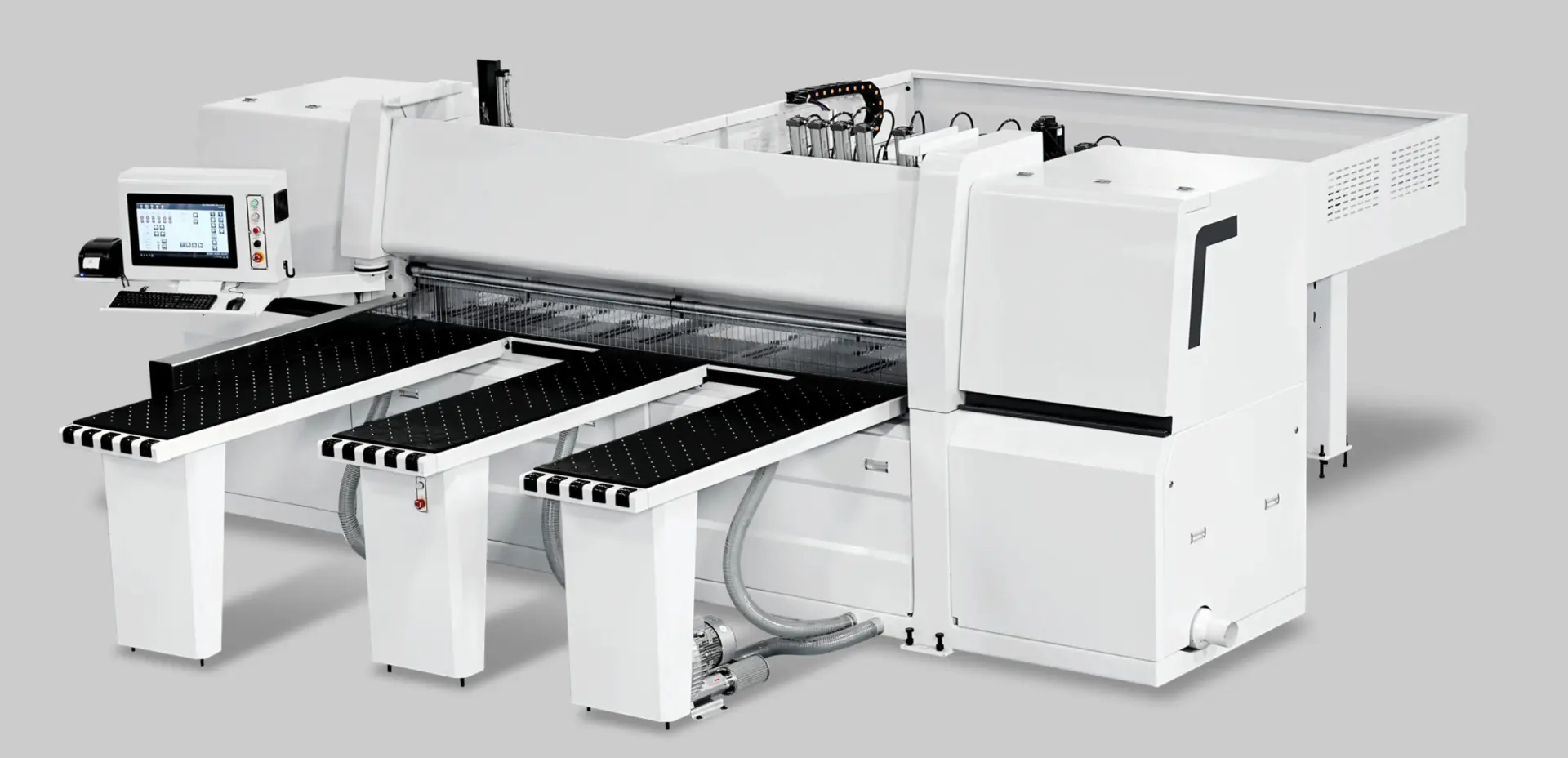
In batch panel production, stability usually disappears before a full breakdown ever stops the machine. Cut sizes begin to drift between stacks, clamping feels less consistent, vibration becomes easier to hear, or the first parts of the shift look cleaner than the last. For a beam saw, those are not small housekeeping issues. They are signs that the cutting cell is losing the stability needed to feed downstream processing without extra sorting, recuts, or assembly correction.
That is why beam saw maintenance should be treated as a production-stability routine, not just a repair routine. In factories that rely on panel saws for continuous panel sizing, long-term performance depends on keeping the machine mechanically clean, motion systems predictable, pressure systems consistent, and reference checks disciplined over time.
Why Long-Term Stability Matters More Than Short-Term Uptime
A beam saw can remain operational while already causing hidden production loss. The machine may still cycle, cut, and meet basic output targets, but if stability is weakening, the effects spread across the line:
- Part dimensions become less repeatable across repeated cutting programs.
- Edge quality becomes less consistent from one batch to the next.
- Panel movement risk increases when clamping or pressure conditions change.
- Operators spend more time checking, adjusting, or recutting parts.
- Downstream processes such as edgebanding and drilling become less predictable.
This is why maintenance for a beam saw should be judged by one practical question: does the machine still produce the same result at the end of the week, month, and quarter that it produced when the cutting conditions were stable?
The Main Systems That Influence Beam Saw Stability
When a beam saw loses stability, the problem is rarely isolated to only one component. It is more often the result of gradual deterioration across several systems working together.
| System Area | What To Watch | Why It Affects Stability |
|---|---|---|
| Cutting System | Blade wear, contamination, mounting condition, unusual noise | Directly affects cut quality, load, and vibration behavior |
| Pressure And Clamping | Uneven contact, contamination, inconsistent movement | Allows subtle panel shift that reduces repeatability |
| Motion And Guide Paths | Wear, friction, debris, rough travel | Increases positioning inconsistency over long runs |
| Support And Reference Surfaces | Dust buildup, chips, damage, poor contact | Reduces consistent panel support and reference accuracy |
| Extraction And Cleanliness | Fine dust accumulation, poor chip removal | Creates contamination that affects movement and cutting conditions |
| Inspection Discipline | Missed trend checks, no control-cut routine | Lets small drift become a larger production issue |
Looking at the beam saw in this system-based way helps maintenance teams avoid a common mistake: replacing consumables while missing the stability condition that made performance deteriorate in the first place.
Daily Maintenance That Protects Stability From Shift To Shift
Daily maintenance is where most long-term stability is either protected or slowly lost. The aim is not deep service. The aim is to prevent contamination, visible wear, and operating irregularities from entering production.
- Clean the table, support areas, pressure contact points, and accessible cutting zones so chips and dust do not interfere with panel positioning.
- Inspect the blade for visible wear, buildup, or damage before the machine enters normal production.
- Check that the pressure beam or hold-down system contacts material evenly and moves without hesitation.
- Confirm that extraction is removing debris effectively instead of allowing fine dust to accumulate around support and motion areas.
- Listen for changes in vibration, tone, or cutting noise during startup cuts.
- Run a control cut at the start of the shift to verify cut quality, size consistency, and squareness.
The control cut matters because beam saw problems often appear as drift rather than failure. A quick reference check catches that drift before a full stack of parts is processed under unstable conditions.
Weekly Checks For Motion Consistency And Repeatability
Weekly maintenance is the right time to focus less on visible cleanliness and more on how the machine is behaving mechanically across repeated use.
- Inspect guide paths, sliding areas, and service-accessible moving components for contamination, roughness, or abnormal wear.
- Check clamp and pressure contact surfaces for residue, wear marks, or uneven material contact.
- Review blade mounting areas and accessible fastening points for looseness, residue, or improper seating.
- Inspect exposed hoses, cables, sensors, and guards for wear or interference caused by dust and repeated movement.
- Confirm that stops, reference points, and panel-contact surfaces remain clean and stable.
- Compare repeated test cuts instead of relying on a single acceptable part.
This repeated-cut mindset is important. A beam saw intended for batch work must hold its result over repetition, not just on the first good panel after an adjustment.
Monthly Maintenance For Long-Run Mechanical Stability
Monthly work should focus on the areas that affect machine behavior over time rather than just immediate cut appearance.
- Review lubrication points and serviceable motion areas according to the manufacturer guidance.
- Inspect wear-prone areas in guides, carriage-related movement systems, pressure mechanisms, and panel support zones.
- Verify dimensional repeatability with the same internal reference method each month.
- Check cut squareness and compare results against the shop’s normal quality baseline.
- Review extraction performance if dust accumulation has started increasing between routine cleanings.
- Compare maintenance observations with production symptoms such as more recuts, edge inconsistency, or slower downstream fitting.
Monthly maintenance becomes far more valuable when quality records and machine observations are reviewed together. If the assembly area is correcting more size variation, the beam saw should be investigated as a likely source of instability rather than treated as unrelated.
Stability Warning Signs Operators Should Report Early
Operators often notice instability before maintenance schedules reflect a pattern. The fastest way to protect long-term performance is to treat those early signs as maintenance inputs instead of isolated complaints.
| Warning Sign | Likely First Check Area | Risk If Ignored |
|---|---|---|
| Cut quality degrades during longer runs | Blade condition, extraction, vibration sources | Quality drift and more recuts later in the shift |
| Repeated parts begin showing size variation | Reference surfaces, guide behavior, clamping consistency | Batch inconsistency and slower sorting downstream |
| Material feels less stable under pressure | Pressure beam contact, contamination, movement reliability | Panel shift and reduced repeatability |
| Noise or vibration increases without obvious failure | Blade mounting, wear, contamination, motion-path condition | Accelerated wear and unstable cutting behavior |
| Operators need more frequent corrections | Alignment checks, reference verification, support cleanliness | Hidden labor cost and gradual process instability |
The key is speed of response. Stability problems become expensive when the shop normalizes them and keeps cutting instead of tracing the underlying condition.
Maintenance Habits That Improve Long-Term Results
Even good technical routines lose value if the shop treats maintenance as a loose suggestion instead of a controlled process. A more stable beam saw operation usually depends on a few management habits as much as on any single inspection point.
- Assign clear ownership for daily, weekly, and scheduled tasks.
- Use the same reference-cut method each time so drift can be measured consistently.
- Record symptoms like vibration, cut roughness, or repeatability issues before they become major failures.
- Replace wear-sensitive consumables before quality visibly collapses.
- Link beam saw maintenance findings to downstream quality issues in drilling, edge processing, and assembly.
This type of discipline is especially important in factories running repeated cabinet or furniture components, where a beam saw is expected to behave like a stable front-end production system rather than a stand-alone cutting station.
When Preventive Maintenance Should Turn Into Deeper Service
Not every stability issue can be solved through routine cleaning and surface inspection. If drift continues after normal maintenance, the problem should be escalated into deeper service and calibration review.
That is usually necessary when the machine shows persistent repeatability loss, recurring vibration, unstable pressure behavior, or cut-quality decline that returns quickly after consumables are addressed. At that stage, the priority is no longer simple upkeep. It is restoring the machine’s ability to hold stable performance over production time rather than only passing a short test.
Shops often wait too long because the beam saw is still producing parts. That threshold is too weak. If the machine can still run but no longer holds stable output through repeated cycles, long-term maintenance has already become overdue.
Practical Summary
Beam saw machine maintenance is really about protecting stable production conditions: clean panel support, consistent clamping, predictable movement, controlled vibration, and regular repeatability checks. Those are the conditions that keep a beam saw useful over the long term, especially in factories where the cutting cell drives the pace of the rest of the line.
For long-term stability, the best maintenance routines do not wait for a visible failure. They catch drift early, track repeated symptoms, and protect the machine’s ability to produce the same clean, reliable result across entire production runs, not just at startup.