When cabinet parts start waiting at the drilling station, the biggest loss is usually not the seconds needed to make a hole. It is the time spent rechecking references, resetting layouts, verifying first parts, and correcting fit problems later in assembly. That is why the choice between a CNC drilling machine and a multi-spindle boring machine should be made around workflow stability, not around which machine sounds more advanced.
For manufacturers comparing boring and drilling machines, the practical difference is straightforward. A multi-spindle boring machine is usually the better fit when hole groups repeat across stable part families. A CNC drilling machine is usually the better fit when part logic changes often and drilling needs to follow program-driven production with less manual reset. Both can deliver accurate hole processing. The real question is which one removes more friction from your daily production model.
What Each Machine Is Really Optimized To Do
In many factories, the terms boring and drilling overlap. Suppliers may even describe similar equipment as multi-spindle drilling machines, row-boring machines, or boring machines depending on the market and the application. For selection purposes, the more useful distinction is not vocabulary alone. It is the production logic behind the machine.
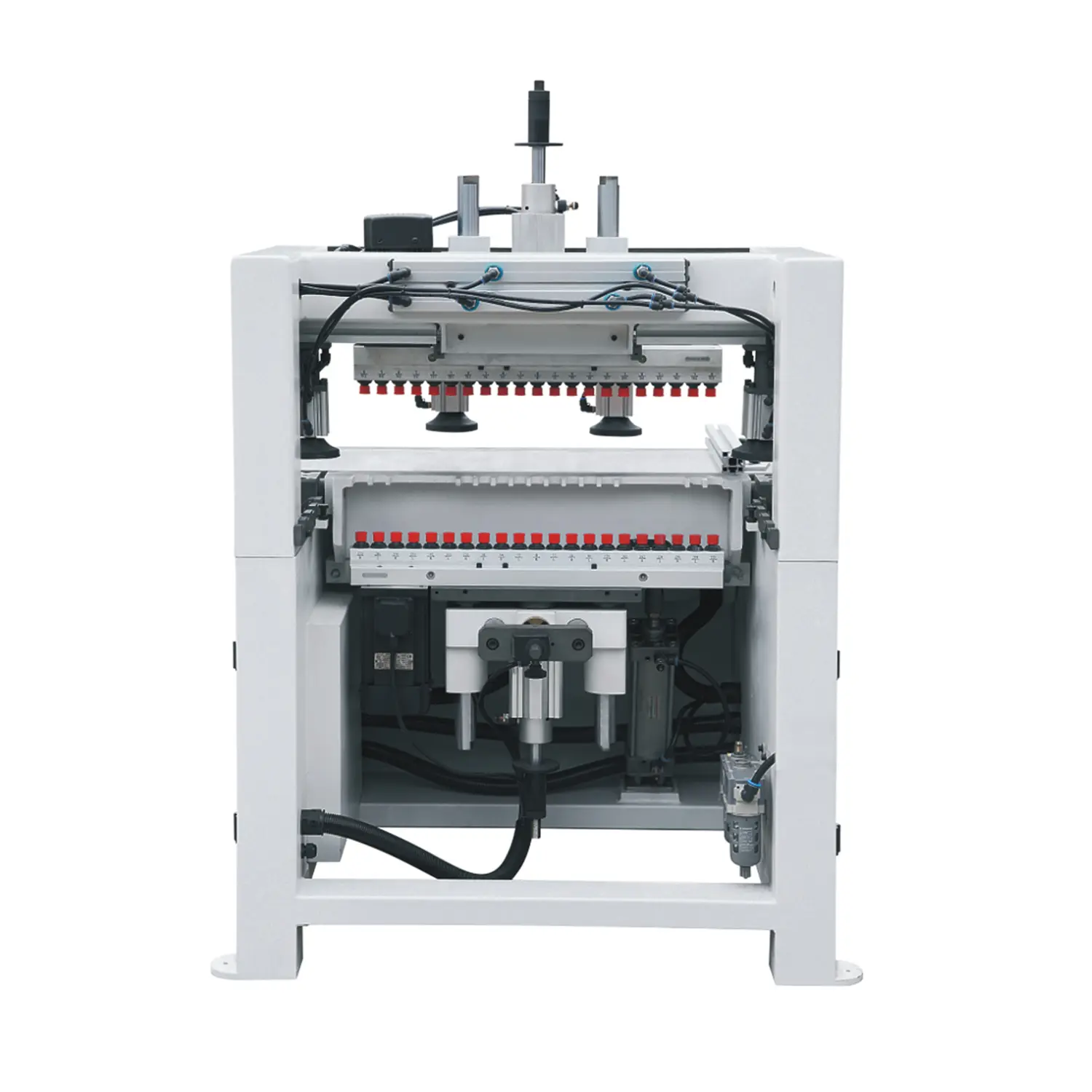
A multi-spindle boring machine is commonly used for repeated hole groups such as shelf-pin rows, connector drilling, hinge-related patterns, and other standardized cabinet-part operations. Its main advantage is repeated positioning on familiar layouts.
A CNC drilling machine is commonly used when hole locations, panel sizes, or drilling sequences change more often. Its main advantage is that the drilling logic can follow the part program rather than relying mostly on a fixed mechanical setup.
That is why this is not really a comparison between simple and sophisticated technology. It is a comparison between a machine built to repeat and a machine built to adapt.
The Core Tradeoff Is Repetition Versus Change
Many buying mistakes happen because factories compare machine categories without first identifying where the real delay is coming from. If most daily output consists of repeated cabinet sides, shelves, drawer parts, or other stable components, the production problem is usually how to keep drilling fast and repeatable across long runs. If orders shift constantly across sizes, hardware layouts, and product families, the problem is usually how to keep changeovers from eroding throughput.
That makes the real comparison much clearer:
- A multi-spindle boring machine usually protects rhythm on stable work.
- A CNC drilling machine usually protects flexibility on changing work.
- Neither machine is automatically better outside the workflow it is meant to support.
This matters because a flexible machine can be underused in a highly standardized factory, while a repeated-pattern machine can become a bottleneck in a change-heavy environment.
Side-By-Side Decision Table
| Decision Factor | Multi-Spindle Boring Machine | CNC Drilling Machine | Stronger Fit |
|---|---|---|---|
| Repeated 32 mm System Or Similar Standard Cabinet Patterns | Usually stronger because the drilling pattern stays consistent across many parts | Can handle the work, but much of the flexibility may go unused | Multi-Spindle Boring |
| Frequent Order-To-Order Hole Variation | Usually weaker because setup logic changes more often | Usually stronger because pattern changes can follow the program | CNC Drilling |
| Throughput On Stable Part Families | Commonly strong when the same drilling groups run all shift | Strong, but not always the simplest production answer for repetitive work | Multi-Spindle Boring |
| Changeover Between Different Part Types | Often more disruptive when layouts vary often | Usually better when production shifts between part programs regularly | CNC Drilling |
| Operator Routine On Standardized Work | Often easier to stabilize once references and patterns are fixed | Can be very effective, but the workflow may require more digital discipline | Multi-Spindle Boring |
| Engineering Revisions And Product Updates | Less convenient when hole logic changes often | Usually stronger when drilling instructions need to change quickly | CNC Drilling |
| Best Use Case | Repeated cabinet-part drilling with stable layouts | Mixed batches, custom work, and program-driven variation | Depends On Job Mix |
The table shows why this decision should be tied to production structure rather than machine labels. One machine usually wins by protecting repeated output. The other usually wins by protecting change.
Choose A Multi-Spindle Boring Machine When Stable Parts Drive Output
A multi-spindle boring machine is usually the stronger choice when the factory already knows what the hole pattern is and expects to repeat it across a large share of daily output.
That commonly applies when:
- Cabinet Components Follow Stable Hardware Logic.
- Shelf-Pin, Connector, Or Hinge-Hole Groups Repeat Across Part Families.
- Output Depends More On Process Rhythm Than On Constant Program Changes.
- The Drilling Cell Is Meant To Run As A Dedicated Production Station.
- Simpler Setup Discipline Is More Valuable Than Broad Pattern Flexibility.
In that environment, the practical gain is not just hole making. It is easier process control. The team can keep references stable, reduce unnecessary setup interpretation, and feed assembly with more predictable drilled parts. If downstream hardware fitting depends on repeated, familiar patterns, a multi-spindle boring machine often keeps the line moving with less day-to-day disruption.
Choose A CNC Drilling Machine When Pattern Variation Drives Cost
A CNC drilling machine is usually the stronger choice when the biggest production loss comes from changing jobs rather than repeating them.
That commonly applies when:
- Part Sizes And Hole Layouts Change Frequently.
- The Factory Produces Mixed Batches Or Custom Cabinetry.
- Engineering Revisions Need To Reach Production Quickly.
- Manual Resetting Between Jobs Is Slowing Output.
- Drilling Must Stay Closely Aligned With Digital Production Data.
In those conditions, the main value of CNC drilling is not that every part is drilled faster in isolation. The value is that drilling logic can change with less physical rework around the machine. When the product mix is unstable, program-driven drilling can protect repeatability without forcing the operator to rebuild the setup every time the order changes.
When The Best Answer Is Not Either-Or
Some factories should not frame this as a pure either-or decision. If one part of the business is highly standardized while another part changes constantly, the most practical answer may be to separate the work by pattern stability.
For example, repeated cabinet sides, shelves, and common hardware parts may be better suited to a multi-spindle boring station, while specials, custom panels, and frequently revised parts may be better suited to CNC drilling. That approach can reduce compromise because each machine handles the type of work it supports best.
This is especially relevant in factories where standard-volume work pays for process speed, but flexible work still matters for margin or customer mix. In that situation, the wrong decision is often trying to force one machine category to carry both roles equally well.
Questions To Answer Before You Buy
Before choosing between the two, it helps to answer a few process questions clearly:
- Are Most Of Your Daily Drilled Parts Built Around Stable, Repeated Hole Groups?
- How Often Does The Hole Layout Change Between Orders, SKUs, Or Design Revisions?
- Is Your Real Bottleneck The Drill Cycle Itself Or The Changeover Around It?
- Do Assembly Problems Come From Repeated Pattern Drift Or From Mixed-Part Variation?
- Should Drilling Stay A Dedicated Station Or Become Part Of A More Digital Panel-Processing Flow?
If the last question points toward a broader cut-route-drill strategy rather than a dedicated hole-processing station, some manufacturers also compare standalone drilling equipment with CNC nesting machines to decide where flexibility should live in the overall line.
The point is not to create more complexity before buying. It is to make sure the machine matches the real source of production loss.
Practical Summary
If your factory runs stable cabinet parts with repeated hole patterns, a multi-spindle boring machine is often the better choice because it keeps drilling simple, repeatable, and easier to hold at production pace. If your factory handles frequent order changes, mixed batches, and pattern variation, a CNC drilling machine is often the better choice because it protects changeover speed and drilling consistency at the same time.
Neither machine is universally better. One is usually stronger for repetition. The other is usually stronger for variation. And in some factories, the smartest choice is to let each machine handle the work it fits best.
The right decision becomes much clearer once you stop asking which machine is more advanced and start asking which one removes the bigger constraint from your actual workflow.