When a furniture or cabinet factory starts looking beyond manual cutting, the real question is rarely which machine looks more advanced. The harder question is whether the business needs a faster front end for repeated rectangular panels or a more adaptable processing cell for changing part designs.
Factories that mainly need steadier panel breakdown often begin by evaluating panel saws because the priority is usually batch rhythm, repeatable sizing, and easier control of downstream flow. Factories dealing with more product variation often move in a different direction. When shaped parts, cutouts, routing, and drilling need to happen closer together, a CNC nesting machine is often the more relevant comparison.
That is why beam saw versus CNC nesting is not just a machine comparison. It is a production-model decision.
The Core Difference Starts With The Workflow
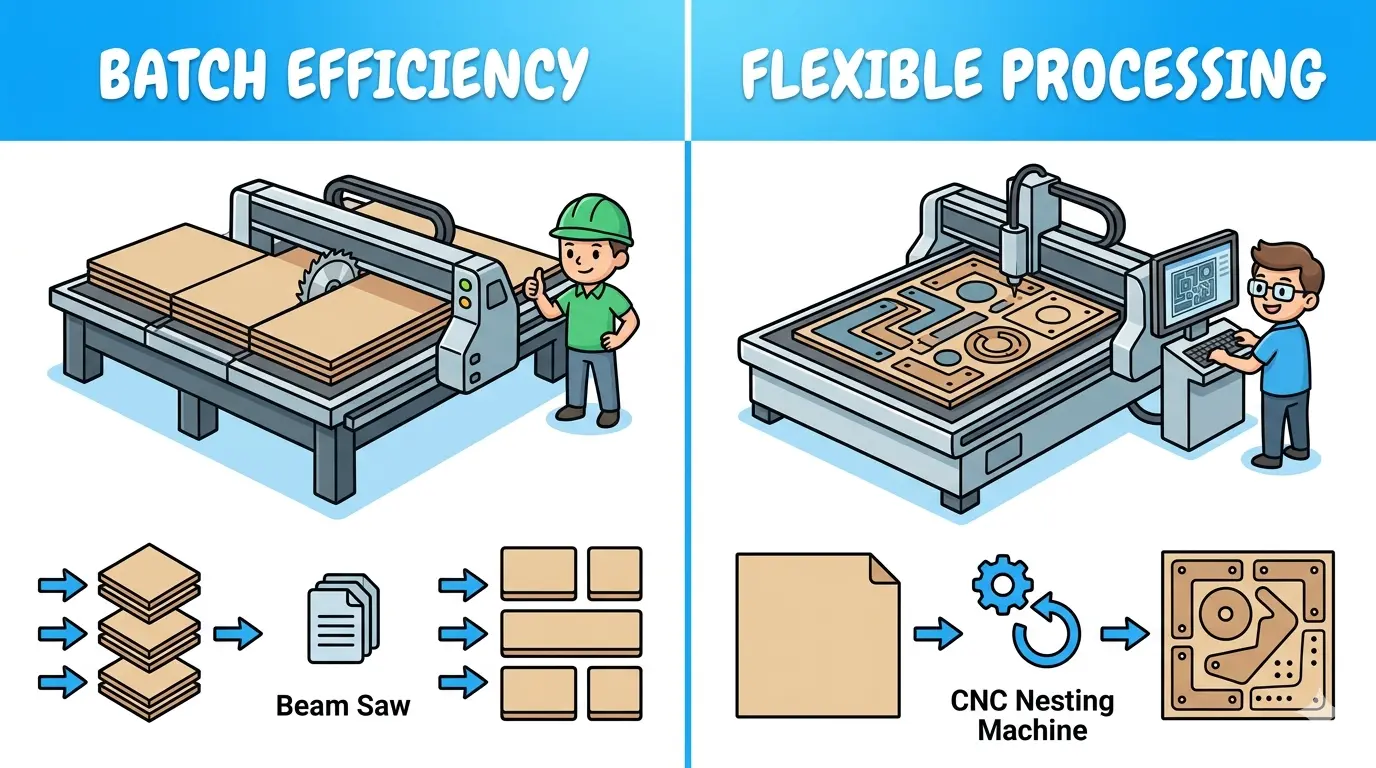
A beam saw is commonly evaluated as a dedicated panel-sizing solution. It is strongest where the workload is dominated by repeated rectangular parts, full-sheet breakdown, and a need to feed other departments in a stable, predictable way.
A CNC nesting machine is usually evaluated as a more flexible processing platform. It is better suited to workflows where cutting is only part of the requirement and where routing, drilling, part shapes, and frequent design variation change the economics of the line.
In practical terms, the difference looks like this:
- A Beam Saw Favors Structured Batch Logic
- A CNC Nesting Machine Favors Mixed And Variable Part Processing
- A Beam Saw Separates Cutting From Other Operations More Clearly
- A CNC Nesting Machine Often Reduces Handoffs By Combining More Processing In One Cell
Neither approach is universally better. Each one becomes stronger when the factory’s bottleneck matches the machine’s logic.
Beam Saw Vs. CNC Nesting At A Glance
| Decision Factor | Beam Saw | CNC Nesting Machine | What It Usually Means On The Floor |
|---|---|---|---|
| Main Production Logic | Repeated rectangular panel sizing | Flexible cutting with integrated processing potential | The choice depends on whether the line is volume-led or variation-led |
| Best Fit | Batch cabinet, wardrobe, and furniture parts with stable dimensions | Custom furniture, short runs, and jobs with cutouts or varied part geometry | Product mix matters more than brochure language |
| Throughput Pattern | Usually stronger for sustained rectangular batch cutting | Usually stronger when flexibility prevents repeated setup and handling losses | Raw speed is only one part of total output |
| Shaped Or Nested Parts | Less naturally suited | Usually a stronger fit | Irregular parts often shift the decision toward nesting |
| Routing And Drilling Integration | Usually handled in separate downstream stations | Can often be brought closer to the cutting step | This changes part flow and labor coordination |
| Downstream Workflow | Works well with specialized edge banding, boring, and assembly stages | Works well when the shop wants fewer process handoffs early in production | The machine should fit the line, not only the cut list |
| Change Frequency | Better when batches are organized and repeated | Better when orders change often and part programs vary more | High product variation can dilute beam-saw advantages |
| Material Utilization Strategy | Strong when cut planning is structured around repeated panels | Strong when part nesting and shape variety affect yield | Waste control depends on job structure, not only machine type |
| Labor Model | Supports standardization in repetitive front-end cutting | Supports consolidation of multiple operations in one work area | The better labor model depends on shop layout and skill needs |
When A Beam Saw Is Usually The Stronger Choice
Beam saw logic becomes more attractive when the factory wins or loses on how smoothly it can process large numbers of rectangular panels.
That usually applies when the shop has conditions such as:
- A High Share Of Repeated Cabinet Or Wardrobe Components
- Full-Sheet Breakdown As A Daily Throughput Constraint
- Stable Cut Lists And Planned Batches
- Dedicated Downstream Stations For Edge Banding, Drilling, Or Assembly
- Pressure To Increase Output Without Letting The Front End Become More Chaotic
In those conditions, the beam saw advantage is not only faster cutting. The larger gain is often that the cut cell becomes easier to schedule and easier to connect to the rest of the line. Parts move forward in cleaner batches. Supervisors spend less time managing avoidable variation. Downstream teams receive more consistent panel sizes.
This is especially important in factories where cutting is expected to behave like a production stage rather than a flexible job-shop station.
When A CNC Nesting Machine Usually Makes More Sense
CNC nesting becomes more compelling when the factory is losing time not because rectangular panel breakdown is too slow, but because too many different operations are being broken apart and reassembled across the shop.
That often describes workflows with:
- Frequent Design Changes Or Short Production Runs
- Shaped Parts, Sink Openings, Hardware Cutouts, Or Non-Rectangular Components
- A Need To Combine Cutting With Routing Or Drilling More Efficiently
- High Handling Friction Between Separate Machines
- Product Customization That Makes Fixed Batch Logic Harder To Sustain
In those cases, a nesting machine can improve flow by keeping more processing closer together. That does not automatically mean it produces every rectangular batch faster than a beam saw. It means it may reduce the hidden delays caused by transfers, re-staging, reprogramming across separate stations, and manual sorting of variable parts.
For highly customized furniture production, that flexibility can be more valuable than the stronger rectangular-panel discipline of a beam saw.
Batch Efficiency Is About Line Balance, Not Just Cutting Speed
Factories often describe beam saw decisions in terms of speed, but the more useful concept is line balance.
If the front end handles repeated panel sizing cleanly, the rest of the production line usually becomes easier to stabilize. Edge banding, drilling, sorting, and assembly can work from more predictable incoming parts. That is why beam saws are often favored in production systems built around specialization.
Batch efficiency usually improves when the line gains:
- More Predictable Panel Output
- Fewer Measurement-Related Interruptions
- Cleaner Batch Sequencing
- Lower Dependence On Constant Manual Rechecking
- Better Coordination Between Cutting And Downstream Stations
The tradeoff is that this advantage becomes weaker when the product mix stops behaving like a repeated rectangular-panel workflow. If the schedule is full of variable parts, openings, contours, and design changes, the line may lose more time to secondary handling than it gains at the saw itself.
Flexible Processing Is About Reducing Handoffs On Mixed Jobs
The strongest argument for CNC nesting is not simply that it can do more kinds of work. The stronger argument is that mixed production often becomes inefficient when too many operations are separated.
When cutting, routing, and drilling requirements change from order to order, every handoff creates another chance for delay, confusion, or rework. A flexible processing cell can help contain that complexity earlier in the workflow.
That often leads to practical benefits such as:
- Fewer Transfers Between Early Production Steps
- Better Handling Of Variable Part Geometry
- Less Reliance On Manual Interpretation Of Complex Part Sets
- Easier Processing Of Customized Panels In Smaller Runs
- A Better Fit For Shops Where Flexibility Is A Core Commercial Requirement
This is why nesting machines are often selected by factories that are trying to keep customization profitable rather than simply maximize rectangular panel throughput.
The Most Common Buying Mistake Is Solving The Wrong Constraint
Many factories compare these machines as if one is a faster version of the other. That is usually the wrong approach.
The more common mistake is buying a machine that solves the wrong constraint:
- A Factory Buys CNC Nesting Because It Seems More Capable, But The Real Bottleneck Is Repeated Rectangular Panel Volume
- A Factory Buys A Beam Saw For Speed, But The Real Problem Is Product Variation And Too Many Separate Processing Steps
- A Shop Focuses On Machine Capability, But Ignores Whether Its Downstream Layout Supports Specialized Or Integrated Flow
- Buyers Compare Cutting Technology, But Not The Labor Model Needed To Run The Workflow Well
The right decision usually becomes clearer when the factory asks where time, errors, and rework actually accumulate today.
A Simple Decision Framework For Buyers
Before choosing between a beam saw and a CNC nesting machine, pressure-test the decision against the production model the business really runs.
- If Most Parts Are Repeated And Rectangular, Beam-Saw Logic Usually Becomes Stronger.
- If The Product Mix Changes Constantly And Includes More Complex Geometry, Nesting Usually Gains Ground.
- If Cutting Is Only One Step In A Variable Part Workflow, Flexible Processing Often Matters More Than Peak Panel-Sizing Efficiency.
- If The Factory Already Has Strong Downstream Specialization, A Beam Saw Can Fit More Naturally Into The Existing Line.
- If The Factory Wants To Reduce Early-Stage Handoffs, A Nesting Cell May Offer A Better Process Fit.
- If The Business Is Moving Toward Higher Batch Discipline, Beam-Saw Logic Often Becomes Easier To Justify Over Time.
- If The Business Competes On Customization And Mixed Orders, Nesting Often Protects Workflow Better.
These questions shift the purchase discussion away from generic machine preference and back to operational fit.
Some Factories Eventually Need Both, But Not At The Same Moment
In larger operations, the comparison does not always end with one machine replacing the other. Some factories eventually use beam-saw-style panel sizing for repetitive front-end production while also using CNC nesting capacity for more variable jobs.
That does not mean both should be purchased together. It means the two machine types often solve different constraints inside the same plant. The better first investment is usually the one that addresses the bottleneck that is most expensive right now.
Practical Summary
Beam saw versus CNC nesting is really a choice between two production priorities. A beam saw is usually the stronger answer when the factory needs structured batch efficiency, repeated rectangular panel output, and cleaner support for downstream specialized stations. A CNC nesting machine is usually the stronger answer when flexible processing, varied part geometry, and reduced handoffs matter more than maximum batch panel-sizing discipline.
The key is to stay honest about the workflow. If the business runs on repeatable panel volume, a beam saw often fits better. If the business runs on variation, integration, and customization, nesting usually makes more sense. The better machine is the one that removes the real source of delay, rework, and production friction.