When a shop starts losing time at the cutting stage, the real issue is usually not blade speed or machine labeling. It is workflow fit. The saw at the front of production affects how smoothly parts move into edge banding, drilling, sanding, assembly, and final delivery. If the wrong machine is handling that first step, the whole line feels less stable.
That is why the better comparison is not simply manual saw versus automated saw. It is flexibility versus structured throughput, operator-led control versus repeatable panel processing, and mixed-job capability versus cleaner batch flow.
Start With the Type of Work Leaving the Cutting Cell
The fastest way to choose between these two saw types is to look at the output your cutting station is expected to produce every day.
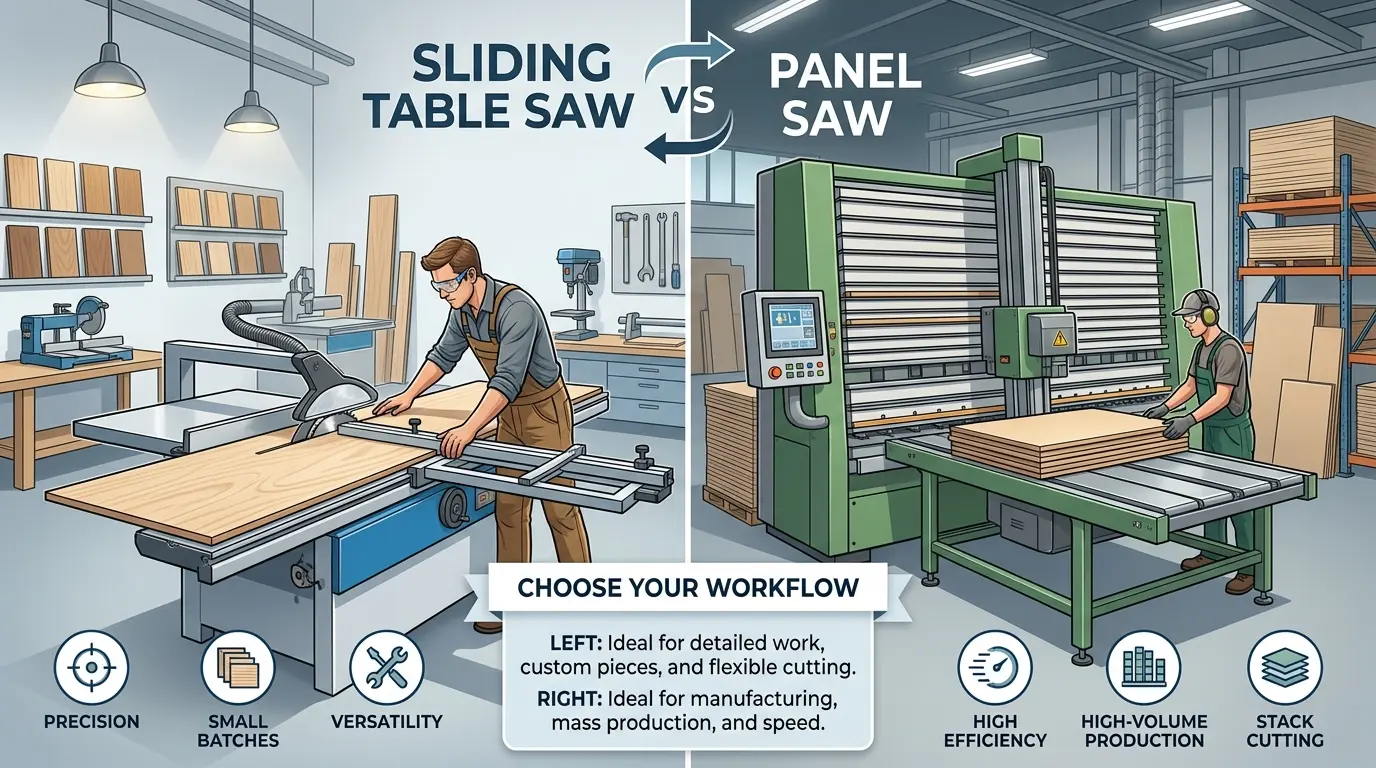
If most orders are rectangular cabinet parts, wardrobe panels, office furniture components, or other repeatable sheet-based pieces, a panel saw is commonly the stronger fit. If the same station must also handle short runs, job changes, solid wood, angled cuts, and more operator judgment, a sliding table saw often makes more sense.
In other words, one machine helps standardize production. The other helps absorb variation.
What a Sliding Table Saw Brings to the Workflow
A sliding table saw is usually chosen for its range rather than for maximum batch output. It gives the operator direct involvement in positioning, feeding, and controlling the cut, which is valuable when jobs change often or when the shop does not want the cutting cell locked into one narrow production pattern.
That kind of flexibility helps in workflows such as:
- Custom Furniture Production With Frequent Part Changes
- Mixed Processing of Sheet Goods and Solid Wood
- Shops Handling One-Off, Prototype, or Short-Run Work
- Jobs That Include Angled, Irregular, or Operator-Guided Cuts
- Workshops Where One Machine Must Cover Many Daily Tasks
The practical benefit is adaptability. A sliding table saw can stay productive in shops where the work mix changes faster than a more structured cutting process can comfortably absorb.
The tradeoff is that output consistency depends more heavily on setup discipline, operator technique, and how repeatable the workload actually is.
What a Panel Saw Brings to the Workflow
A panel saw is usually selected when the cutting stage has become a bottleneck in a more repeatable production system. In panel furniture and cabinet manufacturing, the goal is often not just to cut sheets faster, but to cut them more consistently so downstream operations receive parts with less variation.
That matters when the factory is trying to stabilize:
- Batch Flow Into Edge Banding and Drilling
- Part Size Consistency for Assembly
- Material Handling Across Repeated Cutting Lists
- Labor Efficiency in Sheet Breakdown
- Rework Caused by Dimension Variation Upstream
In those environments, the saw does more than size panels. It helps turn the front end of production into a controlled process instead of a high-skill manual checkpoint.
The Core Difference: Adaptability vs. Process Structure
Both machines can produce accurate work when they are used correctly. The difference is how they support production behavior.
A sliding table saw is usually stronger when the cutting cell must adapt to different jobs throughout the week. A panel saw is usually stronger when management wants the cutting cell to behave the same way every shift, across repeated parts and more standardized output.
That distinction shapes labor, scheduling, material flow, and even how easy it is to scale the line later.
| Workflow Factor | Sliding Table Saw | Panel Saw |
|---|---|---|
| Best Fit | Mixed work, custom orders, changing job requirements | Repeated panel sizing and batch production |
| Main Strength | Flexibility and direct operator control | Throughput and repeatable sheet processing |
| Labor Dependence | Higher reliance on operator skill and consistency | Lower dependence on manual technique in repeated workflows |
| Part Profile | More varied shapes, angles, and mixed tasks | Mostly rectangular panel parts and standardized components |
| Downstream Effect | Works well when later stages are also flexible | Helps stabilize edge banding, drilling, and assembly flow |
| Production Goal | Versatility across many cutting demands | Cleaner, more structured front-end capacity |
| Main Tradeoff | Less efficient for repeated high-volume sheet breakdown | Less useful when the job mix changes constantly |
Neither saw is universally better. The right choice depends on whether your shop is trying to absorb variety or reduce variation.
When a Sliding Table Saw Usually Makes More Sense
A sliding table saw is often the better choice when the business model depends on responsiveness rather than maximum repetition. Many smaller workshops, project-based manufacturers, and custom furniture shops fall into this category.
It is commonly the better fit if:
- The Job Mix Changes Frequently.
- Operators Need to Switch Between Different Materials and Part Types.
- Short Runs Matter More Than Batch Efficiency.
- The Shop Still Depends on Skilled Manual Judgment at the Cutting Stage.
- One Saw Needs to Cover a Broad Range of Daily Work.
In these conditions, a more rigid cutting workflow can create friction instead of removing it. The flexibility of a sliding table saw often protects productivity better than a higher-throughput machine that does not match the work profile.
When a Panel Saw Usually Makes More Sense
A panel saw is often the better fit when the factory has already moved toward repeated panel-based production and wants the cutting stage to become more disciplined, faster, and easier to repeat.
It is commonly the better fit if:
- Most Parts Are Repeated Rectangular Components.
- The Shop Produces Cabinets, Closets, or Modular Furniture in Volume.
- Downstream Stations Lose Time When Part Dimensions Drift.
- Management Wants Cleaner Batch Planning at the Start of Production.
- Growth Depends on More Stable Sheet Breakdown Rather Than More Manual Flexibility.
In that environment, the value is not just cutting capacity. It is the ability to support more predictable handoffs into the rest of the line.
The Hidden Cost of Choosing the Wrong One
The wrong saw does not always fail obviously. Often, it shows up as recurring inefficiency elsewhere.
If a high-variation shop buys a machine better suited to rigid batch flow, operators may work around it instead of with it. Setup friction increases, job changes feel slower, and the machine may be underused outside a narrow range of work.
If a batch-oriented factory relies on a saw better suited to flexible manual work, the problem often appears as uneven throughput, inconsistent part handling, more dependence on individual operators, and more variation flowing into later processes.
That is why the comparison should always include downstream consequences. A saw is not just a cutting asset. It is a workflow decision.
Questions to Ask Before You Decide
Before making the investment, pressure-test the cutting stage with a few practical questions:
- Are most of our daily cuts repeated rectangular parts or constantly changing jobs?
- Is the larger problem slow batch flow or limited flexibility?
- How much do later stages depend on highly consistent panel sizing?
- How much of our current cutting quality depends on individual operator skill?
- Are we trying to scale a standardized line or protect a more custom production model?
These questions usually reveal the better machine faster than feature-by-feature comparisons taken out of production context.
Practical Summary
Choose a sliding table saw when your workflow depends on flexibility, operator control, and the ability to move between different types of cutting work without slowing the shop down. Choose a panel saw when your workflow depends on repeated panel sizing, steadier throughput, and cleaner handoffs into later operations.
The right investment is the one that removes the real constraint in your factory. If the cutting cell must stay adaptable, a sliding table saw is often the better fit. If the cutting cell needs to become more repeatable and production-oriented, a panel saw usually delivers more value.