In panel furniture production, the cutting cell does more than size boards. It sets the pace for edge processing, drilling, sorting, and assembly. When the first step is inconsistent, every downstream department spends more time correcting dimensions, rechecking parts, or working around avoidable delays.
That is where a beam saw usually enters the conversation. A beam saw is commonly used when a factory needs repeated, accurate panel sizing with less operator-to-operator variation. Understanding how it works is useful not only for machine selection, but also for deciding whether this type of front-end cutting system actually fits the production model behind it.
What a Beam Saw Is Designed to Do
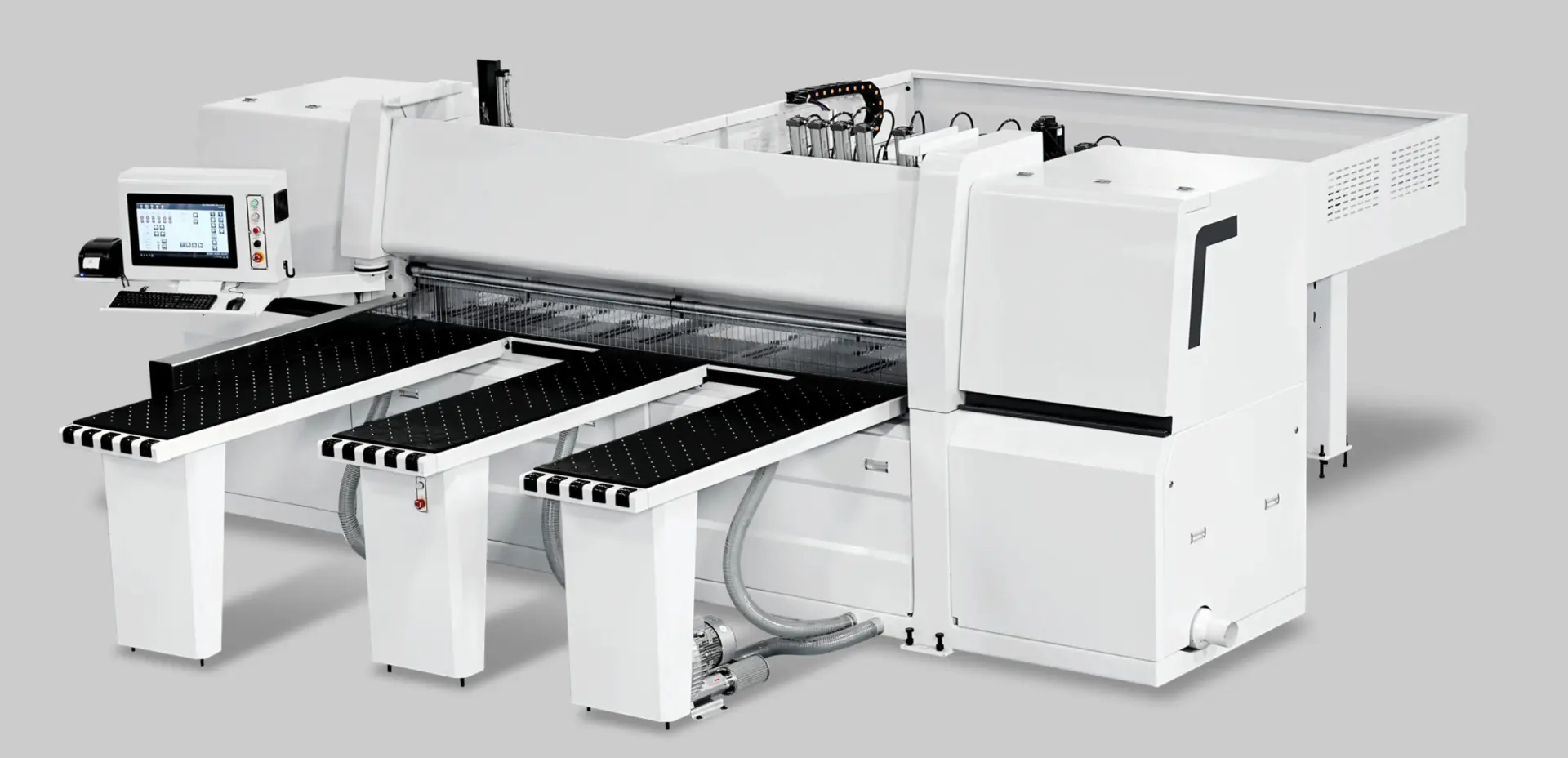
A beam saw is primarily used to break down sheet material into accurate, repeatable rectangular parts. In woodworking and panel-based manufacturing, that usually means materials such as MDF, particleboard, plywood, melamine-faced board, and similar sheet goods.
In practical buying terms, a beam saw usually sits inside the broader category of industrial panel saws. What makes the beam saw distinct is not simply that it cuts panels, but that it is built around controlled positioning, clamping stability, and organized batch processing.
That matters most in factories producing cabinets, wardrobes, office furniture, modular storage, and other products where a large share of the output starts as repeated rectangular components.
How a Beam Saw Works in Practice
The exact configuration varies, but the basic operating logic is usually straightforward. The machine is designed to hold the panel securely, position it consistently, and execute repeated cuts according to a planned cutting sequence.
In most production environments, the workflow looks like this:
- A cut list or production plan is prepared so the machine knows what parts need to be produced.
- The panel or panel stack is loaded and aligned within the cutting area.
- A pressure beam clamps the material to help control movement during the cut.
- The saw unit travels through the programmed cut path while the positioning system indexes the material for the next cut.
- Finished parts are sorted, stacked, or moved forward for downstream processing.
The important point is not just automation for its own sake. The beam structure and clamping method are used to make repeated cuts more stable and predictable, especially when the production goal is volume and consistency rather than one-off flexibility.
Why the Beam Design Matters to Production
The value of a beam saw is usually easier to see in workflow terms than in feature lists. A well-matched beam saw helps control the front end of production in ways that a more manual process often cannot sustain at the same output level.
Common workflow advantages include:
- More Consistent Part Sizing Across Repeated Jobs
- Less Dependence on Individual Operator Technique During Each Cut
- Better Throughput for Batch-Oriented Panel Breakdown
- Cleaner Handoff Into Edge Processing, Drilling, and Assembly
- Fewer Interruptions Caused by Re-cuts or Dimension-Related Sorting Problems
Those benefits matter most when the saw is not working alone, but as the first step in a larger, repeatable production flow.
Where Beam Saws Fit Best
Beam saws are usually strongest where the part mix is repeatable, the sheet-goods volume is meaningful, and the factory wants cutting to behave like a controlled production system rather than a manual workstation.
| Production Situation | Beam Saw Fit | Why It Fits |
|---|---|---|
| Batch Cabinet Production | Strong | Repeated rectangular parts benefit from stable, repeatable panel sizing |
| Modular Furniture Manufacturing | Strong | Standardized components reward structured cutting flow and part consistency |
| Dedicated Cut-To-Size Department | Strong | Centralized breakdown work gains from throughput and repeatability |
| Mixed Low-Volume Custom Shop | Moderate to Weak | The machine may be underused if work changes constantly |
| Irregular Or Nested Part Production | Weak | A beam saw is not usually the first choice when part geometry is highly variable |
The right fit usually appears when most of the production value comes from cutting many similar panels accurately and moving them downstream without confusion.
Where Beam Saws Sit in the Production Line
A beam saw usually makes the most sense at the front of a panel-processing workflow. Its job is to create order early, so later departments can work faster and with fewer corrections.
In a typical factory flow, that often means:
- Raw panels enter the cut cell with a defined job plan.
- The beam saw sizes panels into repeatable components.
- Parts move to edge treatment, hole-making, or hardware preparation.
- Sorted components continue into assembly with fewer dimension-related surprises.
This is why beam saw selection should not be treated as a stand-alone cutting decision. It is really a decision about how the factory wants to organize sheet breakdown and support the rest of the line.
Beam Saws vs. More Flexible Cutting Options
Buyers often understand beam saws more clearly when they compare them with equipment designed for more flexible or operator-led work. A beam saw is not automatically better than other saw formats. It is simply better aligned with certain production goals.
| Machine Type | Best Fit | Main Strength | Main Tradeoff |
|---|---|---|---|
| Beam Saw | Repeated rectangular panel cutting in batch production | Throughput, repeatability, and controlled panel breakdown | Less flexible for varied one-off jobs or irregular shapes |
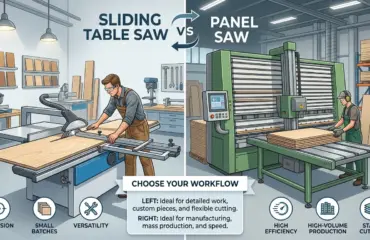
| Sliding Table Saws | Custom shops, varied jobs, and operator-guided cutting | Flexible handling and direct operator control | More dependent on operator consistency and usually slower on repeated batches |
| CNC Nesting Machine | Nested parts, routing integration, and shape variation | Combines cutting with routing or drilling in one workflow | May be more complex than needed when the main job is only fast rectangular sizing |
This comparison usually brings the real decision into focus. If the factory primarily needs efficient, repeated sheet breakdown, a beam saw often fits well. If the work depends on shape flexibility, frequent changeovers, or integrated routing, another machine type may be the more practical answer.
When a Beam Saw Is Not the Right Choice
Beam saws are not universal solutions. They can be the wrong fit when the production model depends more on flexibility than on repeated volume.
A beam saw may be less suitable when:
- Most Jobs Are One-Off or Constantly Changing
- Irregular Shapes Matter More Than Rectangular Part Output
- The Shop Relies Heavily on Manual Judgment and Flexible Cutting Decisions
- Production Volume Is Too Low to Benefit From a Structured Cut Cell
- The Real Bottleneck Is Elsewhere, Such as Edge Finishing, Drilling, or Assembly
In those situations, the better investment may be a different cutting format or a downstream improvement that removes the actual constraint first.
Practical Summary
Beam saws are built for controlled, repeatable panel sizing. They work by combining stable clamping, organized positioning, and planned cut sequences so large volumes of rectangular parts can move through the front end of production with fewer interruptions and less variation.
They fit best where sheet-goods processing is central to the business and where accurate batch cutting supports everything that happens next. They fit less well where the work is highly customized, irregular, or too varied to benefit from a structured panel-sizing system. The best way to evaluate a beam saw is not to ask whether it is advanced, but whether its workflow discipline matches the kind of factory you are actually running.