In panel furniture production, customers rarely measure glue spread or roller pressure, but they notice the result immediately. A dark glue line, a visible gap, squeeze-out on the top edge, or an edge band that lifts after machining makes the whole panel look lower grade, even when the substrate and banding material are acceptable.
That is why glue line quality should be treated as a setup discipline, not only an adhesive choice. In most factories, the biggest improvements come from stabilizing edge preparation, glue application, pressure, and line conditions before changing materials or adding labor at the end of the line.
What Good Glue Line Quality Actually Means
A good glue line is not just strong enough to hold. In production, it usually means:
- The Bond Line Looks Narrow And Consistent From Panel To Panel
- The Edge Band Seats Fully Without Visible Open Spots Or Telegraphing
- Glue Squeeze-Out Is Controlled, Not Excessive
- The Finished Edge Can Move Into Trimming, Corner Processing, and Assembly Without Rework
- Visual Quality Stays Stable Across A Full Batch, Not Only On The First Few Panels
This matters because glue line appearance is often a proxy for overall process control. If the bond line changes from one panel to the next, the problem is usually upstream or in the setup window rather than in the adhesive itself.
Start With The Panel Edge, Not The Glue Pot
Many glue line problems begin before the panel reaches the edge banding machine. If the cut edge is chipped, fuzzy, out of square, dusty, or inconsistent in thickness, the glue system has to compensate for a poor bonding surface.
Before adjusting temperature or glue quantity, confirm:
- The Panel Edge Is Clean And Reasonably Uniform After Cutting Or Sizing
- Dust Extraction Is Doing Enough To Keep The Bonding Face Clear
- Moisture And Storage Conditions Are Not Causing Obvious Substrate Instability
- The Reference Surfaces Guiding The Panel Into The Machine Are Clean And Repeatable
In higher-finish work, pre-milling often matters because it removes saw marks, minor edge damage, and thickness variation before glue is applied. When operators try to hide poor edge preparation by using more adhesive, the result is often a thicker, less attractive glue line rather than a better bond.
Match Glue Temperature, Feed Speed, And Open Time
Glue line quality depends on time and temperature working together. If the adhesive is too cool for the current feed rate, wetting becomes inconsistent. If the line slows down but glue application stays too hot or too heavy, squeeze-out and visible glue build-up become more likely.
The key is to treat setup as a process window:
- Glue Temperature Should Be Stable Before The First Approved Panel
- Feed Speed Changes Should Trigger A Review Of The Glue Setting, Not Just The Conveyor Pace
- Start-Up Panels Should Be Inspected Separately From Steady-State Production
- A Machine That Runs Well After Warm-Up May Still Produce Weak Or Messy Results During The First Unstable Minutes Of The Shift
Operators often chase symptoms by making large adjustments at the glue unit. A better approach is to change one variable at a time and watch whether the bond line improves in a consistent way over several panels, not only on a single sample.
Set Glue Application For Full Coverage, Not Excess
More glue does not automatically produce a better bond. In many shops, over-application is used as a safety margin when edge quality, temperature stability, or pressure settings are not under control. That usually leads to visible glue lines, top-and-bottom squeeze-out, trimming contamination, and extra cleaning.
A better target is full, even coverage that matches the real bonding surface. In practical terms:
- Too Little Glue Can Leave Dry Areas Or Intermittent Open Spots
- Too Much Glue Can Make The Edge Look Heavy, Uneven, Or Dirty After Finishing
- Uneven Application Across The Edge Height Can Create Panels That Look Acceptable On One Side And Weak On The Other
When the process is stable, the goal is not maximum glue quantity. The goal is repeatable wetting with the smallest application that still produces a reliable, visually clean bond.
Adjust Pressure Rollers For Contact, Not Compression
Pressure rollers should close the bond line consistently, but they cannot correct every problem created upstream. If pressure is too low, the edge band may not seat fully against the panel. If pressure is too aggressive, the panel edge or banding material can deform, especially on thinner or less stable parts.
Good setup usually means checking:
- Roller Alignment To The True Panel Path
- Sufficient Pressure To Seat The Band Immediately After Glue Application
- Stable Panel Support So The Workpiece Does Not Rock Or Drift During Contact
- Roller Sequencing That Maintains Contact Instead Of Forcing The Panel Sideways
This is where straight feeding matters. If the panel is not presented consistently, operators may keep increasing pressure to force a better result, when the real issue is alignment, reference stability, or part variation.
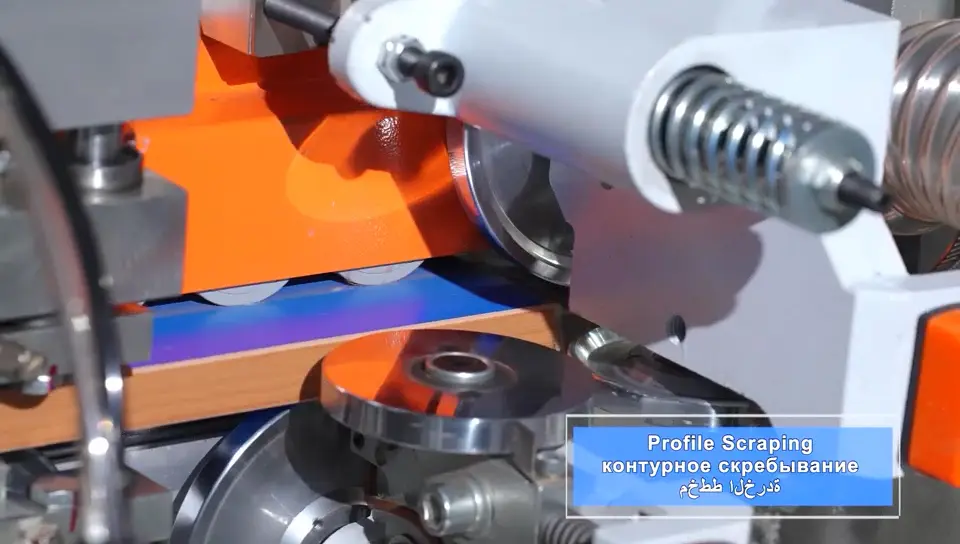
Use Pre-Milling When Edge Preparation Is The Real Bottleneck
Pre-milling is not mandatory for every factory, but it becomes important when finished edge appearance matters and upstream cutting variation is hard to eliminate completely.
A pre-milling unit helps when:
- Saw-Cut Edges Show Small Chips Or Compression Marks
- Panel Thickness Varies Enough To Affect Band Seating
- Glue Line Appearance Must Stay Clean Across Melamine, MDF, Particle Board, Or Laminated Panels
- Operators Are Repeatedly Increasing Glue Quantity To Cover Edge Irregularities
In those cases, pre-milling improves the bonding surface before the glue and edge band meet. That usually produces a cleaner visual line and reduces the need to use adhesive as a substitute for surface preparation.
Keep The Glue System Clean And Stable
Even a well-set machine will struggle if the glue unit is contaminated or drifting. Carbonized residue, unstable heating, dirty nozzles, or inconsistent glue circulation can change line quality gradually across the shift.
Practical checks usually include:
- Cleaning Adhesive Build-Up Before It Hardens Into A Recurring Defect Source
- Confirming The Glue Unit Reaches A Stable Operating Condition Before Approval Panels Are Run
- Watching For Gradual Quality Drift Rather Than Waiting For Obvious Bond Failure
- Checking Whether Maintenance Intervals Match Actual Production Intensity
If glue line quality gets worse as the shift progresses, that pattern usually points to contamination, temperature drift, or unstable feed conditions rather than a one-time material issue.
Troubleshooting Common Glue Line Problems
| Visible Symptom | Likely Setup Cause | First Corrective Priority |
|---|---|---|
| Thick, Dark, Or Highly Visible Glue Line | Excess Adhesive, Poor Edge Preparation, Or Unstable Temperature | Reduce Over-Application And Confirm The Panel Edge Is Clean And Uniform |
| Intermittent Open Spots | Incomplete Wetting, Low Temperature For Current Speed, Or Uneven Pressure | Recheck The Glue-Temperature-To-Feed-Speed Relationship And Pressure Consistency |
| Heavy Top-And-Bottom Squeeze-Out | Too Much Glue, Uneven Edge Condition, Or Excessive Compensation During Setup | Reduce Glue Quantity And Inspect Edge Quality Before Changing Roller Force |
| Bond Looks Acceptable At Start-Up But Drifts Later | Glue Unit Contamination, Heating Instability, Or Uncontrolled Shift Changes | Check Glue-System Cleanliness And Temperature Stability Through The Shift |
| Edge Band Seats Inconsistently From Panel To Panel | Variable Panel Thickness, Poor Guiding, Or Unstable Part Presentation | Check Referencing, Support, And Whether Pre-Milling Is Needed |
This kind of table matters because it keeps operators from changing several settings at once. If temperature, glue quantity, and roller pressure all move together, the real cause becomes harder to find.
Know When The Issue Is Bigger Than Setup Alone
Sometimes the process repeatedly falls out of tolerance because the machine configuration is not well matched to the finish standard or production mix. If the team must slow the line excessively, over-apply glue, or rely on frequent manual correction just to maintain acceptable appearance, the limitation may no longer be the operator.
For shops reviewing different edgebanders, this is where features such as pre-milling, more stable glue application, and better pressure control become workflow questions rather than optional upgrades. A machine that supports cleaner, repeatable edge preparation usually reduces rework pressure throughout trimming, polishing, inspection, and final assembly.
Build A Short Daily Routine Instead Of Relying On Experience Alone
The strongest results usually come from standardizing a short setup routine at the start of the shift and after material changes.
A practical routine often includes:
- Inspect The Incoming Panel Edge Before Adjusting The Glue Unit
- Warm The Glue System To A Stable Operating Condition Before First Approval
- Run A Small First-Off Sample And Check Bond Appearance On More Than One Panel
- Adjust One Variable At A Time Instead Of Chasing The Defect From Three Directions
- Recheck The Setup Whenever Panel Material, Thickness, Or Edge Band Changes
- Watch For Quality Drift Mid-Shift, Not Only Obvious Failures
This kind of routine is especially useful in factories that switch frequently between board types, banding thicknesses, or finish standards. It protects quality without turning every changeover into a long troubleshooting session.
Practical Summary
Better glue line quality rarely comes from one dramatic adjustment. In most edge banding operations, it comes from controlling the basics in the right order: edge preparation, stable adhesive conditions, accurate glue application, consistent pressure, and repeatable panel guidance.
When those factors are stable, the bond line becomes cleaner, rework drops, and the finished panel looks more consistent through trimming and assembly. When they are unstable, adding more glue or more operator attention usually only hides the problem for a short time. The factories that achieve better edge quality most reliably are the ones that treat edge banding machine setup as a controlled production system, not a last-minute cosmetic fix.