In wood-product manufacturing, “better detail” is usually the wrong starting question. A factory making branded gift boxes, decorative wall panels, or engraved signage is chasing one kind of detail. A shop producing carved cabinet doors, profiled furniture parts, or routed joinery features is chasing another.
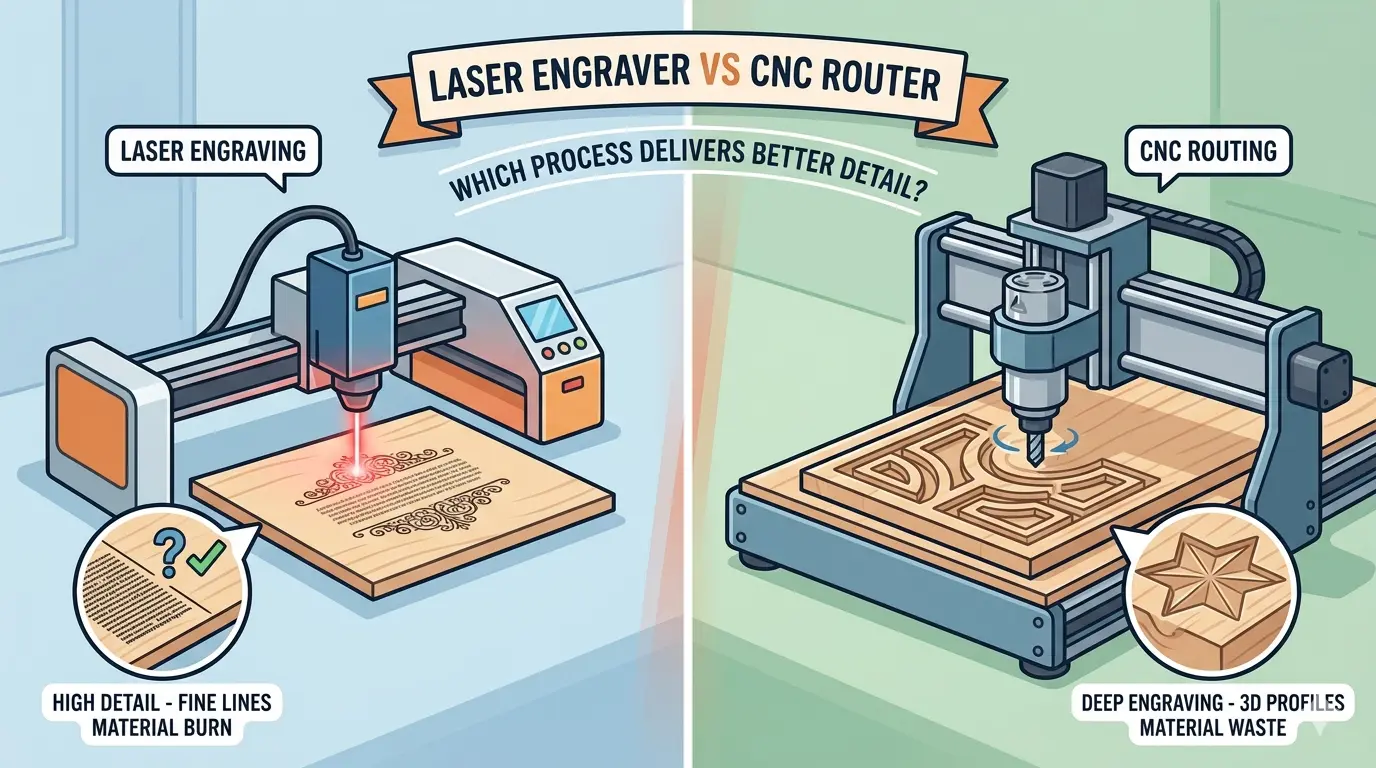
A laser engraver usually delivers better detail when the job depends on fine surface graphics, small text, sharp internal geometry, and fast design changes. A CNC router usually delivers better detail when the part needs carved depth, shaped edges, pockets, grooves, or tactile relief that becomes part of the finished product. The better process depends on whether detail lives on the surface or inside the geometry of the part.
Why The Answer Depends On What Kind Of Detail You Need
In real production, wood detail usually falls into three different categories:
- Visual Surface Detail Such As Logos, Text, Patterns, Artwork, And Decorative Marking
- Geometric Cut Detail Such As Tight Internal Shapes, Small Openings, And Complex Outlines
- Machined Depth Detail Such As Relief Carving, V-Grooves, Pockets, Chamfers, And Profiled Edges
Once those categories are separated, the comparison becomes much clearer.
A laser engraver is strongest when detail has to look crisp from the face of the part. A CNC router is strongest when detail has to be felt, assembled, coated, or machined into the body of the material.
Where A Laser Engraver Usually Delivers Better Detail
For wood products that depend on visible graphics and fine decorative definition, laser cutters and engravers are commonly the stronger choice.
That is usually true when the job requires:
- Small Text And Fine Branding Elements
- Dense Decorative Linework Or Repeating Patterns
- Sharp Internal Corners Or Narrow Open Areas
- Fast Switching Between Custom Designs
- Consistent Surface Marking Without Physical Tool Changes
The main advantage is that the process is not limited by cutter diameter in the way a router is. If the artwork includes tight internal features, narrow lettering, or delicate contour transitions, a laser can usually reproduce those details more cleanly than a mechanical toolpath using standard router bits.
This matters for products such as:
- Branded Wooden Packaging
- Decorative Wall Panels
- Signage And Display Components
- Personalized Wood Products
- Thin Decorative Inserts And Face Panels
Laser engraving also helps when short-run variety is part of the business model. If each order carries different artwork, names, logos, or decorative patterns, the changeover advantage can matter as much as the visual detail itself.
But the tradeoff is real. On wood products, laser detail can come with edge darkening, smoke residue, or contrast variation across plywood, MDF, veneer-faced panels, and solid wood. If the finish standard is very sensitive to burn marks, the crispest detail on paper may still create more cleanup than expected.
Where A CNC Router Usually Delivers Better Detail
When detail must have depth, shape, or structural function, a CNC router usually becomes the better tool.
For router-led panel and component processing, router-class CNC nesting machines are commonly more relevant because the workflow is not only about marking or contour definition. It is also about profiling, pocketing, grooving, and machining features that support later assembly.
A CNC router usually delivers better detail when the part needs:
- Deep Carved Lettering Or Logos
- Relief Patterns With Visible Depth
- Pockets, Grooves, And Functional Recesses
- Profiled Edges, Chamfers, Or Decorative Moulding Shapes
- Three-Dimensional Contours Or Textured Surfaces
- One-Setup Integration With Routing And Drilling Operations
This is where router detail becomes more valuable than laser detail. A router can cut detail into the material, not just onto it. That matters for cabinet doors, carved furniture components, sign blanks with dimensional lettering, and wood products where the finished look depends on physical depth rather than only visual contrast.
The tradeoff is that small mechanical details are constrained by tool size and toolpath behavior. Very tight internal corners, very small text, and narrow linework may require smaller cutters, slower cycle times, and stricter tooling discipline. Tool wear and sanding requirements can also affect whether the theoretical detail level shows up consistently on the finished part.
Laser Engraver vs CNC Router for Wood Detail at a Glance
| Detail Priority | Laser Engraver | CNC Router | Better Fit |
|---|---|---|---|
| Small Text And Logos | Usually Very Strong | Limited By Tool Size | Laser Engraver |
| Fine Surface Patterns | Usually Very Strong | Application Dependent | Laser Engraver |
| Sharp Internal Corners | Usually Very Strong | Limited By Cutter Radius | Laser Engraver |
| Deep Carved Lettering | Limited | Usually Very Strong | CNC Router |
| Relief Carving And Tactile Texture | Limited | Usually Very Strong | CNC Router |
| Grooves, Pockets, And Recessed Features | Limited | Usually Very Strong | CNC Router |
| Decorative Face Marking With Frequent Artwork Changes | Usually Very Strong | Slower To Adapt | Laser Engraver |
| Profiled Edges And Shaped Part Geometry | Limited | Usually Very Strong | CNC Router |
| Combination Of Detail And Assembly Features | Limited | Usually Very Strong | CNC Router |
| Thin Decorative Geometry With Minimal Tooling Change | Usually Very Strong | Application Dependent | Laser Engraver |
The table only works if “detail” is defined by the product requirement. It is not a universal scorecard.
The Hidden Tradeoff Is Cleanup, Not Just Precision
Many buyers compare detail quality without looking closely at secondary work. That is where the real production cost often shows up.
With laser engraving, the cleanup risk is usually thermal. The concern is smoke residue, darkened edges, or surface discoloration that may need wiping, sanding, or finish compensation.
With CNC routing, the cleanup risk is usually mechanical. The concern is tool marks, edge fuzz, small-feature instability, or the need for sanding before coating or assembly.
That means the better-detail process is often the one that reaches finish quality faster, not the one that creates the most impressive sample in isolation.
If the product is customer-facing and lightly finished, laser detail may look better and require less manual shaping. If the product needs carved dimension, edge shaping, or deep decorative features before coating, routed detail may reduce compromise even if it needs more sanding discipline.
Which Process Fits Common Wood Product Lines Better?
For most buyers, the decision becomes easier when it is tied to the actual product family.
- Branded Gift Boxes, Presentation Packaging, And Personalized Products: Laser Engraver Usually Fits Better
- Decorative Signage And Fine Surface Graphics: Laser Engraver Usually Fits Better
- Thin Decorative Panels With Tight Artwork Or Intricate Openings: Laser Engraver Usually Fits Better
- Carved Cabinet Doors, Raised Decorative Panels, And Relief Work: CNC Router Usually Fits Better
- Furniture Components With Grooves, Pockets, And Profiled Edges: CNC Router Usually Fits Better
- Wood Parts That Need Detail Plus Drilling Or Machined Assembly Features: CNC Router Usually Fits Better
- Product Lines Combining Surface Branding With Dimensional Machining: A Hybrid Workflow May Make More Sense Than Forcing One Machine To Do Everything
This is also where many buying mistakes happen. A laser is sometimes chosen because the sample detail looks cleaner, even though the production line really needs dimensional routing. A router is sometimes chosen because it feels more versatile, even though the selling value of the product depends on fine face detail and quick artwork changes.
Practical Summary
If “better detail” means fine text, decorative linework, sharp internal geometry, and repeatable surface graphics on wood products, a laser engraver usually has the advantage. If “better detail” means carved depth, profiled geometry, tactile relief, and machined features that become part of the part itself, a CNC router usually has the advantage.
Neither process is universally better. Laser detail is usually better for visual precision. Router detail is usually better for dimensional precision. The right choice comes from the kind of detail your product sells, the finish standard you must hit, and how much secondary cleanup the process adds before the part is ready for the next step.