In furniture production, drilling problems rarely start with a lack of machine capacity. They usually start with poor configuration. Cabinets reach assembly with mismatched connector holes, shelf-pin lines drift from one batch to the next, drawer parts arrive mirrored the wrong way, and hardware fitting turns into manual correction instead of repeatable flow.
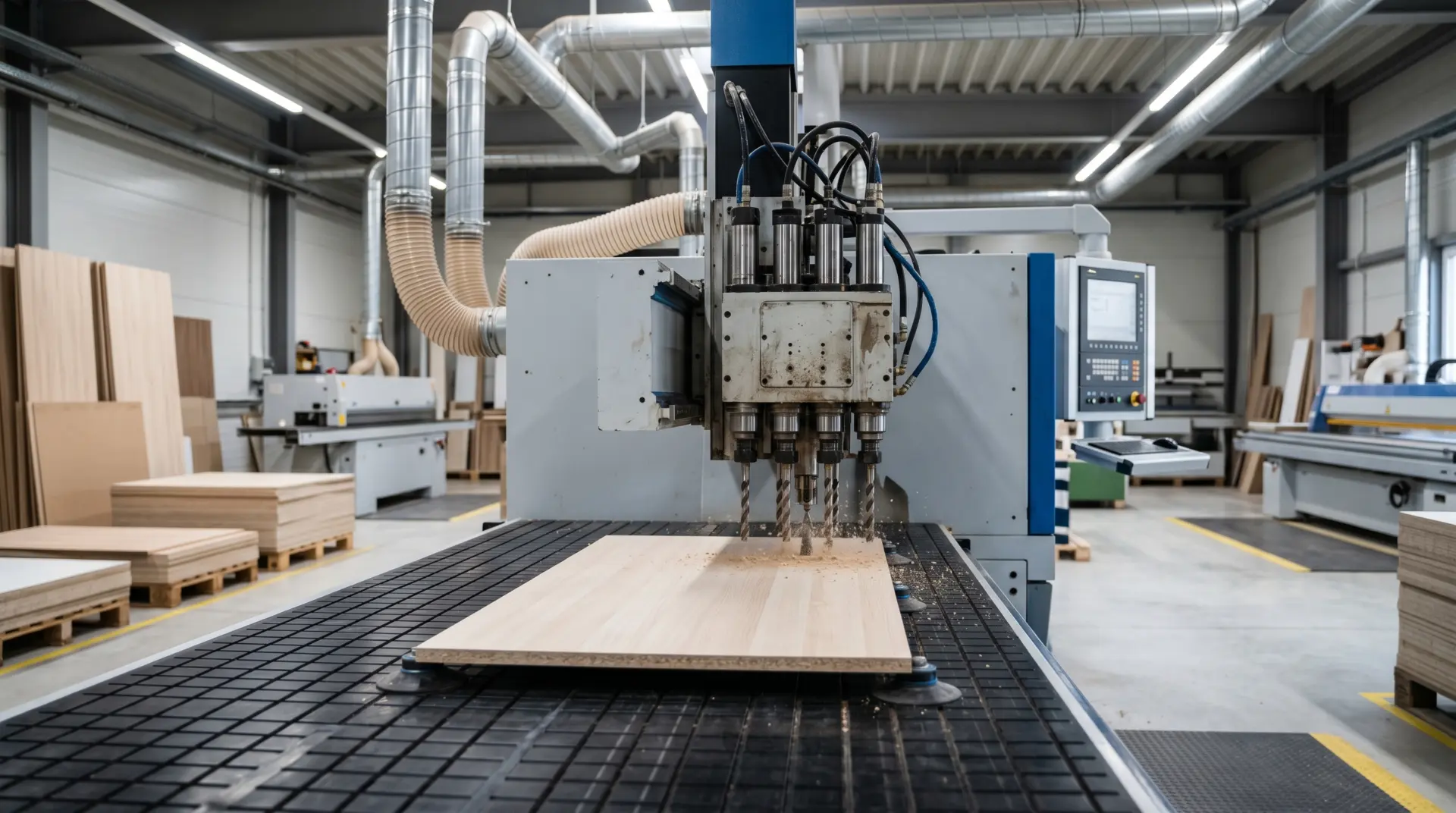
A CNC drilling machine can help standardize hole processing, but only if the factory configures it around real product logic. This guide looks at the setup decisions that matter most, where factories often go wrong, and how to configure drilling so it supports stable production instead of repeating the same errors faster.
What Configuration Should Actually Control?
In a furniture factory, machine configuration should do more than tell the drill where to move. It should define how the factory translates product rules into repeatable hole patterns.
That usually includes decisions such as:
- Part Orientation And Reference Conventions
- Hole Libraries For Different Product Families
- Hardware And Joinery Standards
- Material Thickness Rules
- Left-Hand And Right-Hand Part Logic
- Batch Identification And Program Matching
- Inspection Points Before Parts Move To Assembly
If those decisions are unclear, even a capable drilling setup can become a reliable way to produce the wrong result at scale.
Start With The Product System, Not The Machine Menu
Many weak drilling configurations start from available functions instead of actual furniture construction logic. A stronger approach is to begin with the products the factory builds every day.
For panel furniture, that often means mapping the real part families first: cabinet sides, shelves, tops, bottoms, stretchers, drawer parts, and hardware-related panels. If the factory works around a 32 mm system, the drilling strategy should reflect that consistently across the product range instead of relying on ad hoc operator judgment from job to job.
| Configuration Input | Why It Matters | What The Factory Should Clarify |
|---|---|---|
| Cabinet Construction Standard | Determines the base logic behind line boring, connector placement, and assembly repeatability | Is the factory using one dominant construction method or several competing ones? |
| Part Families | Prevents one generic setup from being stretched across panels with different hole requirements | Which panels repeat across most orders, and which are exceptions? |
| Hardware Families | Keeps drilling aligned with the connectors, slides, hinges, and fittings actually used in production | Which hardware changes are standard, and which create special cases? |
| Material Thickness Groups | Affects edge distance, hole depth planning, and fit at assembly | Are thickness changes tightly controlled or frequent across orders? |
| Finished-Part Rules | Prevents confusion between raw cut size and finished assembly dimensions | Are panels drilled before or after certain finishing steps in the workflow? |
The more standardized the product system is before configuration begins, the easier it becomes to keep drilling stable across shifts and order mixes.
Set A Clear Datum And Part Orientation Strategy
In furniture drilling, some of the most expensive mistakes come from inconsistent referencing rather than inaccurate motion. If one operator treats the front edge as primary and another treats the back edge as primary, the machine may still drill accurately while the factory still produces unusable parts.
Every drilling configuration should define a consistent answer to questions such as:
- Which Face Is The Reference Face?
- Which Edge Is The Primary Datum?
- How Are Left-Hand And Right-Hand Parts Distinguished?
- How Is Part Rotation Controlled Between Cutting, Drilling, And Assembly?
- How Are Labels Or Part IDs Matched To Orientation Rules?
This matters because drilling is downstream-sensitive. If the datum strategy shifts between panel cutting, edge processing, and hole preparation, the error shows up later as poor fit, uneven reveals, or connector positions that force manual correction.
Configure By Part Family, Not With One Universal Program
Furniture factories often create unnecessary instability when they try to force too many panel types into one overly broad drilling routine. That usually saves time at setup and loses time everywhere else.
A better configuration groups recurring parts into clear drilling families, such as:
- Cabinet Side Panels
- Shelf And Adjustable Shelf Components
- Tops, Bottoms, And Fixed Shelves
- Drawer-Related Components
- Hardware-Specific Panels
- Special Panels That Need Separate Validation
This approach improves repeatability because each family can follow its own logic for edge referencing, hole spacing, part orientation, and inspection. It also reduces the risk that a small rule change for one product line quietly breaks another.
Match The Drilling Configuration To The Production Workflow
Not every factory should configure drilling the same way, because not every factory uses drilling in the same production role. Some plants need dedicated hole-processing capacity. Others need drilling integrated into a broader cut-and-machine workflow.
| Workflow Option | Best Fit | Main Configuration Priority | Main Tradeoff |
|---|---|---|---|
| Dedicated Boring And Drilling Machines | Repeated cabinet and panel-furniture work with high hole volume | Stable part-family programs, batching discipline, and fast repeatable setup | Requires clean handoff from upstream cutting and labeling |
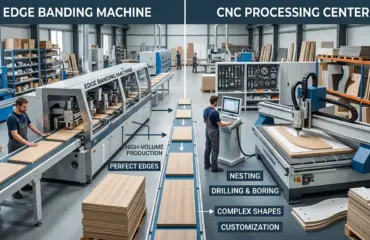
| Integrated CNC Nesting Machines | Higher-mix work where cutting, routing, and drilling are handled in one programmed flow | Strong job data control and part-level program accuracy | One machine must balance more operations, which changes scheduling logic |
The best configuration is the one that supports the factory’s real bottleneck. If the plant already cuts panels efficiently and mainly struggles with hole-processing consistency, a dedicated drilling workflow may make more sense. If the product mix is more variable and drilling is tightly tied to routing and part shape, an integrated workflow may fit better.
Tooling And Boring Patterns Should Reflect Recurring Work, Not Every Possible Job
Factories sometimes over-configure drilling by trying to prepare for every possible panel variation in one setup. In practice, that often makes changeovers harder and program discipline weaker.
It is usually better to configure tooling and drilling logic around recurring operations such as:
- Shelf-Pin And Line-Boring Work
- Connector And Joinery Preparation
- Hardware Mounting Patterns
- Drawer-Part Drilling Routines
- Face And Edge Drilling Rules For Standard Components
The objective is not maximum theoretical flexibility. It is daily repeatability with manageable changeovers. A setup that covers the factory’s common work cleanly is often more valuable than one that tries to cover every rare exception without structure.
Material Thickness And Finished-Part Rules Need Their Own Logic
Hole quality in furniture production is not only about position. It is also about how the hole pattern relates to finished part conditions.
Different panel thicknesses, edge treatments, laminates, veneers, and finishing stages can all affect whether a drilling pattern still makes sense once the part reaches assembly. If the factory treats all panels as interchangeable at configuration level, it can create recurring fit issues even when the machine performs consistently.
Configuration rules should account for factors such as:
- Thickness Families That Change Joinery Or Hardware Positioning
- Panels With Different Finished Faces
- Parts That Are Drilled Before Versus After Edge Processing
- Mirrored Components That Need Separate Orientation Control
- Special Materials That Require More Conservative Hole Planning
This is one of the main reasons drilling should be configured from production logic rather than copied from a generic template.
Batch Identification Matters As Much As Hole Accuracy
In larger furniture factories, the drilling program is only one part of the control system. The other part is making sure the right program is tied to the right part, in the right orientation, at the right time.
Whether the factory relies on printed labels, barcode-based job control, or simpler work-order discipline, the configuration should reduce opportunities for part mixing. If similar panels with different hole patterns can be confused easily, the drilling cell may become a source of repeatable sorting errors.
That means the setup should support:
- Clear Part Naming Conventions
- Distinct Rules For Mirrored Parts
- Stable Job And Batch Identification
- First-Part Validation After Setup Changes
- Simple Traceability When A Drilling Error Appears Downstream
Factories often focus on machining precision and overlook identification discipline. In practice, both matter equally if the goal is clean assembly flow.
Common Configuration Mistakes In Furniture Factories
Most drilling problems in furniture plants are not mysterious. They come from a short list of repeated configuration mistakes.
- Using One Master Program For Too Many Part Types
- Allowing Different Datum Rules Across Cutting And Drilling
- Ignoring Mirrored-Part Logic Until Assembly Problems Appear
- Treating Material Thickness Changes As Minor When They Affect Hardware Fit
- Letting Operators Override Standard Naming Or Orientation Conventions Too Freely
- Validating The First Part At Setup But Not Watching For Drift After Batch Changes
These mistakes usually create the same operational result: hole processing becomes technically fast but organizationally unstable.
What A Good Drilling Configuration Should Improve Downstream
The point of a well-configured drilling machine is not only to make accurate holes. It is to make the rest of the factory easier to run.
When configuration is strong, the benefits usually appear as workflow outcomes such as:
- Better Joinery Fit At Assembly
- More Reliable Hardware Installation
- Less Manual Checking Between Departments
- Fewer Mixed Or Misidentified Panels In Batches
- Lower Rework Caused By Orientation Or Referencing Errors
- Smoother Coordination Between Cutting, Edge Processing, Drilling, And Assembly
That is the real test. If the drilling cell is fast but downstream teams still spend time correcting, sorting, or rechecking parts, the configuration is not finished yet.
Practical Summary
A CNC drilling machine configuration for furniture factories should be built around product structure, datum discipline, part-family logic, and clean batch control. The strongest setups are not the ones with the most options turned on. They are the ones that make daily hole processing predictable across repeated cabinet and panel-furniture workflows.
If a factory wants drilling to support throughput, repeatability, and easier assembly, it should configure the machine around how parts are built, identified, oriented, and handed off, not just how holes are machined. That is what turns drilling from a technical function into a stable production process.