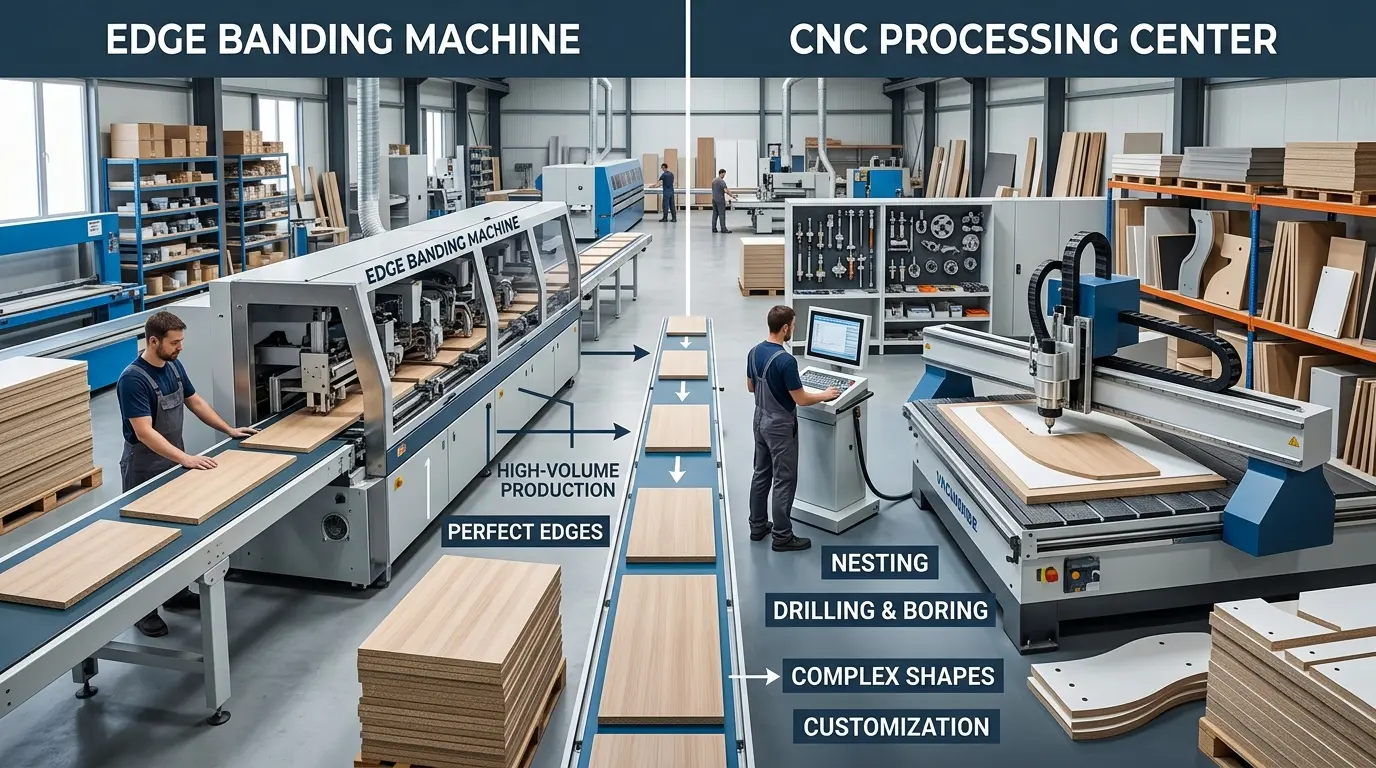
In many panel-furniture factories, these two options get compared because both are associated with automation, labor reduction, and cleaner workflow. But they do not solve the same problem. An edge banding machine is a dedicated finishing station. A CNC processing line is a broader production system that organizes how parts are cut, routed, drilled, transferred, and prepared for later steps.
That distinction matters. If the main pain point is edge quality, glue-line consistency, or manual touch-up, a dedicated edge bander is usually the more direct investment. If the larger problem is disconnected upstream processing, too many handoffs, or unstable part flow, a CNC line often fits better.
Why This Comparison Is Often Misframed
Many buyers treat this as a machine-versus-machine decision. In practice, it is a station-versus-system decision.
An edge bander is designed to finish panel edges efficiently and repeatedly. A CNC processing line is designed to control how panels move through several production stages. Depending on the factory, that line may include cutting, routing, drilling, labeling, buffering, sorting, or automated transfer between stations. Edge banding may still sit downstream as its own process.
That is why a factory can choose one, the other, or both in sequence. The right answer depends on where the bottleneck begins and where quality loss becomes expensive.
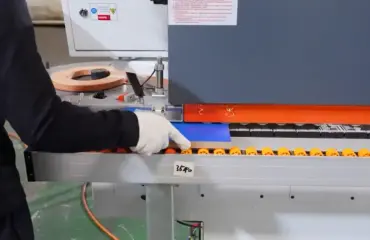
What An Edge Banding Machine Is Designed To Solve
A dedicated edgebander is usually the right tool when the part is already dimensionally acceptable and the remaining problem is finishing the exposed edge to a stable standard.
This is often the case in cabinet, closet, and panel-furniture production where parts are already being cut accurately, but operators still spend too much time on trimming, cleanup, or correcting uneven finished edges.
In practical terms, an edge banding machine is well suited to operations that need:
- More Consistent Edge Appearance
- Less Manual Rework After Banding
- Better Repeatability Across Batches
- Cleaner Handoffs Into Assembly Or Final Inspection
Depending on configuration, functions such as pre-milling and corner rounding can also help reduce manual touch-up and support a higher finish standard. That matters most when visible panel quality influences customer acceptance or downstream assembly speed.
What A CNC Processing Line Is Designed To Solve
A CNC processing line is usually chosen when the factory problem starts earlier than finishing. The issue is not only how the edge looks, but how raw panels become organized, production-ready parts without repeated manual handling.
In many operations, that line is built around CNC nesting machines or other CNC-controlled front-end processing stations. The goal is to combine or coordinate cutting, routing, drilling, part identification, and movement so the factory does not depend on loosely connected stand-alone steps.
This kind of line is well suited to factories that need:
- Fewer Manual Handoffs Between Operations
- More Stable Part Sequencing
- Better Control Of Mixed Or Customized Production
- Stronger Coordination Between Front-End Processing And Downstream Stations
The key point is that a CNC processing line improves flow. It does not automatically eliminate the need for a dedicated edge finishing step. If the product requires finished exposed edges, edge banding still remains part of the workflow.
Where An Edge Banding Machine Fits Best
An edge banding machine usually fits best when the factory already has acceptable upstream part preparation and wants to fix a specific downstream constraint.
That often means:
- Cutting Accuracy Is Already Under Control
- The Backlog Appears At Edge Finishing Rather Than At Cutting Or Drilling
- Customer Complaints Relate To Edge Appearance, Chipping, Or Inconsistent Finish
- The Factory Wants A More Direct Upgrade Without Reorganizing The Entire Front End
This is a common scenario in shops that already own stable cutting equipment but have outgrown manual or semi-manual edge work. In that environment, the edge bander is not trying to redesign the full process. It is solving a clear finishing bottleneck.
It is also a strong fit when product geometry is relatively straightforward and production depends on reliable rectangular panel finishing more than on multi-process CNC coordination.
Where A CNC Processing Line Fits Best
A CNC processing line fits best when the factory is no longer limited by one isolated finishing station, but by the way parts move through the whole plant.
Typical signs include:
- Operators Repeatedly Re-Handle Parts Between Separate Machines
- Scheduling Becomes Difficult Because Cutting, Drilling, And Sorting Are Not Well Aligned
- Part Tracking Breaks Down As Volume Or Customization Increases
- Upstream Inconsistency Creates Delays At Several Later Stations, Including Edge Processing
In that situation, buying only a better edge bander may improve one step without fixing the larger production disorder. A CNC line is more appropriate when the objective is to stabilize throughput, reduce handoffs, and create a more coordinated front-end workflow.
This is especially relevant in factories moving from smaller batch work into higher-volume or more data-driven production, where process discipline matters as much as single-station speed.
Decision Table: Which Problem Are You Actually Trying To Solve?
| Production Problem | Edge Banding Machine | CNC Processing Line |
|---|---|---|
| Uneven Edge Finish Or Too Much Manual Touch-Up | Strong Fit | Indirect Fit |
| Edge Processing Is The Main Bottleneck | Strong Fit | Partial Fit |
| Too Many Manual Handoffs Before Parts Reach Finishing | Limited Fit | Strong Fit |
| Cutting, Routing, And Drilling Need Better Coordination | Limited Fit | Strong Fit |
| The Factory Wants Better Visible Panel Finish Without Rebuilding The Whole Workflow | Strong Fit | Partial Fit |
| Production Flow Breaks Down As Volume Or Customization Increases | Partial Fit | Strong Fit |
| Finished Edges Still Need To Be Ready For Assembly | Essential Step | Usually Still Requires A Dedicated Edge Banding Step |
When The Best Answer Is Both, Not Either
In many panel-furniture workflows, these two investments are complementary rather than competitive. The CNC line prepares the part flow. The edge bander finishes the exposed edges. One improves system control. The other improves a critical finishing result.
That is why the more useful question is often: which bottleneck should be removed first?
If the factory loses time because panels are moving through disconnected upstream steps, a CNC processing line usually has the larger system-level impact. If part flow is acceptable but edge finishing is holding back quality or daily output, a dedicated edge bander is usually the more direct upgrade.
The exact sequence can vary by product mix, batch structure, and how the factory organizes drilling and assembly. But the logic remains the same: solve the constraint that is shaping the rest of the workflow.
Practical Summary
An edge banding machine and a CNC processing line fit different levels of the production problem. The edge bander is a dedicated answer to edge finishing quality, repeatability, and labor-heavy rework. The CNC processing line is a broader answer to part flow, process coordination, and upstream automation.
If the factory’s main problem begins at the edge, choose the dedicated finishing solution. If the factory’s main problem begins in how parts are processed and transferred across multiple stages, the CNC line is usually the better fit. In many growing operations, the most durable answer is not to treat them as substitutes, but to understand where each belongs in the larger production system.