The upgrade question usually starts when a standard edge-banding line is still producing acceptable parts, but not without too much correction. Glue lines look clean on some batches and uneven on others. Operators keep scraping, polishing, or stopping to check visible panels. Assembly teams begin noticing that parts from the same run do not always look equally finished.
That is the point where buyers start comparing a standard line with more advanced edgebanders that include pre-milling. The real decision is not whether more functions sound attractive. It is whether pre-milling removes a recurring production problem that the current process cannot control consistently enough.
What Actually Changes When You Add Pre-Milling
A standard edgebander applies edge material to the panel edge as it arrives from upstream cutting. That can work well when the incoming edge is already clean, consistent, and stable enough for the finish standard the factory needs.
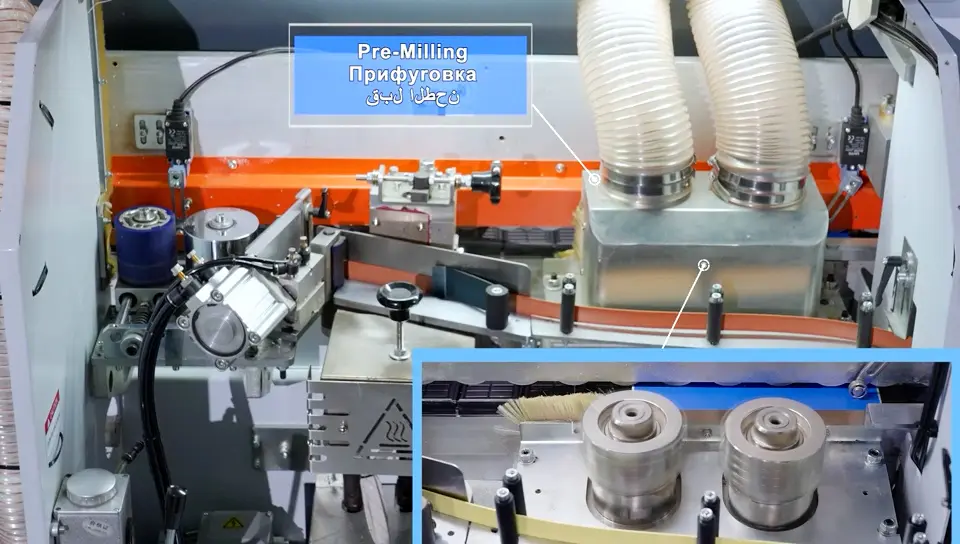
A pre-milling edgebander adds an edge-preparation step before glue and edge material are applied. In practical terms, that means the machine can lightly correct small saw marks, minor edge damage, and small inconsistencies before the bonding stage begins.
The value of that extra step is not that it makes the machine look more advanced. The value is that it gives the glue and edge material a more uniform surface to follow. When the incoming panel edge varies enough to be visible later, pre-milling often improves finish consistency more than any attempt to compensate after the edge has already been applied.
| Decision Factor | Standard Edgebander | Pre-Milling Edgebander |
|---|---|---|
| Incoming Edge Requirement | Works best when cut edges are already clean and stable | More forgiving when small edge irregularities are affecting results |
| Glue-Line Appearance | Can be very good if upstream cutting is controlled | Often more consistent when incoming edges vary from part to part |
| Manual Touch-Up Risk | Higher if saw marks or chipped edges reach the machine | Usually lower when edge preparation is the recurring issue |
| Dependency On Upstream Cutting Quality | High | Still important, but less exposed to small edge-prep variation |
| Best Fit | Stable workflows with moderate finish pressure | Higher finish expectations and tighter tolerance for rework |
| Upgrade Logic | Lower complexity when current process is already under control | More justifiable when defects start with inconsistent panel edges |
A Standard Edgebander Is Still The Right Choice In Many Shops
It is easy to treat pre-milling as an automatic upgrade path, but that is not how most factories should evaluate it.
A standard edgebander can still be the stronger choice when:
- Incoming panel edges are already clean and repeatable
- The finish standard is commercial and practical rather than highly appearance-driven
- Product mix changes frequently and the business values a simpler process structure
- Manual correction is limited rather than constant
- The current bottleneck is somewhere other than edge preparation
This is especially true in workflows where upstream cutting is already disciplined. If panels are coming off well-controlled panel saws with stable cut quality, the edge-banding station may not need an extra correction stage to achieve the required result.
In that situation, the added cost and process complexity of pre-milling may not produce a strong enough return. A simpler line can be the more rational investment when the factory is already controlling the variable that pre-milling is meant to improve.
When Pre-Milling Usually Makes A Visible Difference
Pre-milling becomes easier to justify when the factory is no longer fighting a glue problem alone. It is fighting an edge-condition problem that keeps showing up in finished parts.
The upgrade usually makes more sense when one or more of these conditions apply:
- Visible cabinet, wardrobe, or furniture parts are judged closely for seam quality
- Small chips, saw marks, or edge waviness regularly appear before banding
- Operators spend too much time correcting edges after the machine rather than feeding good parts forward
- Glue-line appearance varies from batch to batch even when adhesive settings seem acceptable
- Output quality depends too heavily on one experienced operator noticing and correcting problems early
- Downstream teams lose time sorting or rechecking panels that should already be ready for the next step
In those environments, pre-milling is not just another feature. It is often a way to stabilize the starting condition of the edge before bonding begins.
The Upgrade Usually Pays Back Through Less Rework
Many buyers ask whether pre-milling will make the line faster. That is usually the wrong first question.
The better question is whether it reduces the hidden costs that are already slowing the factory down. In real production, the upgrade often pays back first through:
- Fewer Visible Glue-Line Corrections
- Less Scraping, Polishing, Or Hand Finishing After Banding
- Lower Rejection Rates On Exposed Panels
- More Predictable Flow Into Drilling, Assembly, Or Packing
- Less Quality Drift Between Shifts Or Operators
That is important because a standard edgebander and a pre-milling edgebander can appear close on paper if the comparison focuses too narrowly on line speed. On the floor, however, the difference may show up in how many parts leave the station genuinely ready for the next step.
If the current process already releases good parts with limited correction, the economic argument for pre-milling is weaker. If the current process creates daily touch-up labor and visible inconsistency, the upgrade case becomes much stronger.
Pre-Milling Does Not Replace Process Discipline Upstream
Buyers should also stay realistic about what pre-milling can and cannot do.
Pre-milling commonly helps correct small irregularities. It does not turn a poorly controlled cutting department into a stable one. If panel edges arrive with major chipping, unstable sizing, poor handling, or contamination, the factory still needs to address those upstream causes.
That is why pre-milling should be understood as a process stabilizer, not a rescue plan for a broken workflow. It is most effective when the factory already has a reasonably controlled process but still needs better surface consistency at the edge before banding.
The practical tradeoff is straightforward:
- If the upstream process is fundamentally stable, pre-milling can help raise finish consistency
- If the upstream process is fundamentally unstable, pre-milling may help somewhat but will not solve the deeper problem by itself
Use The Upgrade Test That Matches Factory Reality
The cleanest way to judge the upgrade is to ask whether the current losses are caused by the exact problem pre-milling is designed to reduce.
| What You See On The Floor | What It Usually Suggests | Upgrade Implication |
|---|---|---|
| Good bonding, but too much manual edge cleanup | The line is producing acceptable parts too inefficiently | Pre-milling may be worth examining if poor edge condition is part of the cause |
| Glue-line variation across otherwise similar batches | The starting edge condition may be too inconsistent | Pre-milling often becomes more defensible |
| Stable finish on utility-grade parts, limited complaints, low touch-up labor | The current process may already match the business need | A standard edgebander may still be sufficient |
| Visible parts regularly fail visual expectations | Edge preparation quality is likely too inconsistent for the finish target | Pre-milling is more likely to justify its cost |
| Output depends on frequent operator correction | Process control is too manual | A more controlled edge-prep stage may improve repeatability |
| Main delays come from sorting, staging, or cutting bottlenecks elsewhere | The edge station may not be the primary problem | Solve the real bottleneck before upgrading |
This approach keeps the decision grounded in production evidence instead of feature comparison alone.
So, Is The Upgrade Worth It?
Sometimes yes, and sometimes clearly no.
The upgrade is usually worth it when the factory has already outgrown the tolerance of a standard edge-banding process. That often means higher finish expectations, more exposed panels, too much correction labor, or recurring variation in incoming cut edges that is now affecting final appearance.
The upgrade is usually not worth it when a standard edgebander is already producing stable results, manual correction is limited, and the real factory constraints sit elsewhere. In that case, buying pre-milling capability may add cost without removing enough waste to matter.
The practical test is simple: if edge-related variation is already costing labor, creating visible defects, or reducing trust in the process, pre-milling is often a meaningful upgrade. If the current line is already under control, a standard edgebander may still be the better business decision.
Practical Summary
Pre-milling edgebanders and standard edgebanders are not competing answers to exactly the same problem. A standard line is often the right fit when upstream edge quality is already strong and finish demands are moderate. A pre-milling line becomes more valuable when small edge inconsistencies are repeatedly turning into visible defects, touch-up labor, or unstable output.
That is why the upgrade should be judged by workflow outcome, not by feature count. If pre-milling helps the factory release cleaner parts with less correction and more repeatability, it can be worth the investment. If the current process already does that reliably enough, staying with a standard edgebander may be the smarter choice.