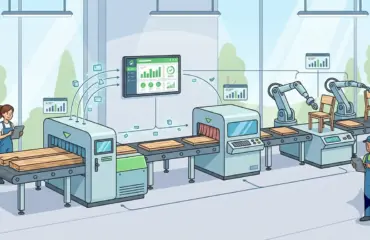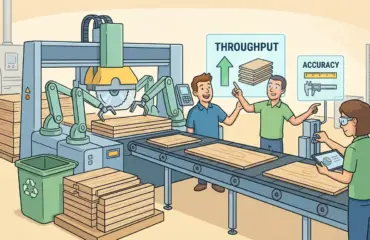
If a panel furniture factory is deciding between a panel saw and a CNC nesting machine, the real issue is not which machine sounds more advanced. The real issue is what kind of production problem the factory needs to solve first.
Some factories need a fast, stable front end for large volumes of rectangular cabinet parts. Others need more flexibility because order sizes change constantly, part shapes vary, and routing or drilling tasks need to happen closer to the first cutting step. That is why this comparison should be treated as a workflow decision, not just a machine comparison.
For many factories, the better choice depends on part geometry, batch consistency, downstream process design, and how much integration is needed at the beginning of production.
The Two Machines Solve Different Front-End Problems
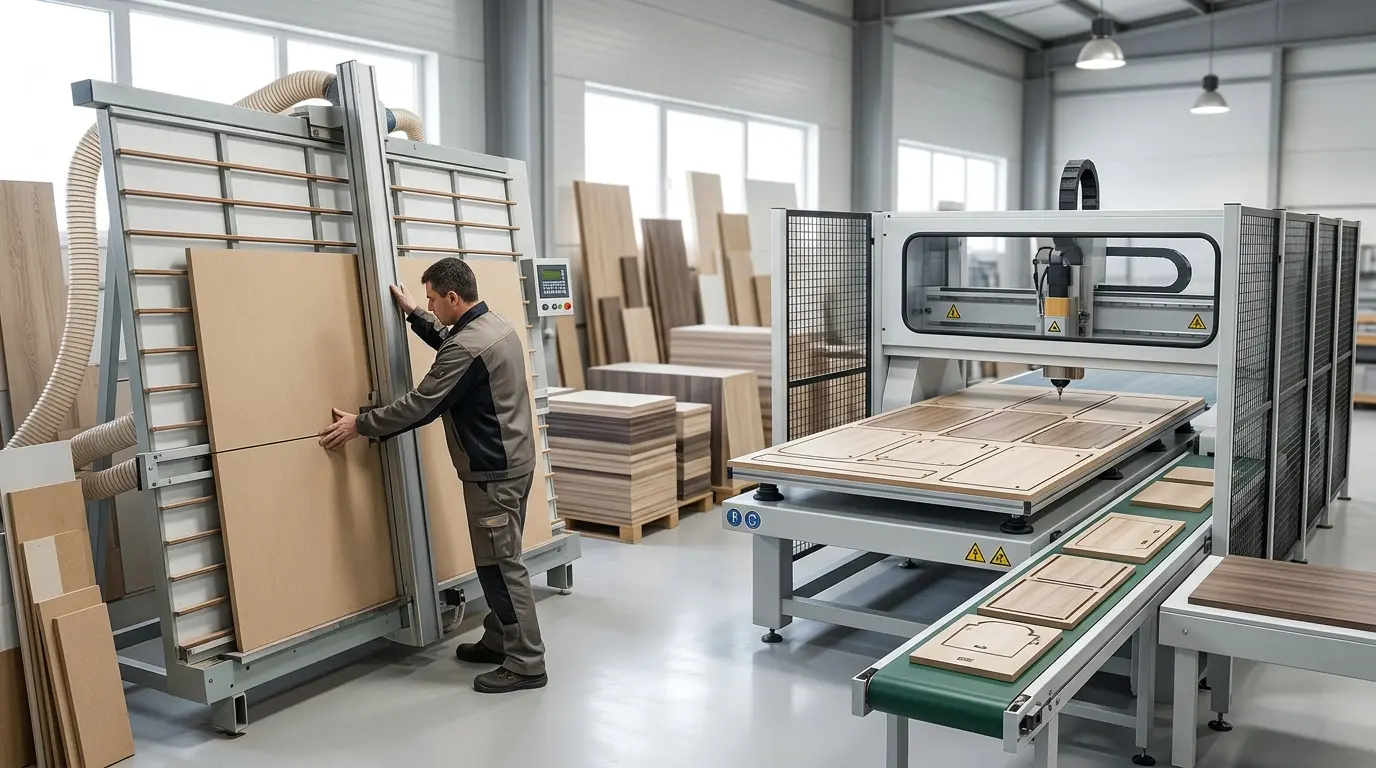
A panel saw is commonly chosen when the main job is to size sheet material into repeated rectangular parts with strong consistency and clean batch flow. In factories producing a large number of cabinet sides, tops, bottoms, shelves, partitions, and other standard components, dedicated panel saws are often used to create a more stable starting point for the rest of the line.
A CNC nesting machine is usually selected when the factory needs more flexibility from the first processing stage. In that kind of workflow, CNC nesting machines are commonly used for panel cutting together with routing and drilling-related operations, especially when parts are less uniform or when custom furniture production is a major share of daily output.
That difference matters because these two machine types do not organize production in the same way.
- A Panel Saw Favors Fast, Repeatable Sizing Of Rectangular Parts.
- A CNC Nesting Machine Favors Process Integration And Greater Part Flexibility.
Neither approach is universally better. The correct choice depends on what happens after the cut.
Side-By-Side Comparison for Panel Furniture Production
| Decision Factor | Panel Saw | CNC Nesting Machine |
|---|---|---|
| Best Part Type | Repeated rectangular panels | Mixed geometries, shaped parts, and varied layouts |
| Front-End Strength | High-throughput panel sizing | Integrated cutting with routing and drilling workflow potential |
| Batch Production Fit | Very strong when orders are standardized | Strong when product variation is high |
| Custom Order Flexibility | More limited when shapes and layouts change often | Better suited to frequent design variation |
| Material Utilization Logic | Strong when cut patterns are stable and production is repetitive | Often advantageous when varied parts need to be nested efficiently |
| Downstream Handoff | Clean fit for separate edge banding, drilling, and assembly stages | Can reduce some early handoffs by combining more work at the front end |
| Factory Rhythm | Supports organized batch release and sorted rectangular-part flow | Supports more flexible, job-driven production logic |
| Main Tradeoff | Less flexible for irregular or highly customized parts | Pure rectangular batch sizing may be less direct than a dedicated saw workflow |
This is why the better machine is usually the one that matches the factory’s dominant production pattern, not the one with the broader theoretical capability.
When a Panel Saw Usually Fits Better
For panel furniture factories focused on repeated cabinet production, a panel saw often creates the cleaner production model.
This is especially true when:
- Most Daily Output Consists Of Rectangular Carcass Components.
- The Factory Already Has Separate Downstream Stations For Edge Banding, Drilling, And Assembly.
- Production Is Organized In Stable Batches Rather Than Constant One-Off Job Changes.
- Management Wants A Stronger Front-End Pace For High-Volume Sheet Processing.
- The Main Goal Is To Improve Throughput, Part Repeatability, And Sorting Discipline.
In this environment, a panel saw helps because it turns cutting into a dedicated sizing operation. That can improve flow in several practical ways.
First, repeated rectangular parts move through the front end with more predictable pacing. Second, the factory can sort components by batch more clearly before they move into later stages. Third, downstream teams receive parts in a format that is easier to edge, drill, inspect, and assemble without constant rechecking.
In other words, the panel saw often fits best when the line is already structured and the factory wants to make that structure faster and more repeatable.
When a CNC Nesting Machine Usually Fits Better
A CNC nesting machine often becomes the better choice when the panel furniture factory is not running a highly standardized cut-first workflow.
That is usually the case when:
- Product Mix Changes Constantly Across Orders.
- The Factory Produces More Customized Cabinets, Wardrobes, Or Furniture Variants.
- Irregular Shapes, Openings, Or Routed Features Are Common.
- Management Wants More Processing Integration At The Front Of Production.
- Reducing Early Manual Handoffs Matters More Than Pure Rectangular Sizing Speed.
In this type of environment, the nesting machine does not just replace a saw. It changes how the first stage of production is organized. Instead of treating the opening operation mainly as sheet breakdown, the factory can treat it as a more integrated processing step.
That can be valuable when orders are diverse and when too many separate handoffs are slowing production down. A CNC nesting machine can help the factory handle custom work more naturally, especially when part variation would otherwise create repeated setup friction between cutting, routing, and drilling stages.
The tradeoff is that a factory focused mainly on repeated rectangular parts may not need that level of front-end flexibility. In those cases, broader process capability does not always translate into a simpler or faster overall line.
The Hidden Variables That Usually Decide the Real Answer
Factories often ask which machine is better before they define what kind of work dominates the schedule. That is the wrong sequence.
In practice, these variables usually matter more than a brochure-style machine comparison:
| Production Variable | Why It Matters |
|---|---|
| Part Geometry | Repeated rectangles favor panel saw logic, while mixed shapes push the decision toward nesting |
| Order Stability | Stable batches support saw-led flow; frequent changes strengthen the case for nesting |
| Downstream Process Design | Separate edge banding and drilling lines often work naturally with panel saw output |
| Labor Flow | If too much labor is spent on rehandling or repeated setup, a more integrated front end may help |
| Factory Layout | Material staging, sorting space, and outfeed discipline can strengthen or weaken either choice |
| Growth Direction | A factory moving toward higher-volume standardization may choose differently from one moving toward customization |
This is also where some buying mistakes begin. A factory may assume CNC nesting is automatically better because it combines more functions. Another may assume a panel saw is automatically better because it sounds more production-oriented. Both assumptions can fail if they do not match the real order mix.
Which Machine Helps the Whole Factory, Not Just the Cutting Area?
That is the question production managers should keep asking.
If the factory runs a classic panel furniture flow where rectangular parts are cut first, then edged, then drilled, then assembled, a panel saw often strengthens the entire process by feeding downstream departments with more stable, repeatable input.
If the factory runs a more custom-oriented workflow where panel shapes, openings, and part-level variation create repeated interruptions, a CNC nesting machine may improve the whole factory because it reduces the number of early transitions between separate operations.
So the better machine is usually the one that removes the largest production bottleneck:
- If The Bottleneck Is Front-End Batch Sizing And Repetitive Panel Breakdown, A Panel Saw Often Makes More Sense.
- If The Bottleneck Is Early-Stage Flexibility, Part Variation, And Process Fragmentation, CNC Nesting Often Makes More Sense.
This is an important distinction because many factories do not lose time on the machine cycle itself. They lose time in sorting, moving, checking, correcting, and reprocessing parts after the first operation.
Some Panel Furniture Factories Eventually Use Both
In some cases, the most practical answer is not to force one machine to handle every production scenario.
Factories with both standardized volume work and high-mix custom work sometimes separate the two logics:
- A Panel Saw Supports Repeated Rectangular Production.
- A CNC Nesting Machine Supports Flexible Or More Complex Parts.
That kind of dual setup is not necessary for every business, but it reflects a useful principle: these machines are not always direct substitutes. In some factories, they serve different production roles.
For a buyer evaluating a first major investment, that does not mean both should be purchased at once. It means the first decision should be anchored in the factory’s dominant workload today and its most likely production direction next.
Practical Summary
For panel furniture factories, a panel saw is often the better choice when production depends on high volumes of repeated rectangular parts and the goal is to improve front-end speed, repeatability, and batch control. A CNC nesting machine is often the better choice when product variation is high, custom work is common, and the factory needs more integration between cutting, routing, and drilling-related operations.
So which one is better? In a highly standardized cabinet flow, the panel saw often fits better. In a more customized and geometry-diverse workflow, CNC nesting often fits better. The stronger decision is not based on which machine appears more advanced, but on which one makes the entire factory easier to run with less rework, cleaner handoffs, and better production control.