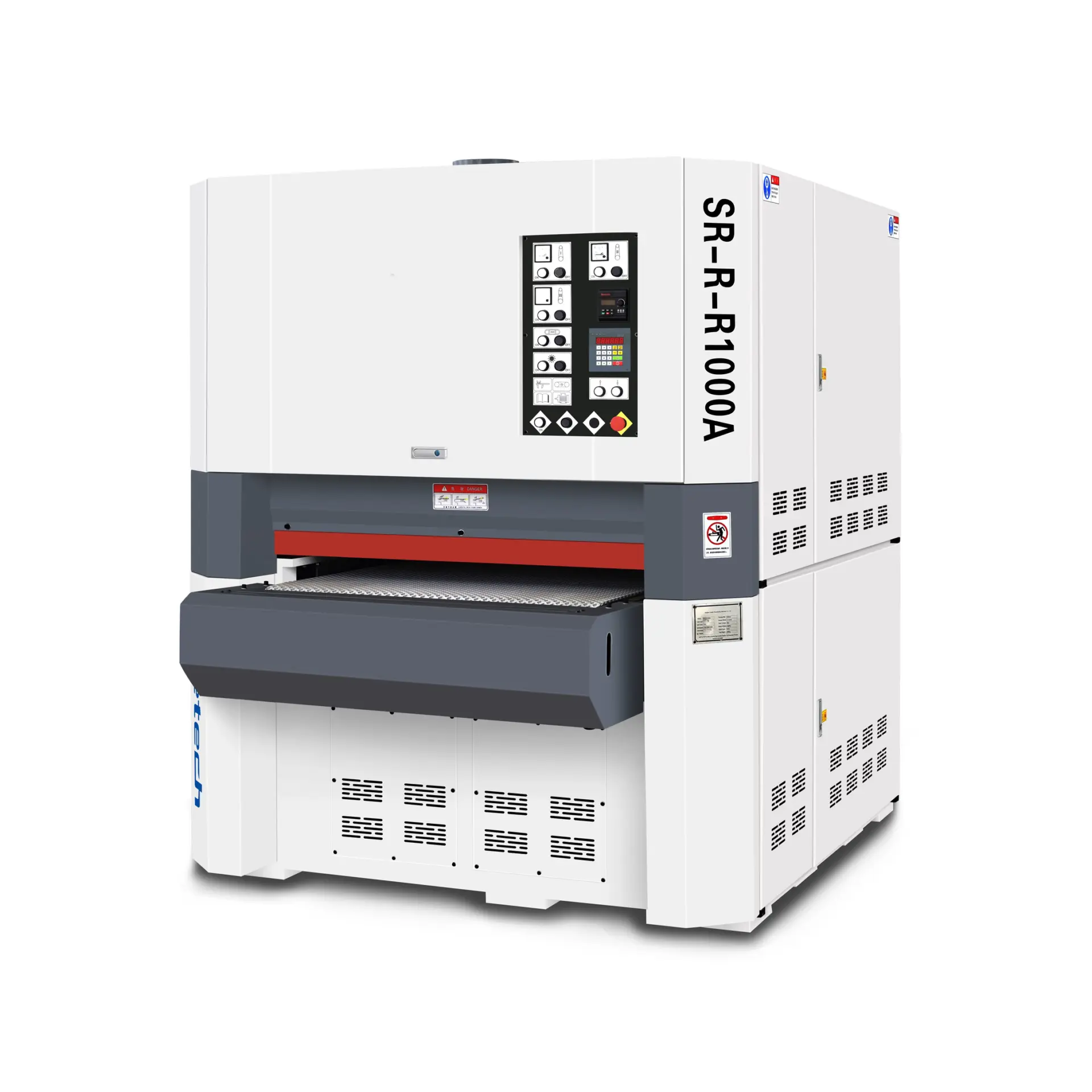
In a woodworking factory, sanding problems rarely stay inside the sanding department. They show up later as uneven stain absorption on solid wood, sand-through on veneered faces, coating defects on panels, or parts that still need hand correction before packing. That is why choosing wide belt sanders should start with the material mix and the finish standard the factory needs to hold every day.
For buyers comparing sanding equipment for furniture, cabinetry, doors, and interior components, the real question is not simply how fast the machine can remove material. It is whether the sanding process can make surfaces flatter, more consistent, and more ready for the next step with less rework.
Why The Material Mix Changes The Buying Decision
Solid wood, veneer, and panels do not respond to sanding in the same way.
- Solid Wood brings density variation, grain-direction changes, and glued-up panels that may need real calibration before finishing.
- Veneer gives the process very little room for error, so surface refinement matters more than aggressive stock removal.
- Panels reward repeatability across large batches, but the right sanding approach still depends on whether the surface is raw, veneered, painted, or already decorative.
That difference matters because a sanding setup that works well for flattening solid wood can be too aggressive for veneer. In the same way, a machine chosen mainly for calibration may not be the best answer when the real bottleneck is finish consistency on panels.
Start With The Real Sanding Objective
Wide belt sanding can serve several different production goals, and those goals should not be treated as identical.
A factory may need the sanding line to help with:
- Thickness Calibration On Solid Wood Panels
- Surface Refinement Before Staining Or Clear Coating
- Veneered Panel Preparation With Minimal Surface Risk
- Large-Batch Panel Consistency Before Coating Or Final Assembly
- Painted Or Coated Surface Preparation Where Scratch Pattern And Flatness Directly Affect Appearance
If that objective is unclear, the machine choice usually becomes too generic. A calibration-oriented process may remove material efficiently but still create extra hand sanding later. A finish-oriented process may protect surface quality well but do little to correct flatness issues that are already affecting assembly or coating.
What Usually Matters Most In Solid Wood Sanding
Solid wood is often where wide belt sanders deliver the clearest production value, because solid wood parts frequently arrive with natural variation that must be brought under control before finishing.
For glued-up panels, table tops, cabinet components, and similar parts, the priorities are usually:
- Stable Thickness Correction Across The Part
- A Flatter Surface Before Staining Or Coating
- Controlled Stock Removal Rather Than Random Manual Correction
- A Scratch Pattern That Does Not Create More Finishing Work Later
The tradeoff is straightforward. A more aggressive sanding approach can help correct variation faster, but it can also leave a heavier scratch pattern or push more work into finishing. A lighter, more surface-focused setup preserves the surface better, but it may not solve the real calibration problem if incoming parts vary too much.
In other words, solid wood sanding should be judged by the balance between correction and finish readiness, not by removal rate alone.
Veneer Requires Control More Than Correction
Veneer is the least forgiving material in this comparison.
The reason is simple: veneer usually does not give the sander much room to fix upstream inconsistency. If the panel surface already varies too much, sanding becomes risky because the process can break through high spots, expose glue-line variation, or create defects that cannot be hidden later.
For veneered work, buyers should focus on whether the sanding process helps deliver:
- Even Surface Refinement Across The Full Panel
- Minimal Risk Of Sand-Through
- Stable Contact And Consistent Surface Preparation
- Better Readiness For Coating Without Excessive Manual Touch-Up
That changes the buying logic. Veneer usually rewards gentler, more controlled finishing behavior rather than heavy calibration.
This is also where factories need to be honest about upstream quality. If veneered panels arrive uneven, poorly bonded, or inconsistent, the sanding machine should not be expected to rescue a lamination or panel-construction problem. In that situation, choosing a more aggressive sanding setup can increase risk rather than reduce it.
Panel Processing Depends On Surface Type, Not Just Panel Size
“Panels” sounds like a single category, but in production it can mean very different things.
A shop may be processing raw MDF-core panels, plywood-based furniture parts, veneered cabinet panels, or painted surfaces moving toward final finish. Each of those asks something different from the sanding line.
For panel processing, the usual priorities are:
- Flat, Repeatable Surface Quality Across The Batch
- Consistent Scratch Pattern From Part To Part
- Less Operator Dependency On Large Runs
- Better Preparation For Coating, Finishing, Or Assembly
- Fewer Parts Diverted To Manual Correction
Where buyers get into trouble is assuming that all panel surfaces should go through the same sanding logic. Raw or veneered panels often benefit directly from wide belt sanding as part of surface preparation. Already decorative laminated faces may call for a different process logic altogether. Painted or coated panels can also require a more finish-sensitive approach than raw-board calibration.
The better question is not whether the material is a panel, but what kind of surface the panel presents to the sander and what the next department needs from it.
A Useful Comparison Framework
| Material Type | Typical Sanding Goal | Main Production Risk | What Buyers Should Prioritize |
|---|---|---|---|
| Solid Wood | Calibration And Surface Preparation | Over-Removing Material Or Leaving A Heavy Scratch Pattern | A Balance Between Thickness Correction And Finish Readiness |
| Veneer | Surface Refinement Before Finishing | Sand-Through And Glue-Line Exposure | Control, Stability, And Minimal Surface Risk |
| Raw Or Engineered Panels | Batch Consistency And Flatness | Surface Variation That Shows Up In Coating Or Assembly | Repeatability Across Runs And Lower Operator Dependency |
| Painted Or Coated Panels | Uniform Finish Preparation | Visible Surface Defects Before Final Finishing | Stable Surface Quality Rather Than Aggressive Stock Removal |
This kind of comparison usually leads to a better decision than a generic discussion about machine size or headline productivity.
Simpler And More Advanced Sanding Setups Solve Different Problems
Not every plant needs the same sanding sequence.
A simpler setup may be the right choice when:
- The Material Mix Is Narrow And Predictable
- The Finish Standard Is Moderate Rather Than Highly Sensitive
- The Main Need Is Consistent Everyday Sanding, Not Multiple Correction Stages
- Upstream Part Preparation Is Already Stable
A more advanced setup becomes easier to justify when:
- The Plant Runs Very Different Material Types On The Same Line
- Calibration And Finish Preparation Both Matter
- The Finish Standard Is High Enough That Scratch Consistency Directly Affects Saleable Quality
- Too Much Labor Is Still Being Spent On Manual Sanding After The Machine
The tradeoff matters. More stages can improve process separation and control, but they also add complexity, setup discipline, and operating demands. They are not automatically better outside the workflow that actually needs them.
The Best Sander Is The One That Reduces Rework After Sanding
Wide belt sanding should be evaluated as part of the whole production chain, not as an isolated machine purchase.
A strong sanding process helps later departments by making surfaces more predictable. In practice, that can mean:
- Less Manual Sanding Before Coating
- More Even Stain Or Topcoat Appearance
- Better Panel Consistency At Assembly
- Fewer Parts Pulled Aside For Surface Correction
- More Confidence That Batches Will Behave The Same Way From Shift To Shift
If the line still depends heavily on hand correction after machine sanding, the factory may not have chosen the right sanding logic, even if the machine itself looks productive on paper.
That matters especially in panel furniture, door, and cabinet production, where sanding quality can affect perceived product value just as directly as cutting accuracy or edge quality.
Questions Buyers Should Ask Before Choosing
- Is The Main Bottleneck Thickness Correction, Surface Quality, Or Coating Preparation?
- What Share Of The Sanding Workload Is Solid Wood, Veneer, And Panel Processing?
- Are Current Defects Being Created By The Sanding Process, Or Are They Coming From Inconsistent Incoming Parts?
- How Much Manual Sanding Still Happens After Machine Sanding?
- Which Material Type Causes The Most Rejected Or Reworked Parts Today?
- Does The Finish Standard Justify A More Controlled Multi-Stage Process, Or Will A Simpler Setup Fit The Workload Better?
- Are Already Decorative Panel Faces Being Mixed Into A Sanding Workflow That Should Really Be Separated?
These questions keep the buying discussion grounded in production reality instead of drifting toward abstract feature comparison.
Where Buyers Commonly Make The Wrong Tradeoff
One common mistake is choosing for maximum removal when the real business problem is final appearance. Another is choosing a finish-oriented sanding process when the plant is still sending uneven solid wood parts into the line and expecting the sander to correct them lightly.
There is also a more subtle mistake: treating veneer and panels as if they simply need gentler versions of a solid wood sanding process. In many cases, they need a different process priority altogether. Veneer needs protection. Panel processing needs repeatability. Solid wood often needs real correction before it needs refinement.
When those differences are ignored, the result is often higher labor, more surface variation, and more manual intervention instead of less.
Practical Summary
Choosing wide belt sanders for solid wood, veneer, and panel processing is really a question of matching the sanding process to material behavior and downstream finish expectations.
Solid wood usually benefits most from a balance between calibration and surface preparation. Veneer rewards control and minimal surface risk rather than aggressive correction. Panels depend on repeatability, but the right sanding logic still changes according to whether the surface is raw, veneered, painted, or already decorative.
The most useful buying approach is to define what the sander must improve in the real workflow: flatter parts, cleaner surface preparation, more stable coating results, or less hand rework. Once that is clear, the right machine choice becomes much easier to defend.