Choosing between a CNC laser cutter and a CNC router is rarely about which machine sounds more advanced. In real production, the decision usually comes down to what the part needs after the first cut: engraving, small internal detail, pockets, grooves, drilled features, edge finishing, material thickness, and how much manual rework the team can tolerate.
A CNC laser cutter is commonly the better fit when parts are detail-heavy, design changes are frequent, and the workflow centers on wood, acrylic, and similar non-metallic materials. A CNC router is usually the stronger choice when the same part also needs machining operations that go beyond contour cutting. The right answer is the one that removes the most friction from your actual process.
Start With the Part Family, Not the Technology Label
Both machines are CNC-controlled. That does not mean they solve the same production problem.
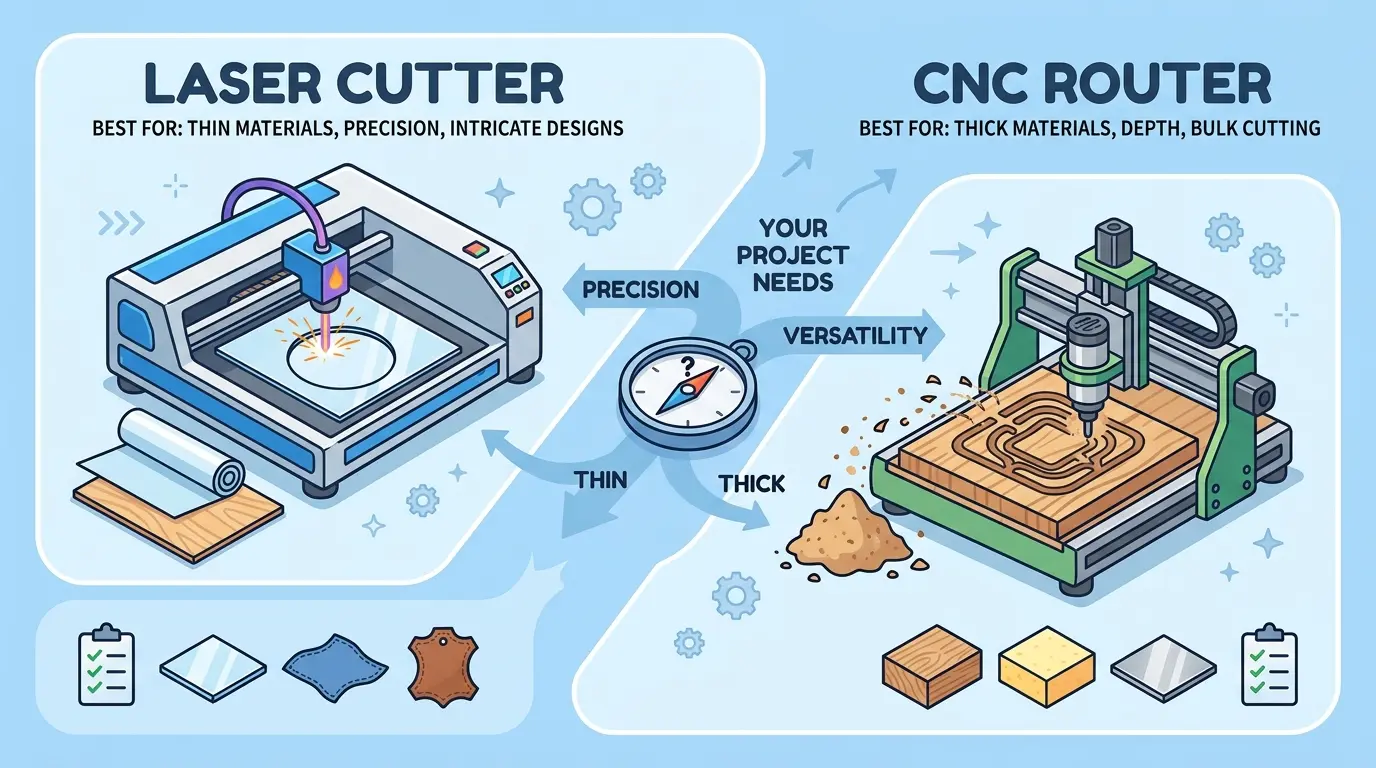
If your output is mostly decorative panels, signs, branded inserts, acrylic parts, templates, display components, or short-run custom pieces, a laser often becomes attractive because it handles complex geometry and rapid design changes without physical tool changes.
If your output is cabinet parts, wardrobes, shelving components, furniture panels, wood fixtures, or routed components that move into drilling, assembly, sanding, or edge banding, a router usually makes more operational sense because it can do far more than separate the part from the sheet.
That is why the first comparison should not be laser versus router in the abstract. It should be decorative cutting and engraving versus machining-intensive production.
Where a CNC Laser Cutter Usually Makes More Sense
For buyers evaluating laser cutters and engravers for wood, acrylic, and similar non-metallic materials, the strongest use case is usually not general panel machining. It is detail-driven production where contour freedom, internal cut complexity, and fast file-to-part turnaround matter more than broad machining capability.
A CNC laser cutter is commonly well suited to workflows such as:
- Decorative Wood Or Acrylic Panels
- Signage And Display Components
- Mixed Cutting And Engraving Jobs
- Short Runs With Frequent Artwork Or Geometry Changes
- Parts With Fine Internal Cutouts Or Small Features
- Production Where Tool Change Time Slows Small Batches
The practical advantage is not only precision. It is the ability to move from one pattern to another with minimal mechanical setup change. That matters when the job queue is varied, customer-specific, or visually driven.
Laser also makes sense when small internal corners and fine contour detail matter. A router always has to respect cutter diameter. A laser does not work under that same physical tool-radius constraint.
But the tradeoffs are real. A laser is limited when the part also needs pockets, grooves, countersunk features, or drilled holes. Thermal processing can also introduce edge darkening, residue, or cleanup depending on the material and finish expectation. A laser is not automatically the cleaner workflow just because it is non-contact.
Where a CNC Router Usually Makes More Sense
A CNC router becomes the stronger choice when cutting is only one step inside a larger machining sequence. In furniture, cabinetry, fixtures, and other wood-processing environments, the ability to route, groove, drill, pocket, and profile on the same platform often matters more than contour complexity alone.
For panel-based production, CNC nesting machines are commonly chosen when material utilization, routed features, and drilled preparation all need to stay connected in one workflow.
A CNC router is usually better suited to workflows such as:
- Cabinet And Wardrobe Component Production
- Nested Panel Cutting For Furniture Parts
- Grooving, Pocketing, And Joinery Preparation
- Drilling Integration For Hardware And Assembly Features
- Thicker Wood Panels Or Solid-Wood Parts Requiring Machining Depth
- Production Lines Where Parts Move Directly Into Assembly Or Edge Banding
This is where the router usually separates itself. It is not only making the outline. It is preparing the part for the next stage of production.
If a part needs channels, hinge-related machining, hardware-hole positioning, dados, or routed recesses, a router is often the more complete production tool. A laser may cut the profile cleanly, but it typically does not replace those additional machining steps.
Material Thickness, Edge Condition, and Secondary Work Matter More Than Most Buyers Expect
Many buying discussions get stuck on a vague idea of cut quality. In practice, cut quality depends on what the part is for.
If the part is customer-facing and highly decorative, laser often looks attractive because it can produce intricate geometry with consistent repeatability. If the material is thin and the job is visually driven, that can be a strong advantage.
If the part will be routed further, edge banded, assembled, sanded, or machined on multiple faces, the better question is not which edge looks best right off the machine. The better question is which process creates the least total downstream work.
A laser can reduce mechanical tool marks, but it can introduce heat effects. A router avoids thermal discoloration, but it can leave tool-related marks and still has to manage cutter wear, hold-down strategy, and small-corner limitations. Neither machine wins on edge condition in every use case.
Material thickness also changes the logic quickly. A laser is often strongest in thinner non-metallic sheet applications. A router usually becomes more practical when the job depends on deeper machining, thicker wood parts, or operations that remove material across more than one depth or surface.
Throughput Depends on the Full Job Cycle
Visible cutting speed is only one part of throughput. The real comparison is how much setup time, material handling, tool change time, and secondary processing each machine creates.
Laser throughput often improves when:
- Jobs Change Frequently
- Designs Include Many Unique Shapes
- Cutting And Engraving Need To Stay In One Queue
- Operators Need Fast Turnaround On Short Runs
Router throughput often improves when:
- Parts Need Multiple Machining Operations In One Setup
- Production Is Panel-Based And Repetitive
- Material Utilization Must Support Furniture Or Cabinet Output
- Fewer Machine Handoffs Matter More Than Decorative Detail
That is why a router can outperform a laser even when the laser looks faster on a complex outline file, and why a laser can outperform a router even when the router appears more versatile on paper. The deciding factor is how much friction the machine removes from the entire workflow.
CNC Laser Cutter vs CNC Router at a Glance
| Decision Factor | CNC Laser Cutter | CNC Router |
|---|---|---|
| Fine Internal Detail And Complex Contours | Usually A Strong Fit | Limited By Cutter Diameter |
| Cutting Plus Engraving | Usually A Strong Fit | Limited |
| Pockets, Grooves, And Routed Features | Limited | Usually A Strong Fit |
| Drilling And Hardware Preparation | Limited | Usually A Strong Fit |
| Thin Non-Metallic Sheet Work | Often A Strong Fit | Application Dependent |
| Thicker Wood Panels And Deeper Machining | More Limited | Usually A Strong Fit |
| Short-Run Design Changes | Usually A Strong Fit | Application Dependent |
| Cabinet And Furniture Component Workflows | More Limited | Usually A Strong Fit |
| Heat-Affected Edge Risk | Present In Some Materials | Not A Thermal Process |
| Tool Wear And Tool Change Dependence | Lower | Higher |
This table works only if it is read as workflow guidance rather than a scorecard. The better machine is the one that matches the part family, material behavior, and downstream operations.
A Practical Selection Filter for Buyers
Before choosing between a CNC laser cutter and a CNC router, answer these questions as directly as possible:
- Are Most Parts Decorative Or Machining-Intensive?
- Do You Need Engraving As Part Of Daily Production?
- Will Parts Require Grooves, Pockets, Or Drilled Features After Cutting?
- Is The Material Mostly Thin Non-Metallic Sheet Or Thicker Wood Components?
- Does The Job Queue Change Constantly, Or Is It Built Around Repetitive Part Families?
- Is The Real Bottleneck Geometry Changeover, Secondary Machining, Or Manual Rework?
- Will The Machine Feed A Furniture Production Line, A Sign-Making Workflow, Or A Mixed Custom Job Queue?
Those answers usually make the decision clearer than any generic feature list.
Practical Summary
A CNC laser cutter is usually the better choice when your production depends on intricate geometry, mixed cutting and engraving, fast design changes, and thin wood, acrylic, or similar non-metallic materials. A CNC router is usually the better choice when the part must move through a broader machining workflow that includes routing, drilling, grooving, pocketing, and smoother integration with furniture or cabinet production.
Neither machine is universally better. If the first cut is also close to the finished result, a laser often makes more sense. If the first cut is only the beginning of a longer machining sequence, a router usually creates more value. When you compare the full workflow instead of just the cut itself, the right choice becomes much easier to defend.